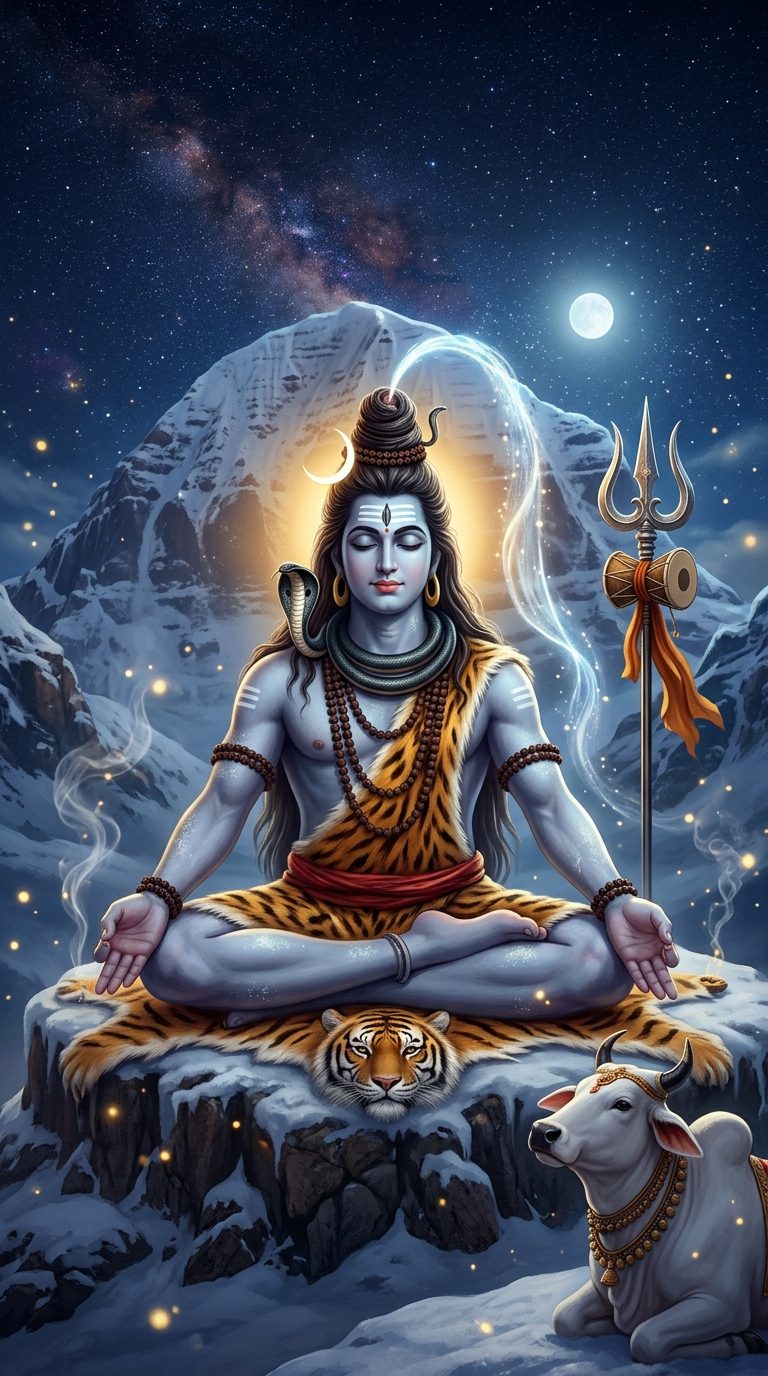
Lord Shiva standing majestically on Mount Kailash with Parvati, Nandi and Ganesha beside him, the cosmos wheeling behind
ShivaAshtakam

Shivashtakam

Lyrics · Meaning · Audio

Eight majestic verses that each end “Shivam Shankaram Shambhum Ishanam Ide” — “I praise Shiva, Shankara, Shambhu, the Lord” — painting Shiva as both lord of the universe and the ash-smeared ascetic of the cremation ground.

Traditionally attributed to Adi Shankaracharya

Listen

Shivashtakam

Son of Kali · Mahashivaratri Mantras

0:005:00
Deity
Shiva
Type
Ashtakam
Verses
9
Language
Sanskrit

Shivashtakam Lyrics with Meaning

Each line shows an easy way to say it, with its English meaning. Turn on the Sanskrit, the exact pronunciation or the word-by-word meaning whenever you want to go deeper.

Verse 1

प्रभुं प्राणनाथं विभुं विश्वनाथं जगन्नाथनाथं सदानन्दभाजम् ।

Prabhum Prananatham Vibhum Vishvanatham Jagannatha Natham Sadananda Bhajam

prabhuṃ prāṇanāthaṃ vibhuṃ viśvanāthaṃ jagannāthanāthaṃ sadānandabhājam

The master, the lord of life, the all-pervading lord of the universe, lord even of Vishnu, ever full of bliss;

    भवद्भव्यभूतेश्वरं भूतनाथं शिवं शङ्करं शम्भुमीशानमीडे ॥ १ ॥

    Bhavad Bhavya Bhuteshvaram Bhutanatham Shivam Shankaram Shambhum Ishanam Ide

    bhavadbhavyabhūteśvaraṃ bhūtanāthaṃ śivaṃ śaṅkaraṃ śambhumīśānamīḍe

    ruler of present, future and past, lord of all beings — I praise Shiva, Shankara, Shambhu, the Lord.

      Verse 2

      गले रुण्डमालं तनौ सर्पजालं महाकालकालं गणेशादिपालम् ।

      Gale Rundamalam Tanau Sarpajalam Mahakala Kalam Ganeshadi Palam

      gale ruṇḍamālaṃ tanau sarpajālaṃ mahākālakālaṃ gaṇeśādipālam

      With a garland of skulls at his throat and snakes around his body, Death of Death itself, protector of Ganesha and his hosts,

        जटाजूटगङ्गोत्तरङ्गैर्विशालं शिवं शङ्करं शम्भुमीशानमीडे ॥ २ ॥

        Jatajuta Gangottarangair Vishalam Shivam Shankaram Shambhum Ishanam Ide

        jaṭājūṭagaṅgottaraṅgairviśālaṃ śivaṃ śaṅkaraṃ śambhumīśānamīḍe

        magnificent with the leaping waves of the Ganga in his matted locks — I praise Shiva, Shankara, Shambhu, the Lord.

          Verse 3

          मुदामाकरं मण्डनं मण्डयन्तं महामण्डलं भस्मभूषाधरं तम् ।

          Mudamakaram Mandanam Mandayantam Mahamandalam Bhasma Bhushadharam Tam

          mudāmākaraṃ maṇḍanaṃ maṇḍayantaṃ mahāmaṇḍalaṃ bhasmabhūṣādharaṃ tam

          The mine of joy, the ornament who adorns all things, vast as the great circle of the cosmos, wearing ash as his decoration;

            अनादिं ह्यपारं महामोहमारं शिवं शङ्करं शम्भुमीशानमीडे ॥ ३ ॥

            Anadim Hyaparam Mahamoha Maram Shivam Shankaram Shambhum Ishanam Ide

            anādiṃ hyapāraṃ mahāmohamāraṃ śivaṃ śaṅkaraṃ śambhumīśānamīḍe

            without beginning, without limit, destroyer of the great delusion — I praise Shiva, Shankara, Shambhu, the Lord.

              Verse 4

              वटाधोनिवासं महाट्टाट्टहासं महापापनाशं सदा सुप्रकाशम् ।

              Vatadho Nivasam Mahattatta Hasam Mahapapa Nasham Sada Suprakasham

              vaṭādhonivāsaṃ mahāṭṭāṭṭahāsaṃ mahāpāpanāśaṃ sadā suprakāśam

              Dwelling beneath the banyan tree, roaring with great laughter, destroyer of great sins, ever shining brightly;

                गिरीशं गणेशं सुरेशं महेशं शिवं शङ्करं शम्भुमीशानमीडे ॥ ४ ॥

                Girisham Ganesham Suresham Mahesham Shivam Shankaram Shambhum Ishanam Ide

                girīśaṃ gaṇeśaṃ sureśaṃ maheśaṃ śivaṃ śaṅkaraṃ śambhumīśānamīḍe

                lord of the mountain, lord of the hosts, lord of the gods, the great lord — I praise Shiva, Shankara, Shambhu, the Lord.

                  Verse 5

                  गिरीन्द्रात्मजासङ्गृहीतार्धदेहं गिरौ संस्थितं सर्वदापन्नगेहम् ।

                  Girindratmaja Sangrihitardha Deham Girau Samsthitam Sarvadapanna Geham

                  girīndrātmajāsaṅgṛhītārdhadehaṃ girau saṃsthitaṃ sarvadāpannageham

                  Half of whose body is taken by the daughter of the mountain king, who lives on the mountain, ever a home for those in distress;

                    परब्रह्म ब्रह्मादिभिर्वन्द्यमानं शिवं शङ्करं शम्भुमीशानमीडे ॥ ५ ॥

                    Parabrahma Brahmadibhir Vandyamanam Shivam Shankaram Shambhum Ishanam Ide

                    parabrahma brahmādibhirvandyamānaṃ śivaṃ śaṅkaraṃ śambhumīśānamīḍe

                    the supreme Brahman, worshipped by Brahma and the gods — I praise Shiva, Shankara, Shambhu, the Lord.

                      Verse 6

                      कपालं त्रिशूलं कराभ्यां दधानं पदाम्भोजनम्राय कामं ददानम् ।

                      Kapalam Trishulam Karabhyam Dadhanam Padambhoja Namraya Kamam Dadanam

                      kapālaṃ triśūlaṃ karābhyāṃ dadhānaṃ padāmbhojanamrāya kāmaṃ dadānam

                      Holding a skull-bowl and a trident in his hands, granting every wish to those who bow at his lotus feet;

                        बलीवर्दयानं सुराणां प्रधानं शिवं शङ्करं शम्भुमीशानमीडे ॥ ६ ॥

                        Balivarda Yanam Suranam Pradhanam Shivam Shankaram Shambhum Ishanam Ide

                        balīvardayānaṃ surāṇāṃ pradhānaṃ śivaṃ śaṅkaraṃ śambhumīśānamīḍe

                        riding the bull, foremost of the gods — I praise Shiva, Shankara, Shambhu, the Lord.

                          Verse 7

                          शरच्चन्द्रगात्रं गणानन्दपात्रं त्रिनेत्रं पवित्रं धनेशस्य मित्रम् ।

                          Sharacchandra Gatram Ganananda Patram Trinetram Pavitram Dhaneshasya Mitram

                          śaraccandragātraṃ gaṇānandapātraṃ trinetraṃ pavitraṃ dhaneśasya mitram

                          His body shining like the autumn moon, the joy of his attendants, three-eyed, pure, the friend of Kubera;

                            अपर्णाकलत्रं सदा सच्चरित्रं शिवं शङ्करं शम्भुमीशानमीडे ॥ ७ ॥

                            Aparna Kalatram Sada Saccharitram Shivam Shankaram Shambhum Ishanam Ide

                            aparṇākalatraṃ sadā saccaritraṃ śivaṃ śaṅkaraṃ śambhumīśānamīḍe

                            husband of Aparna, always of noble conduct — I praise Shiva, Shankara, Shambhu, the Lord.

                              Verse 8

                              हरं सर्पहारं चिताभूविहारं भवं वेदसारं सदा निर्विकारम् ।

                              Haram Sarpaharam Chitabhu Viharam Bhavam Vedasaram Sada Nirvikaram

                              haraṃ sarpahāraṃ citābhūvihāraṃ bhavaṃ vedasāraṃ sadā nirvikāram

                              Hara, wearing serpents as a necklace, roaming the cremation ground, the source of being, the essence of the Vedas, forever changeless;

                                श्मशाने वसन्तं मनोजं दहन्तं शिवं शङ्करं शम्भुमीशानमीडे ॥ ८ ॥

                                Shmashane Vasantam Manojam Dahantam Shivam Shankaram Shambhum Ishanam Ide

                                śmaśāne vasantaṃ manojaṃ dahantaṃ śivaṃ śaṅkaraṃ śambhumīśānamīḍe

                                dwelling in the cremation ground, burning up the god of desire — I praise Shiva, Shankara, Shambhu, the Lord.

                                  Closing verse

                                  स्तवं यः प्रभाते नरः शूलपाणेः पठेत् सर्वदा भर्गभावानुरक्तः ।

                                  Stavam Yah Prabhate Narah Shulapaneh Pathet Sarvada Bharga Bhavanuraktah

                                  stavaṃ yaḥ prabhāte naraḥ śūlapāṇeḥ paṭhet sarvadā bhargabhāvānuraktaḥ

                                  Whoever, devoted to Shiva, recites this hymn to the trident-bearer every morning

                                    स पुत्रं धनं धान्यमित्रं कलत्रं विचित्रं समासाद्य मोक्षं प्रयाति ॥ ९ ॥

                                    Sa Putram Dhanam Dhanya Mitram Kalatram Vichitram Samasadya Moksham Prayati

                                    sa putraṃ dhanaṃ dhānyamitraṃ kalatraṃ vicitraṃ samāsādya mokṣaṃ prayāti

                                    gains children, wealth, harvests, friends and a fine spouse, and at last attains liberation.

                                      About Shivashtakam

                                      The Shivashtakam is an eight-verse hymn in the bhujangaprayata metre — a flowing, snake-like rhythm that makes it easy to sing. Every verse closes with the same line: śivaṃ śaṅkaraṃ śambhum īśānam īḍe, “I praise Shiva, Shankara, Shambhu, Ishana.”

                                      The hymn deliberately holds opposites together. Shiva is the lord of life and of the universe, beyond beginning, worshipped by Brahma — and also the one who wears a garland of skulls, lives under a banyan tree and wanders the cremation ground. Both are true at once.

                                      A ninth verse promises that whoever recites it at dawn with devotion gains a good family, wealth and friends, and finally liberation.

                                      The Stories Inside the Hymn

                                      Four names, one meaning

                                      The refrain uses four names. Śiva means “auspicious,” Śaṅkara “the one who makes peace,” Śambhu “the source of happiness,” and Īśāna “the ruler,” the face of Shiva that looks upward to the sky.

                                      Repeated eight times, they become a short meditation of their own.

                                      How to Chant Shivashtakam

                                      When to chant

                                      • ✦At dawn, as the closing verse recommends
                                      • ✦Mondays and Pradosha evenings
                                      • ✦Maha Shivaratri and the month of Shravan

                                      How many times

                                      Once or three times.

                                      1. 1

                                        Sit before a Shiva Linga or image, and offer water or a bilva leaf.

                                      2. 2

                                        Chant each verse with the recording, letting the rhythm carry you.

                                      3. 3

                                        Join the refrain fully each time: Shivam Shankaram Shambhum Ishanam Ide.

                                      4. 4

                                        End with Om Namah Shivaya and a moment of silence.

                                      Pronunciation Guide

                                      The sounds that trip people up most in this hymn, and how to say them.

                                      prāṇanāthaṃ

                                      praa-na-naa-tum.

                                      īśānamīḍe

                                      ee-shaa-na-mee-day.

                                      aṭṭahāsaṃ

                                      ut-ta-haa-sum — “loud laughter.”

                                      Mahashivaratri Mantras Sacred Chants of Shiva by Son of Kali

                                      The music

                                      Mahashivaratri Mantras Sacred Chants of Shiva

                                      by Son of Kali

                                      More for Shiva

                                      Frequently Asked Questions

                                      Who wrote the Shivashtakam?

                                      It is traditionally attributed to Adi Shankaracharya.

                                      What does Shivam Shankaram Shambhum Ishanam Ide mean?

                                      “I praise Shiva the auspicious, Shankara the peace-giver, Shambhu the source of joy, Ishana the Lord.”

                                      Is this the same as the Rudrashtakam?

                                      No. The Rudrashtakam (Namami Shamishan) is by Tulsidas. This Shivashtakam begins “Prabhum Prananatham.” Both have their own pages.

                                      When is the best time to chant it?

                                      The closing verse recommends dawn. Mondays and Shivaratri are also traditional.

                                      Text: Traditional public-domain Sanskrit hymn. Easy reading, transliteration and English translation written for the Jaguar Medicine Tribe Mantra Library.

                                      Music: Recordings by Son of Kali, produced with AI-assisted vocals and instrumentation.

                                      Note: Benefits described here are traditional beliefs, shared for understanding — not medical or guaranteed outcomes.