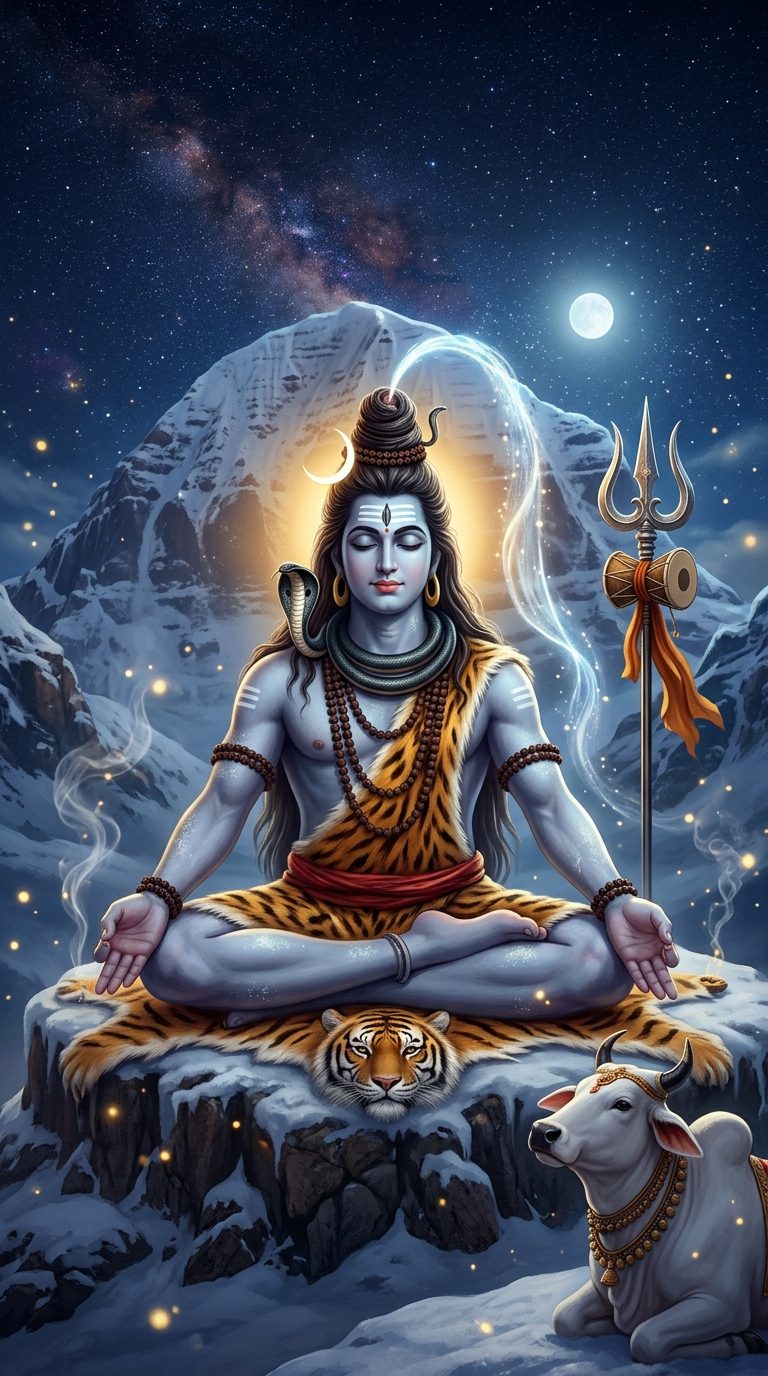
The young sage Markandeya’s hymn to Shiva the moon-crowned, sung as death approached him — eight verses that each end, “I take refuge in Chandrashekhara — what can death do to me?”
Traditionally composed by the sage Markandeya
Listen
Chandrashekhara Ashtakam
Son of Kali · Sacred Shiva Chants
0:004:32
Deity
Shiva
Type
Ashtakam
Verses
10
Language
Sanskrit
ChandrashekharaAshtakamLyricswithMeaning
Each line shows an easy way to say it, with its English meaning. Turn on the Sanskrit, the exact pronunciation or the word-by-word meaning whenever you want to go deeper.
Refrain
चन्द्रशेखर चन्द्रशेखर चन्द्रशेखर पाहि माम् ।
Chandrashekhara Chandrashekhara Chandrashekhara Pahi Mam
Creator of the universe, and again devoted to protecting it,
संहरन्तमपि प्रपञ्चमशेषलोकनिवासिनम् ।
Samharantam Api Prapancham Ashesha Loka Nivasinam
saṃharantamapi prapañcamaśeṣalokanivāsinam
who also dissolves the whole manifest world, and dwells in every world,
क्रीडयन्तमहर्निशं गणनाथयूथसमन्वितं
Kridayantam Aharnisham Gananatha Yutha Samanvitam
krīḍayantamaharniśaṃ gaṇanāthayūthasamanvitaṃ
playing day and night, surrounded by the hosts of his attendants —
चन्द्रशेखरमाश्रये मम किं करिष्यति वै यमः ॥ ८ ॥
Chandrashekharam Ashraye Mama Kim Karishyati Vai Yamah
candraśekharamāśraye mama kiṃ kariṣyati vai yamaḥ
I take refuge in the moon-crowned Shiva — what can death do to me?
Closing verse (Phala Shruti)
मृत्युभीतमृकण्डुसूनुकृतस्तवं शिवसन्निधौ
Mrityu Bhita Mrikandu Sunu Krita Stavam Shiva Sannidhau
mṛtyubhītamṛkaṇḍusūnukṛtastavaṃ śivasannidhau
This hymn, composed in Shiva’s presence by the son of Mrikandu, afraid of death —
यत्र कुत्र च यः पठेन्न हि तस्य मृत्युभयं भवेत् ।
Yatra Kutra Cha Yah Pathen Na Hi Tasya Mrityu Bhayam Bhavet
yatra kutra ca yaḥ paṭhenna hi tasya mṛtyubhayaṃ bhavet
whoever recites it, wherever they may be, will have no fear of death;
पूर्णमायुररोगितामखिलार्थसम्पदमादरं
Purnam Ayur Arogitam Akhilartha Sampadam Adaram
pūrṇamāyurarogitāmakhilārthasampadamādaraṃ
a full life, freedom from illness, every kind of wealth and honour —
चन्द्रशेखर एव तस्य ददाति मुक्तिमयत्नतः ॥
Chandrashekhara Eva Tasya Dadati Muktim Ayatnatah
candraśekhara eva tasya dadāti muktimayatnataḥ
the moon-crowned Shiva himself grants them these, and liberation without effort.
✦ ✦ ✦
AboutChandrashekharaAshtakam
Chandraśekhara means “the one who wears the moon on his crest” — Shiva, with the crescent moon in his matted hair. This ashtakam is traditionally credited to the boy-sage Markandeya, who was destined to die at sixteen and was saved by Shiva from Yama, the lord of death.
It opens with a beloved refrain — candraśekhara candraśekhara candraśekhara pāhi mām, “Chandrashekhara, Chandrashekhara, protect me” — and every verse ends with the same fearless declaration: candraśekharam āśraye mama kiṃ kariṣyati vai yamaḥ — “I take refuge in Chandrashekhara; what can Yama do to me?”
Between those lines the hymn paints Shiva as the cosmic archer who destroyed the three demon cities, the burner of Kama, the wearer of serpents and ash, the healer of the disease of worldly existence, and the creator, protector and dissolver of the universe. It is chanted for courage, health and freedom from the fear of death.
✦ ✦ ✦
TheStoriesInsidetheHymn
Markandeya’srefuge
Markandeya was born as a gift from Shiva to his parents, but with only sixteen years to live. On his last day he went to a Shiva temple and embraced the Linga, singing hymns. When Yama threw his noose, it caught the Linga as well — and Shiva burst out in fury and drove death away.
Markandeya was granted eternal youth. This ashtakam is remembered as his song of total trust, and the Maha Mrityunjaya Mantra is linked to the same story.
Thecosmicarcher
Verse 1 describes the destruction of Tripura, three flying cities of the demons. Shiva used Mount Meru as his bow, the serpent king Vasuki as its string, and Vishnu himself as the arrow tipped with fire.
With one shot he burned all three cities as they aligned — an image of awareness destroying the three bodies of ignorance in a single moment.
✦ ✦ ✦
HowtoChantChandrashekharaAshtakam
When to chant
✦Mondays and Pradosham
✦When ill, afraid or grieving
✦Maha Shivaratri
✦On birthdays, as a prayer for a long and healthy life
How many times
Once through daily, or 11 times on Mondays.
1
Begin with the refrain “Chandrashekhara… pahi mam” three times.
2
Chant each verse with the recording, joining strongly on the closing line.
3
Picture the calm, moon-crowned Shiva standing between you and every fear.
4
End with the closing verse about Markandeya.
5
Sit quietly for a moment, unafraid.
✦ ✦ ✦
PronunciationGuide
The sounds that trip people up most in this hymn, and how to say them.
“The one who wears the moon on his crest” — a name of Shiva, who wears the crescent moon in his matted hair.
WhowroteChandrashekharaAshtakam?
It is traditionally credited to the sage Markandeya, who was saved from death by Shiva.
Whatarethebenefitsofchantingit?
The closing verse says whoever recites it will have no fear of death, and that Shiva grants a full life, health, prosperity and liberation. It is traditionally chanted for courage and well-being.
HowisitrelatedtotheMahaMrityunjayaMantra?
Both are linked to the story of Markandeya and Shiva’s victory over death.