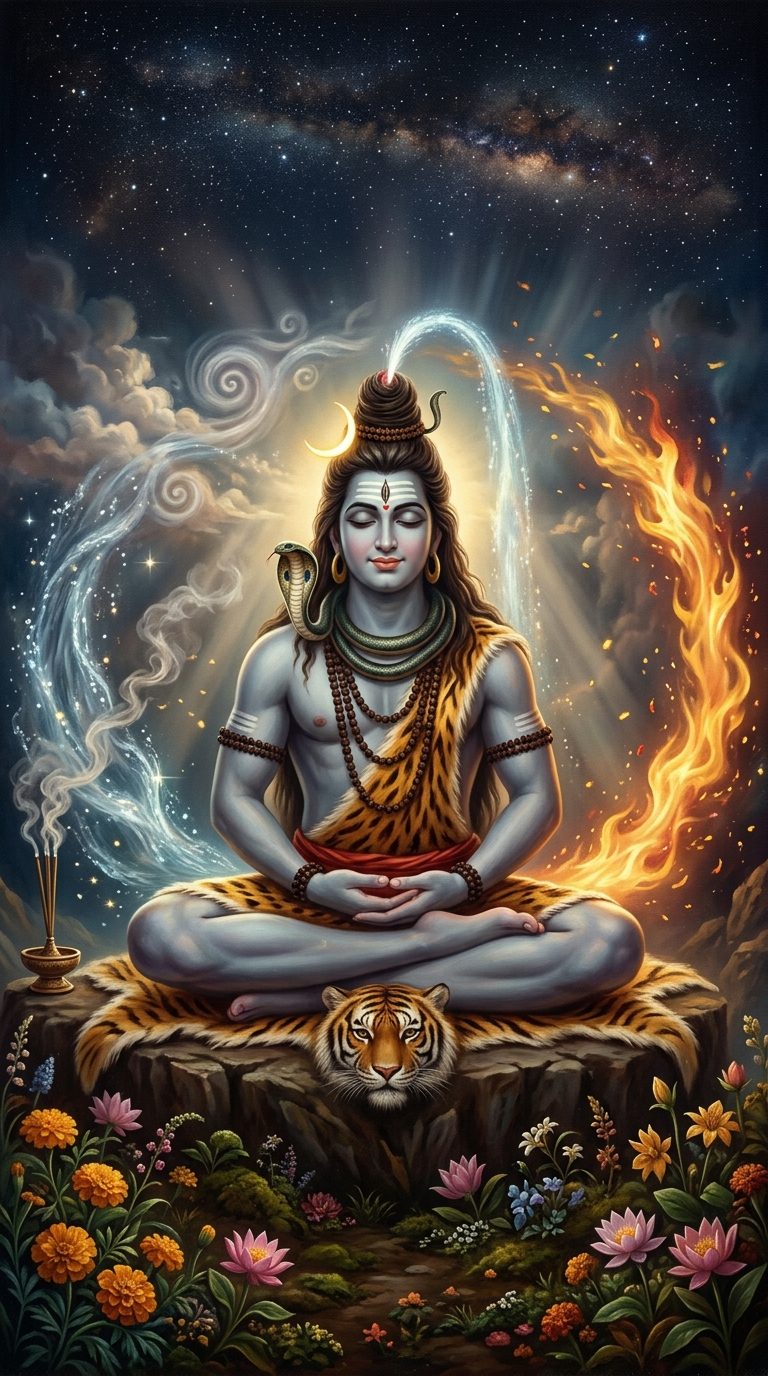
Five verses for the five sacred syllables of Na-Ma-Shi-Va-Ya — each verse paints a portrait of Shiva and ends by bowing to him as one syllable of his great mantra.
Attributed to Adi Shankaracharya
Listen
Shiva Panchakshara Stotram
Son of Kali · Power of Shiva
0:005:35
Deity
Shiva
Type
Stotram
Verses
6
Language
Sanskrit
ShivaPanchaksharaStotramLyricswithMeaning
Each line shows an easy way to say it, with its English meaning. Turn on the Sanskrit, the exact pronunciation or the word-by-word meaning whenever you want to go deeper.
Verse 1 — Na
नागेन्द्रहाराय त्रिलोचनाय
Nagendra Haraya Trilochanaya
nāgendrahārāya trilocanāya
To the one who wears the king of serpents as a garland, the three-eyed one,
भस्माङ्गरागाय महेश्वराय ।
Bhasmanga Ragaya Maheshvaraya
bhasmāṅgarāgāya maheśvarāya
whose body is smeared with sacred ash, the great lord,
नित्याय शुद्धाय दिगम्बराय
Nityaya Shuddhaya Digambaraya
nityāya śuddhāya digambarāya
the eternal, the pure, who is clothed only in the sky —
तस्मै नकाराय नमः शिवाय ॥ १ ॥
Tasmai Na-Karaya Namah Shivaya
tasmai nakārāya namaḥ śivāya
to that Shiva, who is the syllable Na, I bow.
Verse 2 — Ma
मन्दाकिनीसलिलचन्दनचर्चिताय
Mandakini Salila Chandana Charchitaya
mandākinīsalilacandanacarcitāya
Anointed with the waters of the heavenly Ganga and with sandalwood paste,
नन्दीश्वरप्रमथनाथमहेश्वराय ।
Nandishvara Pramatha Natha Maheshvaraya
nandīśvarapramathanāthamaheśvarāya
the great lord, master of Nandi and of his joyful attendants,
मन्दारपुष्पबहुपुष्पसुपूजिताय
Mandara Pushpa Bahu Pushpa Supujitaya
mandārapuṣpabahupuṣpasupūjitāya
lovingly worshipped with coral-tree blossoms and countless flowers —
तस्मै मकाराय नमः शिवाय ॥ २ ॥
Tasmai Ma-Karaya Namah Shivaya
tasmai makārāya namaḥ śivāya
to that Shiva, who is the syllable Ma, I bow.
Verse 3 — Shi
शिवाय गौरीवदनाब्जवृन्द-
Shivaya Gauri Vadanabja Vrinda
śivāya gaurīvadanābjavṛnda-
To the auspicious one — like the sun to the lotus of Gauri’s face,
सूर्याय दक्षाध्वरनाशकाय ।
Suryaya Dakshadhvara Nashakaya
sūryāya dakṣādhvaranāśakāya
making it bloom — the one who ended Daksha’s sacrifice,
श्रीनीलकण्ठाय वृषध्वजाय
Shri Nilakanthaya Vrishadhvajaya
śrīnīlakaṇṭhāya vṛṣadhvajāya
the glorious blue-throated one, whose banner bears the bull —
तस्मै शिकाराय नमः शिवाय ॥ ३ ॥
Tasmai Shi-Karaya Namah Shivaya
tasmai śikārāya namaḥ śivāya
to that Shiva, who is the syllable Shi, I bow.
Verse 4 — Va
वसिष्ठकुम्भोद्भवगौतमार्य-
Vasishtha Kumbhodbhava Gautamarya
vasiṣṭhakumbhodbhavagautamārya-
Worshipped by Vasishtha, by Agastya the pot-born, by Gautama and other noble
मुनीन्द्रदेवार्चितशेखराय ।
Munindra Devarchita Shekharaya
munīndradevārcitaśekharāya
sages and by the gods, who bow before his crowned head,
चन्द्रार्कवैश्वानरलोचनाय
Chandrarka Vaishvanara Lochanaya
candrārkavaiśvānaralocanāya
whose three eyes are the moon, the sun and fire —
तस्मै वकाराय नमः शिवाय ॥ ४ ॥
Tasmai Va-Karaya Namah Shivaya
tasmai vakārāya namaḥ śivāya
to that Shiva, who is the syllable Va, I bow.
Verse 5 — Ya
यक्षस्वरूपाय जटाधराय
Yaksha Svarupaya Jatadharaya
yakṣasvarūpāya jaṭādharāya
To the one who appears as the mysterious yaksha, who wears matted locks,
पिनाकहस्ताय सनातनाय ।
Pinaka Hastaya Sanatanaya
pinākahastāya sanātanāya
who holds the Pinaka bow, the eternal one,
दिव्याय देवाय दिगम्बराय
Divyaya Devaya Digambaraya
divyāya devāya digambarāya
the divine, the shining god, clothed only in the sky —
तस्मै यकाराय नमः शिवाय ॥ ५ ॥
Tasmai Ya-Karaya Namah Shivaya
tasmai yakārāya namaḥ śivāya
to that Shiva, who is the syllable Ya, I bow.
Closing verse (Phala Shruti)
पञ्चाक्षरमिदं पुण्यं
Panchaksharam Idam Punyam
pañcākṣaramidaṃ puṇyaṃ
Whoever recites this holy hymn of the five syllables
यः पठेच्छिवसन्निधौ ।
Yah Pathech Chiva Sannidhau
yaḥ paṭhecchivasannidhau
in the presence of Shiva
शिवलोकमवाप्नोति
Shivalokam Avapnoti
śivalokamavāpnoti
reaches the realm of Shiva
शिवेन सह मोदते ॥
Shivena Saha Modate
śivena saha modate
and rejoices there together with Shiva.
✦ ✦ ✦
AboutShivaPanchaksharaStotram
The Shiva Panchakshara Stotram is a short, musical hymn built on the five syllables of the mantra Namah Shivaya. There is one verse for each syllable: the first verse ends “to that Shiva who is the syllable Na, I bow,” the second “who is Ma,” and so on through Shi, Va and Ya. Many verses also begin with their own syllable, so the whole mantra is woven through the hymn.
Each verse is a vivid portrait. Shiva wears the king of serpents as a garland and sacred ash as his only clothing; he is bathed in the waters of the heavenly Ganga; he is the sun that makes Parvati’s lotus face bloom; his three eyes are the moon, the sun and fire. Learning the hymn is like learning to recognise Shiva by his features.
The stotram is traditionally attributed to Adi Shankaracharya, the 8th-century philosopher who also composed many devotional hymns. It is one of the most commonly sung Shiva hymns in homes and temples, especially on Mondays and during Shravan.
✦ ✦ ✦
TheStoriesInsidetheHymn
Onesyllable,oneverse
Na, Ma, Shi, Va, Ya are traditionally linked to earth, water, fire, air and space. As you move through the five verses you are, symbolically, moving from the densest element to the subtlest — from solid ground to open sky.
That is why the hymn is often chanted as a meditation in itself, not only as praise: each verse is a step inward.
Themysteriousyaksha
Verse 5 calls Shiva yakṣa-svarūpa, “the one who appears as a yaksha.” It recalls a story from the Kena Upanishad. After a great victory, the gods grew proud. A mysterious spirit (a yaksha) appeared before them, and placed a single blade of grass on the ground.
Agni, god of fire, could not burn it. Vayu, god of wind, could not move it. The yaksha vanished, and the goddess Uma appeared to explain: it was the Supreme itself, whose power alone had won the gods their victory. Shiva as the yaksha is the divine that humbles all pride.
✦ ✦ ✦
HowtoChantShivaPanchaksharaStotram
When to chant
✦Mondays, Shiva’s traditional day
✦Pradosham twilight, Maha Shivaratri and the month of Shravan
✦During abhishekam, while offering water or milk to a Shiva Linga
✦As a daily evening prayer
How many times
Once through is complete. Chanting it three times, or 11 times on special days, is common.
1
Sit before a Shiva Linga or image of Shiva, or simply picture him in meditation.
2
Listen to the recording once with the English meaning on.
3
Chant verse by verse. At the end of each verse, pause on its syllable — Na, Ma, Shi, Va, Ya — and feel its element.
4
Close with the final verse and a few rounds of Om Namah Shivaya.
5
Sit quietly for a moment before getting up.
✦ ✦ ✦
PronunciationGuide
The sounds that trip people up most in this hymn, and how to say them.
trilocanāya
The “c” is “ch”: tri-lo-cha-naa-ya.
bhasmāṅga
The ṅ is the “ng” of “sing”: bhas-maang-ga.
śuddhāya
“sh” sound and a breathy “dh”: shud-dhaa-ya.
vṛṣa
ṛ is a short rolled “ri”, ṣ is “sh”: vri-sha.
nakārāya, makārāya…
“the syllable na”: na-kaa-raa-ya. Stress the long “aa” sounds.
Panchakshara means “five syllables” and stotram means “hymn of praise.” It is a hymn in five verses, one for each syllable of Na-Ma-Shi-Va-Ya, the heart of the mantra Om Namah Shivaya.
WhowrotetheShivaPanchaksharaStotram?
It is traditionally attributed to Adi Shankaracharya, the 8th-century philosopher and saint.
Whatarethebenefitsofchantingit?
The closing verse says that whoever recites it near Shiva reaches Shiva’s realm and rejoices with him. Traditionally it is chanted for peace, devotion and purification; many people find it a calm, centring prayer.
Whenisthebesttimetochantit?
Mondays, Pradosham, Maha Shivaratri and the month of Shravan are the most traditional times, but it can be chanted any day.
HowisitconnectedtoOmNamahShivaya?
It is a poetic expansion of that mantra. Each verse honours one of its five syllables, so chanting the hymn is like chanting Om Namah Shivaya slowly, with a meditation on each syllable.