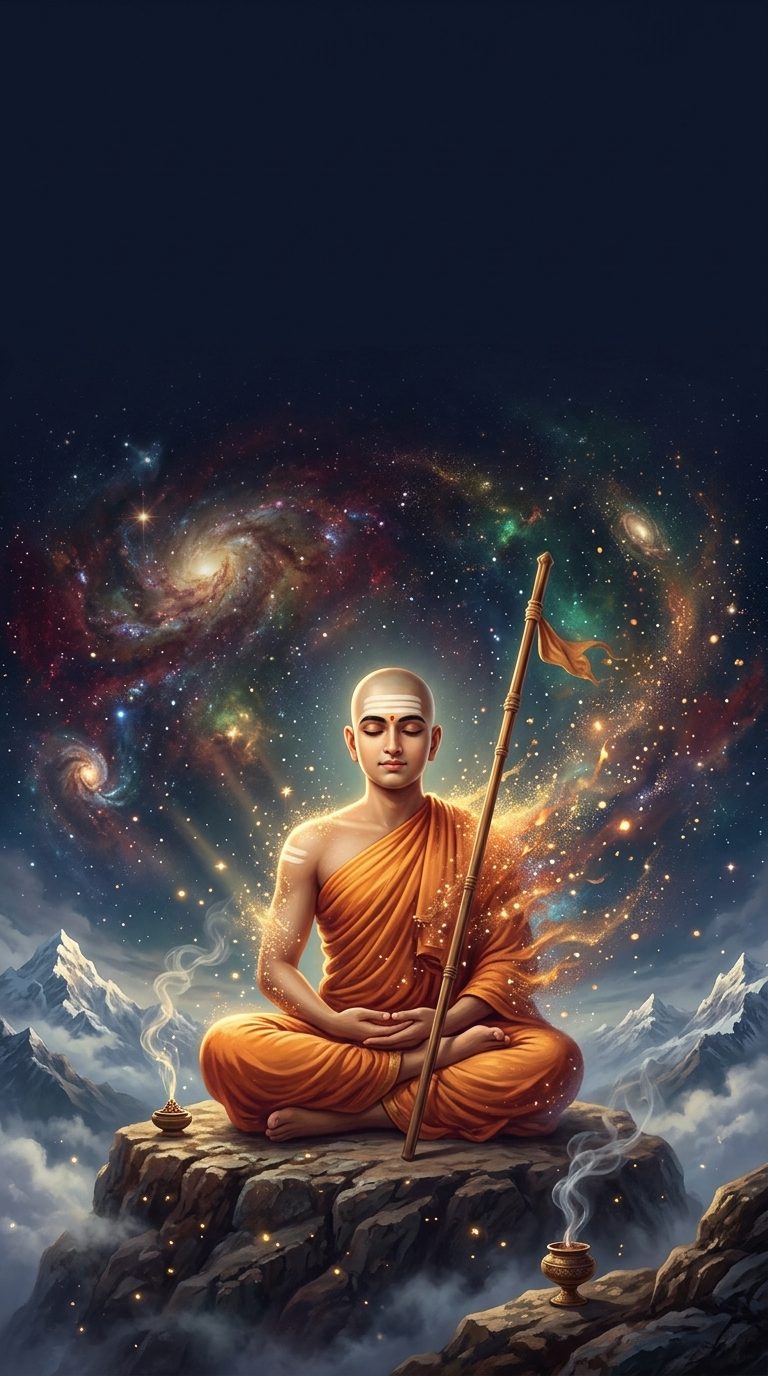
Six verses by Adi Shankaracharya that strip away everything we are not — body, mind, emotions, even religion — until only one truth is left: “I am consciousness and bliss. I am Shiva.”
Composed by Adi Shankaracharya
Listen
Nirvana Shatakam
Son of Kali · Mahashivaratri Mantras
0:006:30
Deity
Shiva
Type
Stotram
Verses
6
Language
Sanskrit
NirvanaShatakamLyricswithMeaning
Each line shows an easy way to say it, with its English meaning. Turn on the Sanskrit, the exact pronunciation or the word-by-word meaning whenever you want to go deeper.
Verse 1
मनोबुद्ध्यहंकारचित्तानि नाहं
Mano Buddhy Ahankara Chittani Naham
manobuddhyahaṃkāracittāni nāhaṃ
I am not the mind, the intellect, the ego or memory,
न च श्रोत्रजिह्वे न च घ्राणनेत्रे ।
Na Cha Shrotra Jihve Na Cha Ghrana Netre
na ca śrotrajihve na ca ghrāṇanetre
nor the ears or the tongue, nor the nose or the eyes.
न च व्योमभूमिर्न तेजो न वायुः
Na Cha Vyoma Bhumir Na Tejo Na Vayuh
na ca vyomabhūmirna tejo na vāyuḥ
I am not space or earth, not fire or air —
चिदानन्दरूपः शिवोऽहं शिवोऽहम् ॥ १ ॥
Chidananda Rupah Shivoham Shivoham
cidānandarūpaḥ śivo'haṃ śivo'ham
I am pure consciousness and bliss. I am Shiva, I am Shiva.
Verse 2
न च प्राणसंज्ञो न वै पञ्चवायुः
Na Cha Prana Sangyo Na Vai Pancha Vayuh
na ca prāṇasaṃjño na vai pañcavāyuḥ
I am not the life-breath, nor the five vital winds,
न वा सप्तधातुर्न वा पञ्चकोशः ।
Na Va Sapta Dhatur Na Va Pancha Koshah
na vā saptadhāturna vā pañcakośaḥ
not the seven tissues of the body, nor its five sheaths,
न वाक्पाणिपादं न चोपस्थपायू
Na Vak Pani Padam Na Chopastha Payu
na vākpāṇipādaṃ na copasthapāyū
not speech, hands or feet, nor the organs of the body’s functions —
चिदानन्दरूपः शिवोऽहं शिवोऽहम् ॥ २ ॥
Chidananda Rupah Shivoham Shivoham
cidānandarūpaḥ śivo'haṃ śivo'ham
I am pure consciousness and bliss. I am Shiva, I am Shiva.
Verse 3
न मे द्वेषरागौ न मे लोभमोहौ
Na Me Dvesha Ragau Na Me Lobha Mohau
na me dveṣarāgau na me lobhamohau
I have no hatred and no attachment, no greed and no delusion,
मदो नैव मे नैव मात्सर्यभावः ।
Mado Naiva Me Naiva Matsarya Bhavah
mado naiva me naiva mātsaryabhāvaḥ
no pride and no envy at all.
न धर्मो न चार्थो न कामो न मोक्षः
Na Dharmo Na Chartho Na Kamo Na Mokshah
na dharmo na cārtho na kāmo na mokṣaḥ
I am beyond duty, wealth, desire — even liberation —
चिदानन्दरूपः शिवोऽहं शिवोऽहम् ॥ ३ ॥
Chidananda Rupah Shivoham Shivoham
cidānandarūpaḥ śivo'haṃ śivo'ham
I am pure consciousness and bliss. I am Shiva, I am Shiva.
Verse 4
न पुण्यं न पापं न सौख्यं न दुःखं
Na Punyam Na Papam Na Saukhyam Na Duhkham
na puṇyaṃ na pāpaṃ na saukhyaṃ na duḥkhaṃ
No virtue and no sin, no pleasure and no pain,
न मन्त्रो न तीर्थो न वेदा न यज्ञः ।
Na Mantro Na Tirtho Na Veda Na Yagyah
na mantro na tīrtho na vedā na yajñaḥ
no mantra, no pilgrimage, no scripture and no ritual.
अहं भोजनं नैव भोज्यं न भोक्ता
Aham Bhojanam Naiva Bhojyam Na Bhokta
ahaṃ bhojanaṃ naiva bhojyaṃ na bhoktā
I am not the experience, nor what is experienced, nor the one who experiences —
चिदानन्दरूपः शिवोऽहं शिवोऽहम् ॥ ४ ॥
Chidananda Rupah Shivoham Shivoham
cidānandarūpaḥ śivo'haṃ śivo'ham
I am pure consciousness and bliss. I am Shiva, I am Shiva.
Verse 5
न मृत्युर्न शङ्का न मे जातिभेदः
Na Mrityur Na Shanka Na Me Jati Bhedah
na mṛtyurna śaṅkā na me jātibhedaḥ
I have no death and no fear, no divisions of caste or birth,
पिता नैव मे नैव माता न जन्म ।
Pita Naiva Me Naiva Mata Na Janma
pitā naiva me naiva mātā na janma
no father, no mother — I was never born.
न बन्धुर्न मित्रं गुरुर्नैव शिष्यः
Na Bandhur Na Mitram Gurur Naiva Shishyah
na bandhurna mitraṃ gururnaiva śiṣyaḥ
No relative, no friend, no teacher and no student —
चिदानन्दरूपः शिवोऽहं शिवोऽहम् ॥ ५ ॥
Chidananda Rupah Shivoham Shivoham
cidānandarūpaḥ śivo'haṃ śivo'ham
I am pure consciousness and bliss. I am Shiva, I am Shiva.
Verse 6
अहं निर्विकल्पो निराकाररूपः
Aham Nirvikalpo Nirakara Rupah
ahaṃ nirvikalpo nirākārarūpaḥ
I am free of all thought and change, without any form,
विभुर्व्याप्य सर्वत्र सर्वेन्द्रियाणाम् ।
Vibhur Vyapya Sarvatra Sarvendriyanam
vibhurvyāpya sarvatra sarvendriyāṇām
all-pervading, present everywhere, beyond all the senses.
सदा मे समत्वं न मुक्तिर्न बन्धः
Sada Me Samatvam Na Muktir Na Bandhah
sadā me samatvaṃ na muktirna bandhaḥ
I am always the same — there is neither freedom nor bondage for me —
चिदानन्दरूपः शिवोऽहं शिवोऽहम् ॥ ६ ॥
Chidananda Rupah Shivoham Shivoham
cidānandarūpaḥ śivo'haṃ śivo'ham
I am pure consciousness and bliss. I am Shiva, I am Shiva.
✦ ✦ ✦
AboutNirvanaShatakam
Nirvana Shatakam means “six verses on liberation.” It is also called Atma Shatakam, “six verses on the Self.” It is one of the clearest and most powerful expressions of Advaita Vedanta, the teaching that our deepest Self is not separate from the Supreme.
The method is simple and radical. Verse after verse, the poet says “I am not this… not this…” — not the mind, not the senses, not the breath, not the body’s tissues, not likes and dislikes, not virtue or sin, not even the rituals of religion, not parents, friends or teacher. Each verse ends with the same answer to what remains when all of that is set aside: cidānanda-rūpaḥ śivo’haṃ śivo’ham — “I am the form of consciousness and bliss. I am Shiva, I am Shiva.”
“Shiva” here is not only the god of Mount Kailash. It means the auspicious, the pure, the unchanging awareness that is present in every being. The hymn invites you to recognise that awareness as your own true nature.
✦ ✦ ✦
TheStoriesInsidetheHymn
“Whoareyou?”
As a young boy, Shankara left home to find a teacher. He walked hundreds of miles to the banks of the Narmada river, where the great sage Govindapada lived in a cave. When he arrived, the sage asked him a simple question: “Who are you?”
Tradition says the boy answered with these six verses — not with his name, family or village, but with a description of the Self beyond all of those. Govindapada accepted him at once as his disciple.
Neti,neti—notthis,notthis
The hymn follows an ancient Upanishadic method called neti, neti — “not this, not this.” Instead of describing the Self directly, you set aside everything that comes and goes: thoughts, feelings, sensations, roles and relationships.
What cannot be set aside is the awareness doing the setting aside. That is what the refrain points to: consciousness, bliss, Shiva.
✦ ✦ ✦
HowtoChantNirvanaShatakam
When to chant
✦Before or after meditation
✦Maha Shivaratri and Mondays
✦In moments of stress, grief or confusion, as a reminder of what does not change
✦Before sleep, to let go of the day
How many times
Once through, slowly, is a complete practice. Some people repeat the refrain “Shivoham, Shivoham” on its own as a mantra for several minutes afterwards.
1
Sit still and take a few slow breaths.
2
Read the English meaning of all six verses once, so you know what you are saying.
3
Listen to the recording, then chant along verse by verse.
4
With each “I am not…,” actually let go of that thing for a moment.
5
After the last verse, sit in silence and simply rest as awareness.
✦ ✦ ✦
PronunciationGuide
The sounds that trip people up most in this hymn, and how to say them.
śivo’ham
Shivaḥ + aham run together as “shi-voh-hum”. Don’t say “shiv-o-ham” as three separate words.
Nirvana means liberation and shatakam (here, shatkam) means a set of six verses. It is “six verses on liberation” — a description of the true Self beyond body and mind.
WhowroteNirvanaShatakam?
It is attributed to Adi Shankaracharya, the 8th-century philosopher who systematised Advaita Vedanta. Tradition says he spoke it as a boy when his future teacher asked him who he was.
Whatdoes“ChidanandaRupahShivoham”mean?
“I am the form of consciousness (chit) and bliss (ananda) — I am Shiva.” It means your deepest nature is pure, peaceful awareness, not the changing body and mind.
IsNirvanaShatakamaprayertoShiva?
It is more a meditation than a prayer. “Shiva” here means the auspicious, unchanging Self. Rather than asking Shiva for something, it recognises that Self as who you really are.
CanbeginnerschantNirvanaShatakam?
Yes. The repeating refrain makes it easy to join in. Reading the meaning first makes the practice far more powerful.