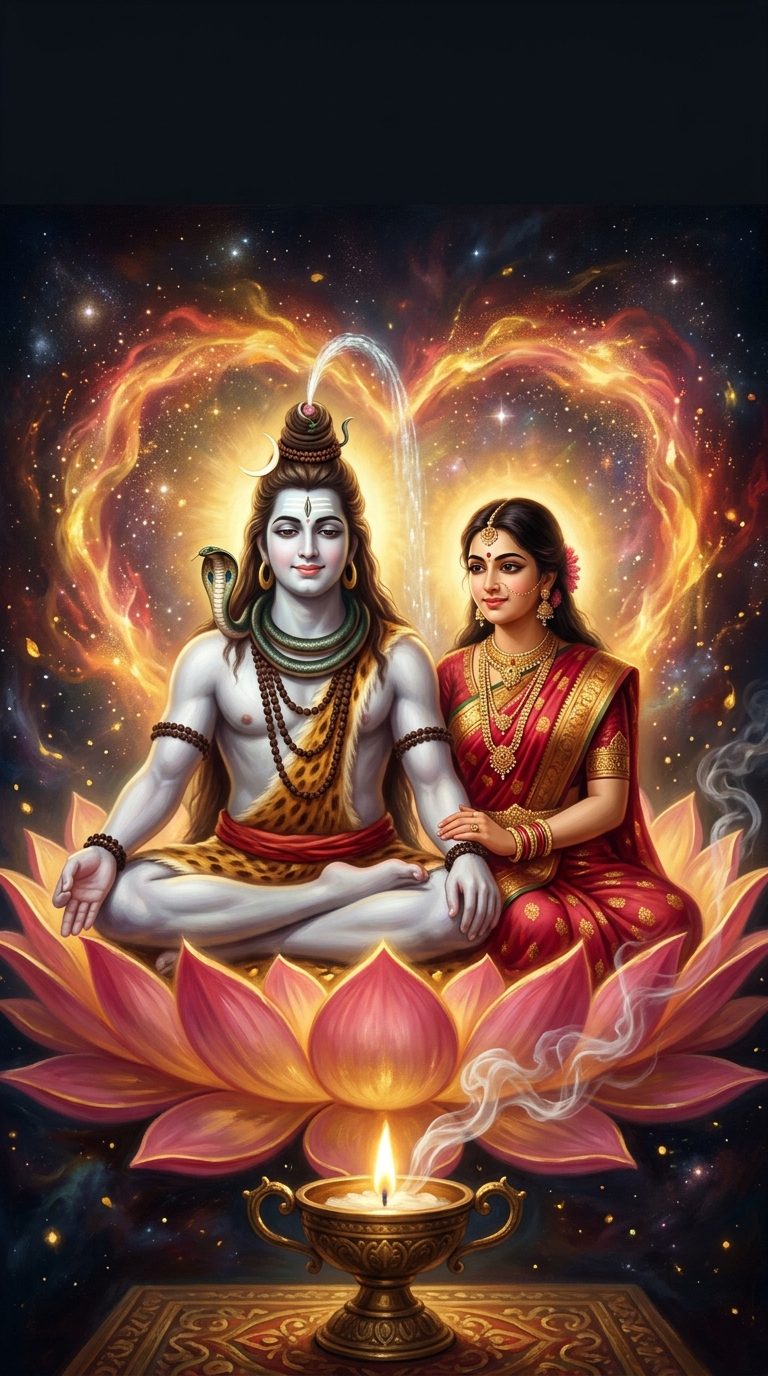
The beautiful four-line verse sung at the end of almost every aarti — praising Shiva, white as camphor, compassion in human form, who lives in the lotus of the heart with Parvati.
Traditional verse, sung at the close of every aarti
Listen
Karpur Gauram
Son of Kali · Divine Chants, Vol. 1
0:006:52
Deity
Shiva
Type
Mantra
Verses
1
Language
Sanskrit
KarpurGauramLyricswithMeaning
Each line shows an easy way to say it, with its English meaning. Turn on the Sanskrit, the exact pronunciation or the word-by-word meaning whenever you want to go deeper.
The Verse
कर्पूरगौरं करुणावतारं
Karpura Gauram Karunavataram
karpūragauraṃ karuṇāvatāraṃ
White as camphor, compassion in human form,
संसारसारं भुजगेन्द्रहारम् ।
Samsara Saram Bhujagendra Haram
saṃsārasāraṃ bhujagendrahāram
the very essence of the world, wearing the king of serpents as a garland —
सदा वसन्तं हृदयारविन्दे
Sada Vasantam Hridayaravinde
sadā vasantaṃ hṛdayāravinde
always dwelling in the lotus of the heart,
भवं भवानीसहितं नमामि ॥
Bhavam Bhavani Sahitam Namami
bhavaṃ bhavānīsahitaṃ namāmi
to Shiva, together with Parvati, I bow.
✦ ✦ ✦
AboutKarpurGauram
Karpur Gauram is one of the most familiar verses in Hindu worship. In temples and homes across the world it is sung at the very end of the aarti, the ceremony of waving lamps before the deity — whichever god the aarti was for. If you have been to a Hindu festival or puja, you have almost certainly heard it.
Its imagery is gentle and luminous. Shiva is karpūra-gaura, “white as camphor” — camphor burns with a bright white flame and leaves no ash behind, a symbol of the ego burning away completely. He is karuṇāvatāra, compassion itself taking form. He wears the king of serpents as a garland, yet he lives in the most tender place there is: the lotus of the devotee’s heart, together with Bhavani (Parvati).
The verse is short, easy to learn and deeply peaceful, which makes it a perfect first Shiva prayer for children and beginners.
✦ ✦ ✦
TheStoriesInsidetheHymn
Whycamphor?
In an aarti, a flame of camphor is waved before the deity. Camphor is special: it burns brightly, gives off a cooling fragrance, and disappears completely, leaving no residue.
Teachers say the devotee’s ego should burn the same way in the presence of the divine — fully, brightly, and without a trace. Calling Shiva “camphor-white” links the lamp in your hand to the pure light of Shiva himself.
ShivaandParvatiintheheart
The last line pictures Shiva living in the heart “together with Bhavani.” Shiva and Parvati together represent consciousness and energy, stillness and movement, which cannot exist without each other.
By asking them to live in the heart, the verse turns the outer worship of the aarti into an inner one: the real temple is within.
✦ ✦ ✦
HowtoChantKarpurGauram
When to chant
✦At the end of any aarti or puja
✦Mondays and Maha Shivaratri
✦Morning and evening prayers at home
✦Before meditation
How many times
Usually sung once at the close of an aarti; 3, 11 or 108 times as a meditation.
1
Light a lamp or a small piece of camphor if you have one.
2
Listen to the recording and follow the meaning.
3
Sing the four lines slowly while gently circling the lamp clockwise.
4
On the last line, place your hand over your heart.
5
Sit for a moment in silence.
✦ ✦ ✦
PronunciationGuide
The sounds that trip people up most in this hymn, and how to say them.
karpūra
Long “oo”: kar-poo-ra.
karuṇāvatāraṃ
ṇ with the tongue curled back; ka-ru-naa-va-taa-rum.
It means “white as camphor.” The full verse praises Shiva as camphor-white, compassion in form, the essence of the world, garlanded with serpents, who lives in the lotus of the heart with Parvati.
WhyisKarpurGauramsungafteraarti?
It is the traditional closing verse of the aarti ceremony. As the camphor lamp is waved, it reminds the worshipper of Shiva’s pure, camphor-like light and invites the divine to live in the heart.
WheredoesKarpurGauramcomefrom?
It is a traditional Sanskrit verse used in worship for centuries. It is often linked to the Yajurveda tradition, but its exact source is uncertain; today it is known mainly from the aarti.
CanIsingitforgodsotherthanShiva?
Yes. Although it describes Shiva, it is traditionally sung at the close of aartis to every deity.