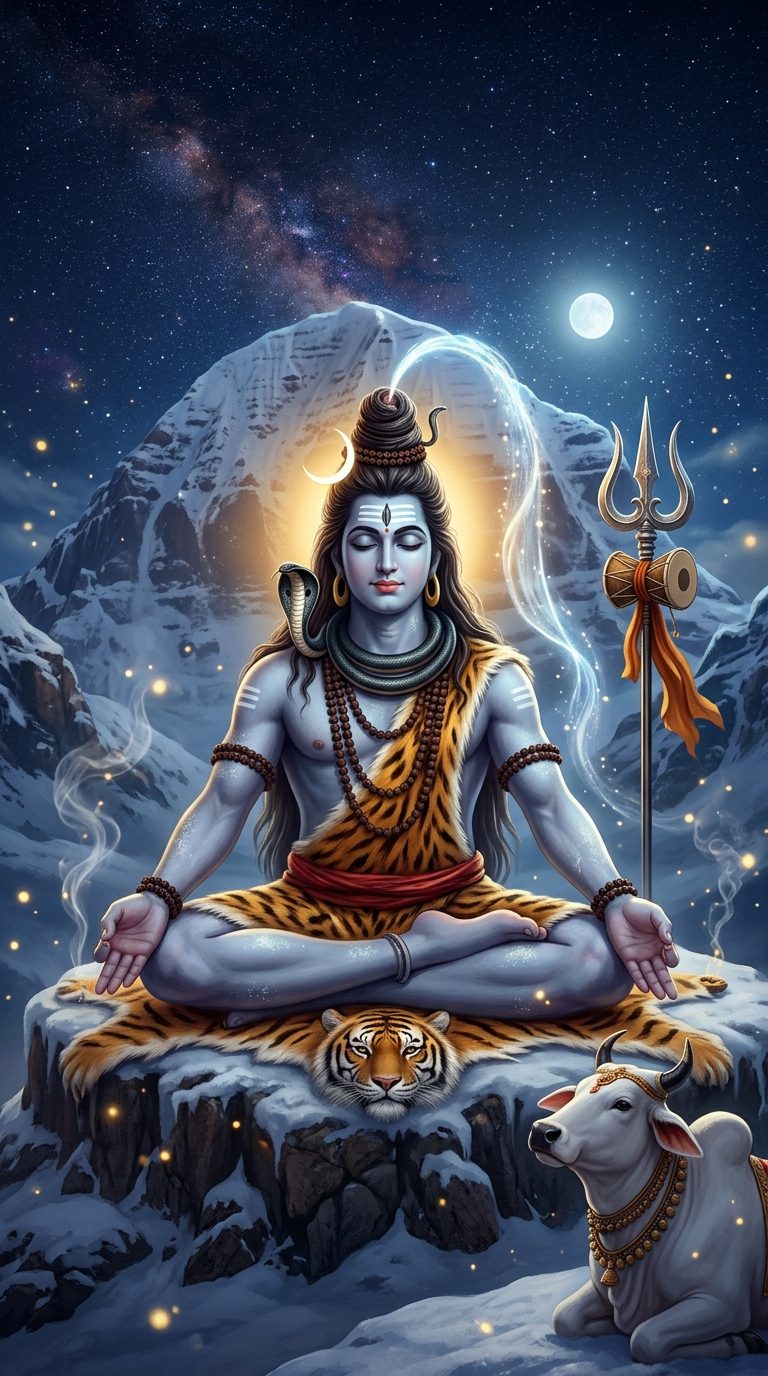
Lord Shiva meditating within a glowing sphere of sound, six radiant points of light orbiting him, a rishi chanting in a Himalayan cave
ShivaStotram

Shiva Shadakshara Stotram

Lyrics · Meaning · Audio

Six verses for the six syllables of “Om Namah Shivaya” — Om, Na, Ma, Shi, Va, Ya — each one opening a different door to Shiva.

Traditional Sanskrit hymn

Listen

Shiva Shadakshara Stotram

Son of Kali · Sacred Shiva Chants

0:005:53
Deity
Shiva
Type
Stotram
Verses
7
Language
Sanskrit

Shiva Shadakshara Stotram Lyrics with Meaning

Each line shows an easy way to say it, with its English meaning. Turn on the Sanskrit, the exact pronunciation or the word-by-word meaning whenever you want to go deeper.

Om

ओंकारं बिन्दुसंयुक्तं नित्यं ध्यायन्ति योगिनः ।

Omkaram Bindu Samyuktam Nityam Dhyayanti Yoginah

oṅkāraṃ bindusaṃyuktaṃ nityaṃ dhyāyanti yoginaḥ

Yogis meditate always on the sound Om joined with the bindu, the point of creation;

    कामदं मोक्षदं चैव ओंकाराय नमो नमः ॥ १ ॥

    Kamadam Mokshadam Chaiva Omkaraya Namo Namah

    kāmadaṃ mokṣadaṃ caiva oṅkārāya namo namaḥ

    it grants both desires and liberation — salutations again and again to the syllable Om.

      Na

      नमन्ति ऋषयो देवा नमन्त्यप्सरसां गणाः ।

      Namanti Rishayo Deva Namantyapsarasam Ganah

      namanti ṛṣayo devā namantyapsarasāṃ gaṇāḥ

      Sages and gods bow to him; the hosts of celestial nymphs bow;

        नरा नमन्ति देवेशं नकाराय नमो नमः ॥ २ ॥

        Nara Namanti Devesham Nakaraya Namo Namah

        narā namanti deveśaṃ nakārāya namo namaḥ

        human beings bow to the lord of the gods — salutations again and again to the syllable Na.

          Ma

          महादेवं महात्मानं महाध्यानं परायणम् ।

          Mahadevam Mahatmanam Mahadhyanam Parayanam

          mahādevaṃ mahātmānaṃ mahādhyānaṃ parāyaṇam

          The great god, the great soul, the great meditation, the highest refuge,

            महापापहरं देवं मकाराय नमो नमः ॥ ३ ॥

            Mahapapa Haram Devam Makaraya Namo Namah

            mahāpāpaharaṃ devaṃ makārāya namo namaḥ

            the god who removes great sins — salutations again and again to the syllable Ma.

              Shi

              शिवं शान्तं जगन्नाथं लोकानुग्रहकारकम् ।

              Shivam Shantam Jagannatham Lokanugraha Karakam

              śivaṃ śāntaṃ jagannāthaṃ lokānugrahakārakam

              Auspicious, peaceful, lord of the world, who showers grace on all the worlds,

                शिवमेकपदं नित्यं शिकाराय नमो नमः ॥ ४ ॥

                Shivam Ekapadam Nityam Shikaraya Namo Namah

                śivamekapadaṃ nityaṃ śikārāya namo namaḥ

                Shiva, the one eternal word — salutations again and again to the syllable Shi.

                  Va

                  वाहनं वृषभो यस्य वासुकिः कण्ठभूषणम् ।

                  Vahanam Vrishabho Yasya Vasukih Kantha Bhushanam

                  vāhanaṃ vṛṣabho yasya vāsukiḥ kaṇṭhabhūṣaṇam

                  He whose vehicle is the bull, whose necklace is the serpent Vasuki,

                    वामे शक्तिधरं देवं वकाराय नमो नमः ॥ ५ ॥

                    Vame Shaktidharam Devam Vakaraya Namo Namah

                    vāme śaktidharaṃ devaṃ vakārāya namo namaḥ

                    the god who holds Shakti at his left side — salutations again and again to the syllable Va.

                      Ya

                      यत्र यत्र स्थितो देवः सर्वव्यापी महेश्वरः ।

                      Yatra Yatra Sthito Devah Sarvavyapi Maheshvarah

                      yatra yatra sthito devaḥ sarvavyāpī maheśvaraḥ

                      Wherever the god abides, the all-pervading great Lord,

                        यो गुरुः सर्वदेवानां यकाराय नमो नमः ॥ ६ ॥

                        Yo Guruh Sarva Devanam Yakaraya Namo Namah

                        yo guruḥ sarvadevānāṃ yakārāya namo namaḥ

                        who is the teacher of all the gods — salutations again and again to the syllable Ya.

                          Closing verse

                          षडक्षरमिदं स्तोत्रं यः पठेच्छिवसन्निधौ ।

                          Shadaksharam Idam Stotram Yah Pathet Shiva Sannidhau

                          ṣaḍakṣaramidaṃ stotraṃ yaḥ paṭhecchivasannidhau

                          Whoever recites this six-syllable hymn in Shiva’s presence

                            शिवलोकमवाप्नोति शिवेन सह मोदते ॥ ७ ॥

                            Shivalokam Avapnoti Shivena Saha Modate

                            śivalokamavāpnoti śivena saha modate

                            reaches Shiva’s realm and rejoices with Shiva.

                              About Shiva Shadakshara Stotram

                              Ṣaḍakṣara means “six syllables”: Om Na-maḥ Śi-vā-ya. This short hymn gives one verse to each syllable, ending every verse with a salutation to it — “salutations to the syllable Om,” “to the syllable Na,” and so on.

                              It is the six-syllable companion to the Shiva Panchakshara Stotram, which treats the five syllables Na-Ma-Shi-Va-Ya. Here Om is added at the start, the seed sound that yogis meditate on as the point (bindu) of all creation.

                              The verses are simple and easy to learn, which makes the hymn a lovely introduction to Om Namah Shivaya as a meditation rather than just a phrase.

                              The Stories Inside the Hymn

                              Five syllables, then six

                              In the Vedic Rudram, the mantra appears as namaḥ śivāya — five syllables. Adding Om in front makes it six, and many teachers say this joins the personal prayer to the cosmic sound behind everything.

                              Both forms are honoured. The Panchakshara hymn praises the five; this hymn praises all six.

                              How to Chant Shiva Shadakshara Stotram

                              When to chant

                              • ✦Mondays
                              • ✦Before or after japa of Om Namah Shivaya
                              • ✦Pradosha and Shivaratri

                              How many times

                              Once, followed by 108 repetitions of Om Namah Shivaya if you wish.

                              1. 1

                                Sit before a Shiva Linga or simply close your eyes.

                              2. 2

                                Chant each verse, focusing on its syllable.

                              3. 3

                                After the hymn, chant Om Namah Shivaya slowly, feeling each of the six syllables.

                              4. 4

                                End with silence.

                              Pronunciation Guide

                              The sounds that trip people up most in this hymn, and how to say them.

                              oṅkāram

                              om-kaa-rum.

                              ṣaḍakṣaram

                              shud-uk-sha-rum — “six syllables.”

                              bindu

                              bin-du — the point.

                              Sacred Shiva Chants: The Ultimate Shiva Mantras by Son of Kali

                              The music

                              Sacred Shiva Chants: The Ultimate Shiva Mantras

                              by Son of Kali

                              More for Shiva

                              Frequently Asked Questions

                              What is the Shadakshara Stotram?

                              A six-verse hymn with one verse for each syllable of Om Namah Shivaya.

                              How is it different from the Shiva Panchakshara Stotram?

                              The Panchakshara hymn praises the five syllables Na-Ma-Shi-Va-Ya; the Shadakshara hymn adds Om at the start, making six.

                              What are its benefits?

                              The closing verse says whoever recites it near Shiva reaches Shiva’s realm and rejoices with him.

                              Text: Traditional public-domain Sanskrit hymn. Easy reading, transliteration and English translation written for the Jaguar Medicine Tribe Mantra Library.

                              Music: Recordings by Son of Kali, produced with AI-assisted vocals and instrumentation.

                              Note: Benefits described here are traditional beliefs, shared for understanding — not medical or guaranteed outcomes.