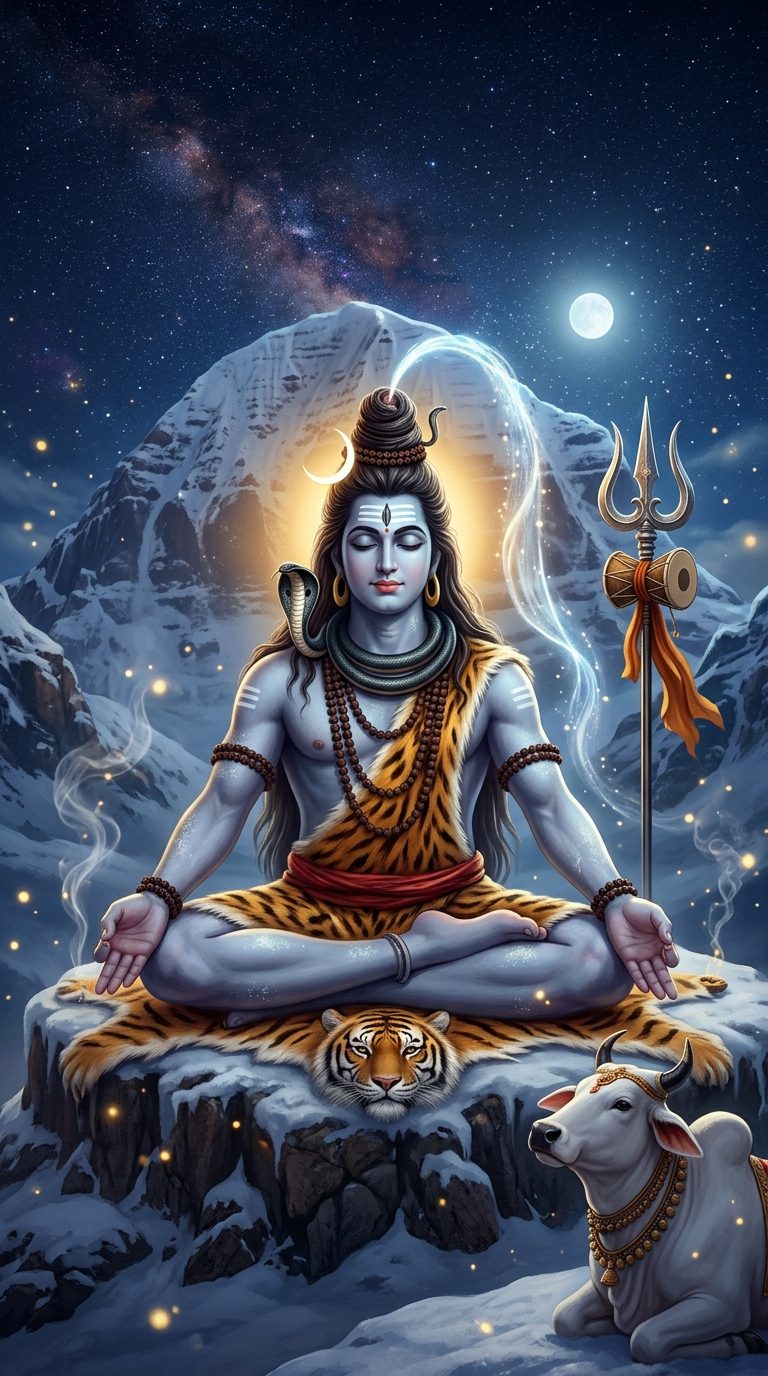
The Gayatri of Shiva — “May we know the Supreme Being, may we meditate on the Great God; may Rudra awaken us” — a short Vedic prayer for clarity and inner strength.
From the Mahanarayana Upanishad (Taittiriya Aranyaka)
Listen
Shiva Gayatri Mantra
Son of Kali · Mahashivaratri Mantras
0:006:29
Deity
Shiva
Type
Gayatri Mantra
Verses
1
Language
Sanskrit
ShivaGayatriMantraLyricswithMeaning
Each line shows an easy way to say it, with its English meaning. Turn on the Sanskrit, the exact pronunciation or the word-by-word meaning whenever you want to go deeper.
The Mantra
ॐ तत्पुरुषाय विद्महे
Om Tatpurushaya Vidmahe
oṃ tatpuruṣāya vidmahe
Om — may we know that Supreme Being;
महादेवाय धीमहि ।
Mahadevaya Dhimahi
mahādevāya dhīmahi
may we meditate on the Great God;
तन्नो रुद्रः प्रचोदयात् ॥
Tanno Rudrah Prachodayat
tanno rudraḥ pracodayāt
may Rudra inspire and awaken us.
✦ ✦ ✦
AboutShivaGayatriMantra
A Gayatri is a short three-line prayer in a special Vedic pattern: “May we know…, may we meditate on…, may that one inspire us.” The original Gayatri Mantra is addressed to the divine sun; over time every major deity received a Gayatri of their own, all following the same shape.
The Shiva (or Rudra) Gayatri comes from the Mahanarayana Upanishad, part of the Taittiriya Aranyaka of the Yajurveda. It addresses Shiva as Tatpuruṣa — “that Supreme Person,” also the name of his eastern face — and as Mahādeva, the Great God, and asks Rudra to awaken and direct our understanding.
Like the Gayatri Mantra itself, it does not ask for things. It asks to know, to meditate and to be inspired — which is why it is loved as a daily practice for focus and inner clarity.
✦ ✦ ✦
TheStoriesInsidetheHymn
ThefivefacesofShiva
In Shaiva tradition Shiva has five faces, each looking in a different direction and each with its own mantra: Sadyojata (west), Vamadeva (north), Aghora (south), Tatpurusha (east) and Ishana (upward).
Tatpurusha is the face of the rising sun, the face of meditation and stillness. Chanting this Gayatri turns the mind toward that peaceful eastern face of the divine.
Onepattern,manygods
Because the Gayatri pattern is so revered, Hindu tradition created a Gayatri for Ganesha, Vishnu, Lakshmi, Hanuman, Durga and many more. Each keeps the same three steps: know, meditate, be inspired.
Learning one makes it easy to recognise all the others — several of them have their own pages in this library.
✦ ✦ ✦
HowtoChantShivaGayatriMantra
When to chant
✦At sunrise, facing east
✦Mondays and Maha Shivaratri
✦Before meditation or study
✦Pradosham twilight
How many times
Traditionally 11, 21 or 108 times on a rudraksha mala.
1
Sit facing east and take a few slow breaths.
2
Listen to the recording to hear the rhythm of the three lines.
3
Chant slowly, one line per breath.
4
Picture the calm face of Shiva glowing like the rising sun.
5
Rest in silence for a minute afterwards.
✦ ✦ ✦
PronunciationGuide
The sounds that trip people up most in this hymn, and how to say them.
“Om Tatpurushaya Vidmahe, Mahadevaya Dhimahi, Tanno Rudrah Prachodayat” — “May we know the Supreme Person, may we meditate on the Great God; may Rudra inspire and awaken us.”
WheredoestheShivaGayatricomefrom?
It comes from the Mahanarayana Upanishad, part of the Taittiriya Aranyaka of the Krishna Yajurveda.
WhatarethebenefitsofchantingtheShivaGayatri?
Traditionally it is chanted for clarity of mind, inner strength, peace and Shiva’s grace. Like all Gayatris, it is a prayer for an awakened understanding.
Howmanytimesshoulditbechanted?
11, 21 or 108 times is traditional, ideally at sunrise or on Mondays.