The most revered prayer of the Vedas — a meditation on the light of the divine sun, asking it to awaken and illuminate our minds.
Rig Veda 3.62.10, seen by the sage Vishvamitra
Listen
Gayatri Mantra
Son of Kali · Essence of Sacred Mantras
0:006:20
Deity
Vedic & Peace
Type
Gayatri Mantra
Verses
1
Language
Sanskrit
GayatriMantraLyricswithMeaning
Each line shows an easy way to say it, with its English meaning. Turn on the Sanskrit, the exact pronunciation or the word-by-word meaning whenever you want to go deeper.
The Mantra
ॐ भूर्भुवः स्वः ।
Om Bhur Bhuvah Svah
oṃ bhūr bhuvaḥ svaḥ
Om — the earth, the space between, and the heavens.
तत्सवितुर्वरेण्यं
Tat Savitur Varenyam
tat savitur vareṇyaṃ
That most excellent light of Savitr, the divine sun —
भर्गो देवस्य धीमहि ।
Bhargo Devasya Dhimahi
bhargo devasya dhīmahi
the radiance of the divine — on that we meditate.
धियो यो नः प्रचोदयात् ॥
Dhiyo Yo Nah Prachodayat
dhiyo yo naḥ pracodayāt
May it awaken and illuminate our minds.
✦ ✦ ✦
AboutGayatriMantra
The Gayatri Mantra is often called the mother of all mantras. It comes from the Rig Veda (book 3, hymn 62, verse 10), the oldest scripture of India, where it is credited to the sage Vishvamitra. It is addressed to Savitr, the sun not just as a ball of fire but as the living source of light, life and awakening behind it.
Notice what the prayer actually asks for. It does not ask for wealth, health or success — it asks for one thing only: that the divine light should inspire and illuminate our minds (dhiyo yo naḥ pracodayāt). Everything else is expected to follow from a clear, awakened mind. That is why the mantra is honoured by people of many paths, not only Hindus.
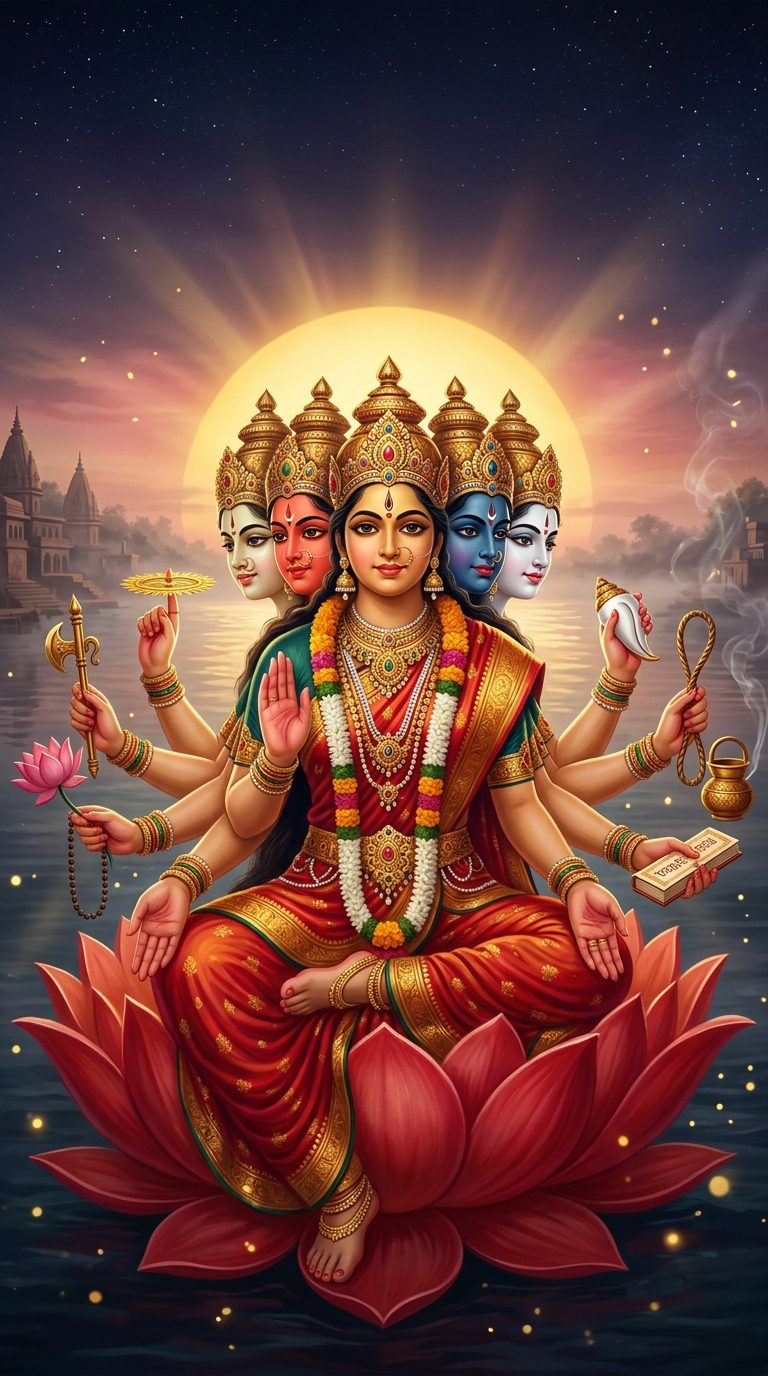
Gayatri is also the name of the poetic metre the verse is written in — three lines of eight syllables — and over time the mantra itself came to be worshipped as a goddess, Gayatri Devi, the mother of the Vedas. The opening words Om bhūr bhuvaḥ svaḥ, naming the three worlds, were added before the Rig Veda verse in later Vedic practice and are now always chanted with it.
✦ ✦ ✦
TheStoriesInsidetheHymn
Thekingwhobecameasage
Vishvamitra was born a powerful king. When he tried to take the wish-fulfilling cow of the sage Vasishtha by force, all his armies and weapons failed against the sage’s spiritual power. Humbled, he gave up his kingdom to seek that power himself.
After long years of austerity, setbacks and pride, he finally became a brahmarishi, the highest kind of seer. The Gayatri Mantra is the verse revealed to him — a fitting gift from a man who learned that true power is not force but an illuminated mind.
Threeworldsinthreewords
Bhūr, bhuvaḥ, svaḥ name the three worlds: the earth beneath us, the space of air and breath between, and the bright heavens above. Some teachers also read them as body, breath and mind, or waking, dreaming and deep sleep.
Chanting them first is like gathering everything — all the worlds and all of yourself — before turning towards the light.
✦ ✦ ✦
HowtoChantGayatriMantra
When to chant
✦At sunrise, facing the rising sun — the most traditional time
✦At the three junctions of the day (sandhya): sunrise, noon and sunset
✦Before study, exams or any work that needs a clear mind
✦As a daily morning meditation
How many times
Traditionally 3, 10, 28 or 108 times. Even three slow repetitions at sunrise are a complete practice.
1
Sit facing east, ideally in the early morning light.
2
Listen once to the recording while reading the meaning of each line.
3
Chant Om bhūr bhuvaḥ svaḥ, pause, then the three lines of the verse slowly and evenly.
4
Picture golden light filling your forehead and spreading through your whole body as you chant.
5
Sit in silence for a few breaths before getting up.
✦ ✦ ✦
PronunciationGuide
The sounds that trip people up most in this hymn, and how to say them.
bhūr bhuvaḥ svaḥ
The “bh” has a breath in it: bhoor bhoo-vah svah. The final ḥ is a soft echo of breath.
savitur
Sa-vi-tur, with “v” closer to a soft “w”: sa-wi-tur.
vareṇyaṃ
The ṇ is said with the tongue curled back: va-ren-yum.
“Om. Earth, the middle realm and the heavens. We meditate on the most excellent radiance of the divine sun, Savitr. May it awaken and illuminate our minds.”
WhowrotetheGayatriMantra?
It is from the Rig Veda (3.62.10) and is credited to the sage Vishvamitra. In the Vedic tradition seers are said to have “seen” or received mantras rather than composed them.
WhenshouldtheGayatriMantrabechanted?
Traditionally at sunrise, noon and sunset, facing the sun. Sunrise is the most popular time, but it can be chanted any time you want clarity and calm.
WhatarethebenefitsoftheGayatriMantra?
The mantra itself asks for an awakened, clear and inspired mind. Traditionally it is chanted for wisdom, focus, purity of thought and spiritual growth.
CanwomenchanttheGayatriMantra?
Yes. Although some old customs restricted it, most teachers and organisations today encourage everyone, of any gender or background, to chant it with respect.