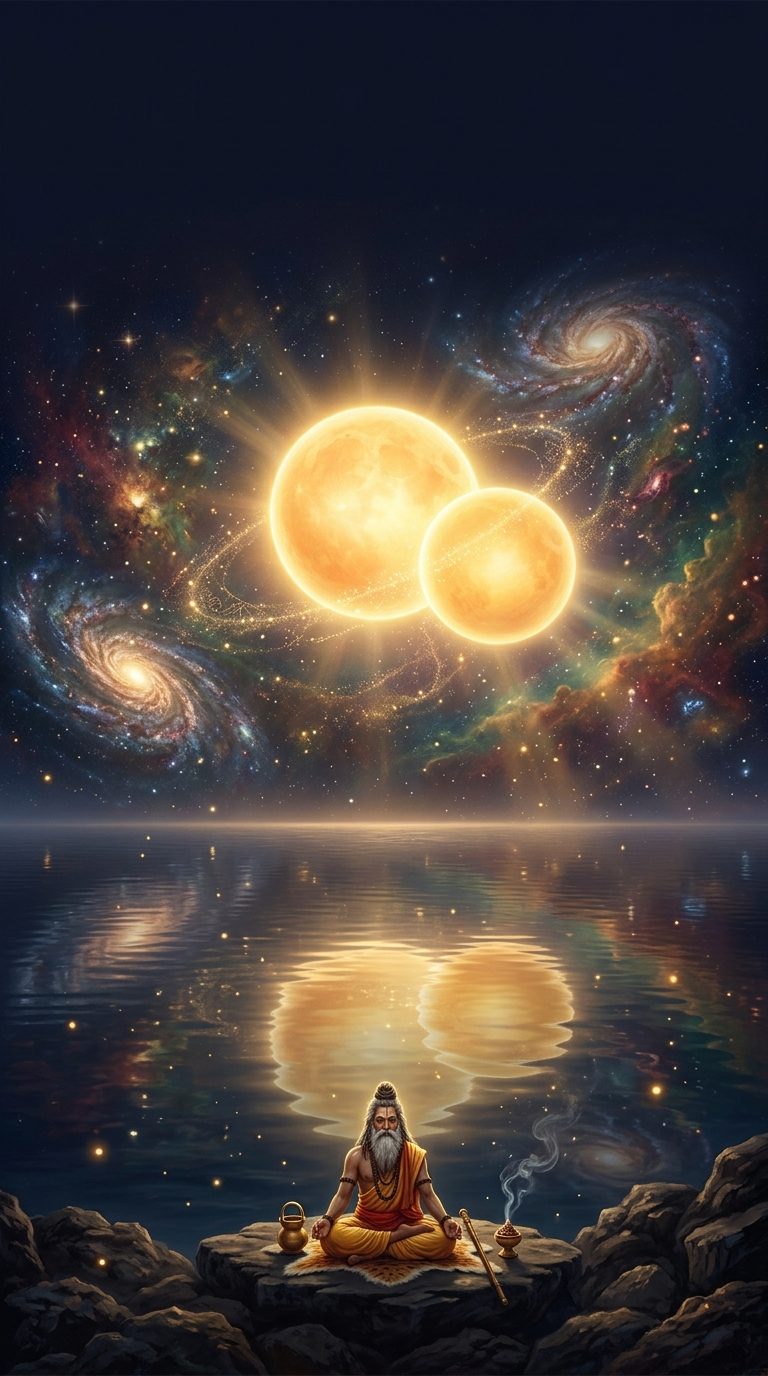
The Upanishads’ great mantra of wholeness: “That is whole, this is whole; from the whole the whole arises — and when the whole is taken from the whole, the whole remains.”
Shanti mantra of the Isha Upanishad (also Brihadaranyaka Upanishad 5.1.1)
Listen
Om Purnamadah Purnamidam
Son of Kali · Essence of Sacred Mantras
0:005:59
Deity
Vedic & Peace
Type
Mantra
Verses
1
Language
Sanskrit
OmPurnamadahPurnamidamLyricswithMeaning
Each line shows an easy way to say it, with its English meaning. Turn on the Sanskrit, the exact pronunciation or the word-by-word meaning whenever you want to go deeper.
The Mantra
ॐ पूर्णमदः पूर्णमिदं
Om Purnamadah Purnamidam
oṃ pūrṇamadaḥ pūrṇamidaṃ
Om — that is whole, this is whole.
पूर्णात्पूर्णमुदच्यते ।
Purnat Purnam Udachyate
pūrṇātpūrṇamudacyate
From the whole, the whole comes forth.
पूर्णस्य पूर्णमादाय
Purnasya Purnam Adaya
pūrṇasya pūrṇamādāya
Taking the whole from the whole,
पूर्णमेवावशिष्यते ॥
Purnam Eva Avashishyate
pūrṇamevāvaśiṣyate
the whole alone remains.
ॐ शान्तिः शान्तिः शान्तिः ॥
Om Shantih Shantih Shantih
oṃ śāntiḥ śāntiḥ śāntiḥ
Om — peace, peace, peace.
✦ ✦ ✦
AboutOmPurnamadahPurnamidam
Om Purnamadah is the peace invocation (śānti mantra) chanted before the Isha Upanishad, and it also opens the fifth chapter of the Brihadaranyaka Upanishad. It is one of the most profound short verses ever written — a riddle that turns ordinary arithmetic upside down.
The key word is pūrṇa: whole, full, complete, infinite. “That” — the infinite reality beyond — is whole. “This” — the world we see, and you yourself — is whole too. From the whole, the whole comes forth, and yet nothing is lost: take the whole from the whole and the whole still remains. Infinity minus infinity is still infinity.
The mantra gently says that you are not a fragment broken off from the divine, and the world is not something less than its source. Everything is already complete. That is why it is often chanted for deep contentment and peace.
✦ ✦ ✦
TheStoriesInsidetheHymn
Thearithmeticoftheinfinite
Imagine lighting one candle from another. The second candle has a complete flame, yet the first loses nothing. Or think of the ocean and its waves: every wave is fully water, and the ocean is never diminished.
The Upanishad uses this paradox to point at a reality that cannot be divided — which is why its peace mantra begins with wholeness rather than asking for anything.
Amantrabeforelearning
In the old forest schools of India, teacher and students chanted a shanti mantra together before studying an Upanishad, so that the learning would be peaceful and free of obstacles.
Starting with Om Purnamadah reminded everyone that the truth they were about to study was not somewhere far away — it was already whole, already present.
✦ ✦ ✦
HowtoChantOmPurnamadahPurnamidam
When to chant
✦Before meditation, study or yoga
✦At the start or end of the day
✦When you feel incomplete, anxious or lacking
✦Before meals, as a reminder of fullness
How many times
Once or three times, ending with the three shantis.
1
Sit still and take a few slow breaths.
2
Read the meaning first — the mantra lands best when understood.
3
Listen to the recording, then chant slowly, one line per breath.
4
On “pūrṇam,” feel a sense of fullness spreading through your body.
5
End with Om shanti, shanti, shanti and rest in silence.
✦ ✦ ✦
PronunciationGuide
The sounds that trip people up most in this hymn, and how to say them.
pūrṇam
Long “oo” and a ṇ with the tongue curled back: poor-num.
“That is whole, this is whole. From the whole, the whole comes forth. When the whole is taken from the whole, the whole remains. Om, peace, peace, peace.”
Whatdoespūrṇammean?
Pūrṇam means whole, full, complete or infinite. The mantra uses it for both the ultimate reality and the world we live in.
Wheredoesthismantracomefrom?
It is the shanti (peace) mantra of the Isha Upanishad and also appears at the start of Brihadaranyaka Upanishad 5.1.
Whenisitchanted?
Traditionally before studying the Upanishads; today also before meditation, yoga, meals and at the start or end of the day.