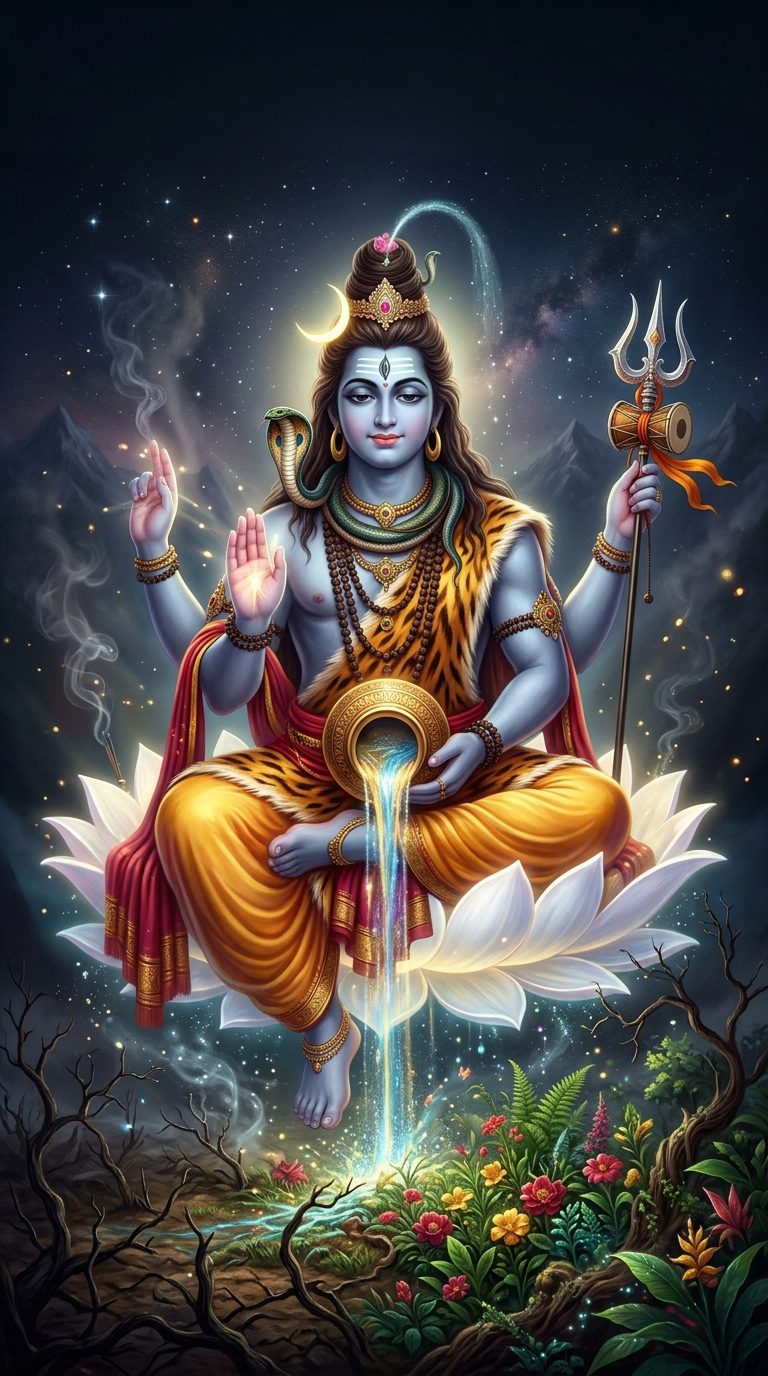
The “life-restoring” armour of Shiva as Mrityunjaya, the Conqueror of Death — a prayer that calls on a different form of Shiva to guard each of the ten directions and every part of the body, and promises freedom from untimely death and disease.
Attributed to the sage Vasishtha (named in the closing line)
Listen
Mrita Sanjeevana Stotram
Son of Kali · Sacred Shiva Chants
0:005:04
Deity
Shiva
Type
Kavacham
Verses
30
Language
Sanskrit
MritaSanjeevanaStotramLyricswithMeaning
Each line shows an easy way to say it, with its English meaning. Turn on the Sanskrit, the exact pronunciation or the word-by-word meaning whenever you want to go deeper.
Verse 1
एवमाराध्य गौरीशं देवं मृत्युञ्जयेश्वरम् ।
Evamaradhya Gaurisham Devam Mrityunjayeshvaram
evamārādhya gaurīśaṃ devaṃ mṛtyuñjayeśvaram
Having worshipped in this way Gauri’s Lord, the god Mrityunjaya, the Conqueror of Death,
मृतसञ्जीवनं नाम्ना कवचं प्रजपेत्सदा ॥ १ ॥
Mritasanjivanam Namna Kavacham Prajapetsada
mṛtasañjīvanaṃ nāmnā kavacaṃ prajapetsadā
one should always recite the kavacham known as Mrita Sanjeevana.
Verse 2
सारात्सारतरं पुण्यं गुह्याद्गुह्यतरं शुभम् ।
Saratsarataram Punyam Guhyadguhyataram Shubham
sārātsārataraṃ puṇyaṃ guhyādguhyataraṃ śubham
It is the essence of essences, holy, the most secret of secrets and auspicious —
महादेवस्य कवचं मृतसञ्जीवनाभिधम् ॥ २ ॥
Mahadevasya Kavacham Mritasanjivanabhidham
mahādevasya kavacaṃ mṛtasañjīvanābhidham
the armour of Mahadeva named Mrita Sanjeevana.
Verse 3
समाहितमना भूत्वा शृणुष्व कवचं शुभम् ।
Samahitamana Bhutva Shrinushva Kavacham Shubham
samāhitamanā bhūtvā śṛṇuṣva kavacaṃ śubham
With a collected mind, listen to this auspicious armour;
शृत्वैतद्दिव्य कवचं रहस्यं कुरु सर्वदा ॥ ३ ॥
Shritvaitaddivya Kavacham Rahasyam Kuru Sarvada
śṛtvaitaddivya kavacaṃ rahasyaṃ kuru sarvadā
having heard this divine armour, keep it always as a sacred secret.
Verse 4 — East
वराभयकरो यज्वा सर्वदेवनिषेवितः ।
Varabhayakaro Yajva Sarvadevanishevitah
varābhayakaro yajvā sarvadevaniṣevitaḥ
He who grants boons and fearlessness, the sacrificer, served by all the gods —
मृत्युञ्जयो महादेवः प्राच्यां मां पातु सर्वदा ॥ ४ ॥
Mrityunjayo Mahadevah Prachyam Mam Patu Sarvada
mṛtyuñjayo mahādevaḥ prācyāṃ māṃ pātu sarvadā
may Mahadeva Mrityunjaya always protect me in the east.
Therefore this most secret armour has been declared —
Verse 30
मृतसञ्जीवनं नाम्ना देवतैरपि दुर्लभम् ॥ ३० ॥
Mritasanjivanam Namna Devatairapi Durlabham
mṛtasañjīvanaṃ nāmnā devatairapi durlabham
named Mrita Sanjeevana, hard to obtain even for the gods.
✦ ✦ ✦
AboutMritaSanjeevanaStotram
The Mrita Sanjeevana Stotram — “the hymn that brings the dead back to life” — is a kavacham, a protective armour of prayer, addressed to Shiva as Mrityunjaya, the Conqueror of Death. Tradition ascribes it to the sage Vasishtha, and it is chanted for health, long life and recovery from illness.
Like other kavachams it moves in a circle and then down the body. Verses 4 to 12 place a form of Shiva in each of the ten directions — as Indra in the east, Agni in the south-east, Yama in the south, and so on — and verses 12 to 20 ask a named form of Shiva to protect each part of the body from the head to the feet, and then one’s family, life and mind.
The closing verses describe its power: that whoever recites it daily overcomes untimely death, is free from disease and lives with the vigour of youth. Read these as the traditional praise of a prayer, and as encouragement to steady practice, not as a replacement for medical care.
✦ ✦ ✦
TheStoriesInsidetheHymn
Why“MritaSanjeevana”?
Mrita means “dead” and sanjeevana means “bringing back to life.” In the epics, the Mrita Sanjeevani vidya was the secret knowledge, granted by Shiva to the sage Shukracharya, of restoring the slain to life.
This kavacham borrows that name for itself: it is “life-giving” because it calls on Shiva as the one who conquered death for his devotee Markandeya — the same Shiva of the Maha Mrityunjaya mantra.
Shivaineverydirection
Hindu tradition guards the ten directions with ten guardian deities: Indra in the east, Agni in the south-east, Yama in the south, Nirriti in the south-west, Varuna in the west, Vayu in the north-west, Kubera in the north, Ishana in the north-east, Brahma above and Ananta below.
In this kavacham each guardian is revealed to be Shiva himself, holding that god’s weapon and showing the gesture of fearlessness — so that wherever the devotee turns, it is Shiva who protects.
✦ ✦ ✦
HowtoChantMritaSanjeevanaStotram
When to chant
✦Mondays
✦Pradosham
✦During illness or recovery, for oneself or a loved one
✦Early morning, as the hymn itself recommends
How many times
Once daily; the hymn names a thousand recitations as its full observance (purashcharana).
1
Sit facing east or north before an image of Shiva or a Shiva Linga.
2
Begin with the Maha Mrityunjaya mantra three times.
3
Chant the kavacham slowly, touching or picturing each part of the body as it is named.
4
Close with a prayer for the health of all beings.
✦ ✦ ✦
PronunciationGuide
The sounds that trip people up most in this hymn, and how to say them.
mṛtasañjīvana
mri-ta-sun-jee-va-na — “bringing the dead to life.”
A kavacham (protective prayer) to Shiva as Mrityunjaya, the Conqueror of Death, asking him to guard every direction and every part of the body. Its name means “bringing the dead back to life.”
Whocomposedit?
Its closing line attributes it to the sage Vasishtha.
Whatisitchantedfor?
Traditionally for health, long life, recovery from illness and protection from untimely death.
HowisitrelatedtotheMahaMrityunjayamantra?
Both are addressed to Shiva as Mrityunjaya. Many people chant the Maha Mrityunjaya mantra before or after this kavacham.