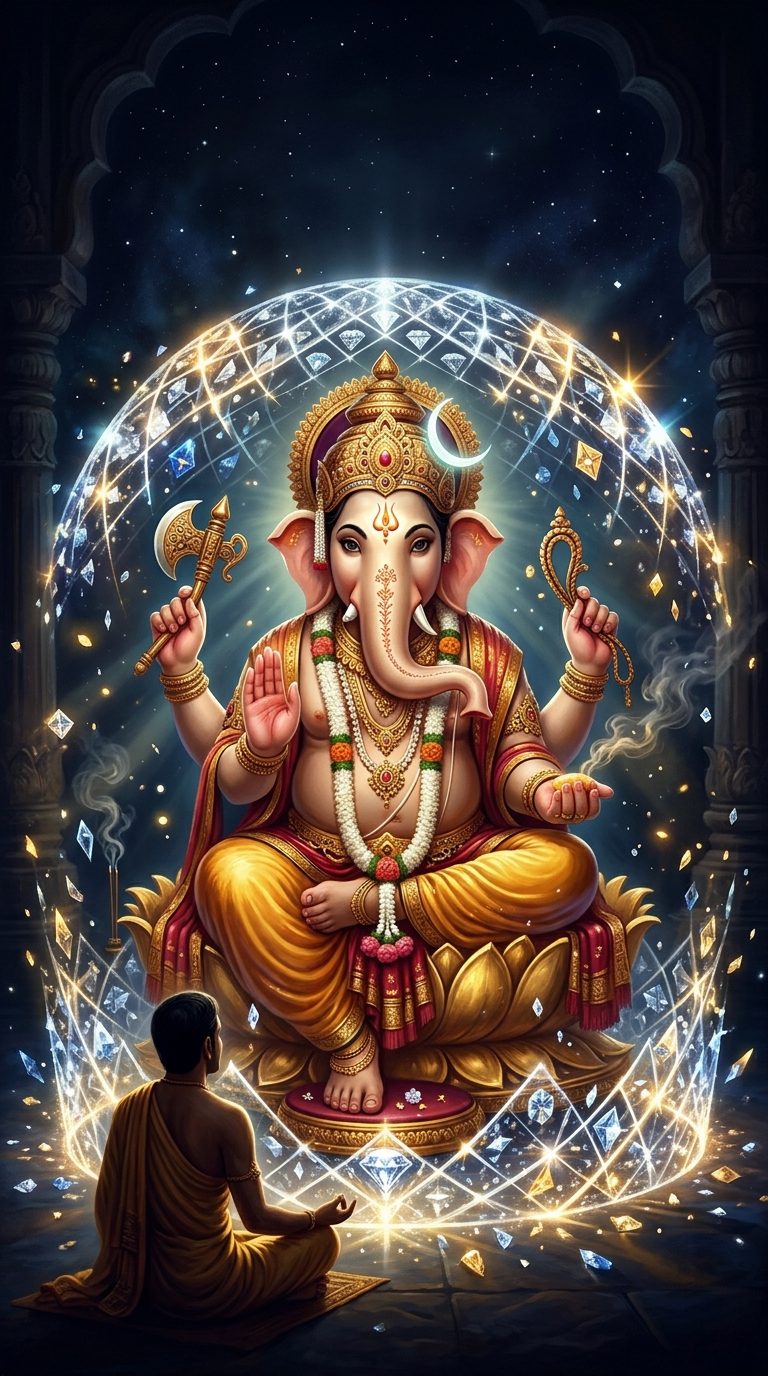
A panjara is a cage or enclosure; a vajra panjara is a cage of diamond — an armour so strong nothing can break it. In this chapter of the Mudgala Purana, Shiva asks Ganesha for such an armour, and Ganesha himself teaches it.
It begins with a meditation on Ganesha: three-eyed, elephant-faced, four-armed, holding the axe and other weapons, the moon on his brow, human in body, ever peaceful in yoga. Then, in a way unique to the Mudgala Purana, his eight avatars protect not parts of the body but layers of being: Vakratunda the heart, Ekadanta the sense of “I”, Mahodara the states of knowing, Gajanana the Sankhya principles, Lambodara and Vikata the mind amid illusion, Vighnaraja the experiences of joy, Dhumravarna the unmanifest.
Then Ganesha’s forms guard the directions — Gajakarna in front, Chintamani in the south-east, south and south-west, Dhundhi in the west, Heramba the north-west, Vinayaka the north, Pramoda the north-east, Siddhipati above and Buddhisha below — and Mayuresha protects every limb. Its promise: whoever wears this cage “moves everywhere with a body made of diamond”.