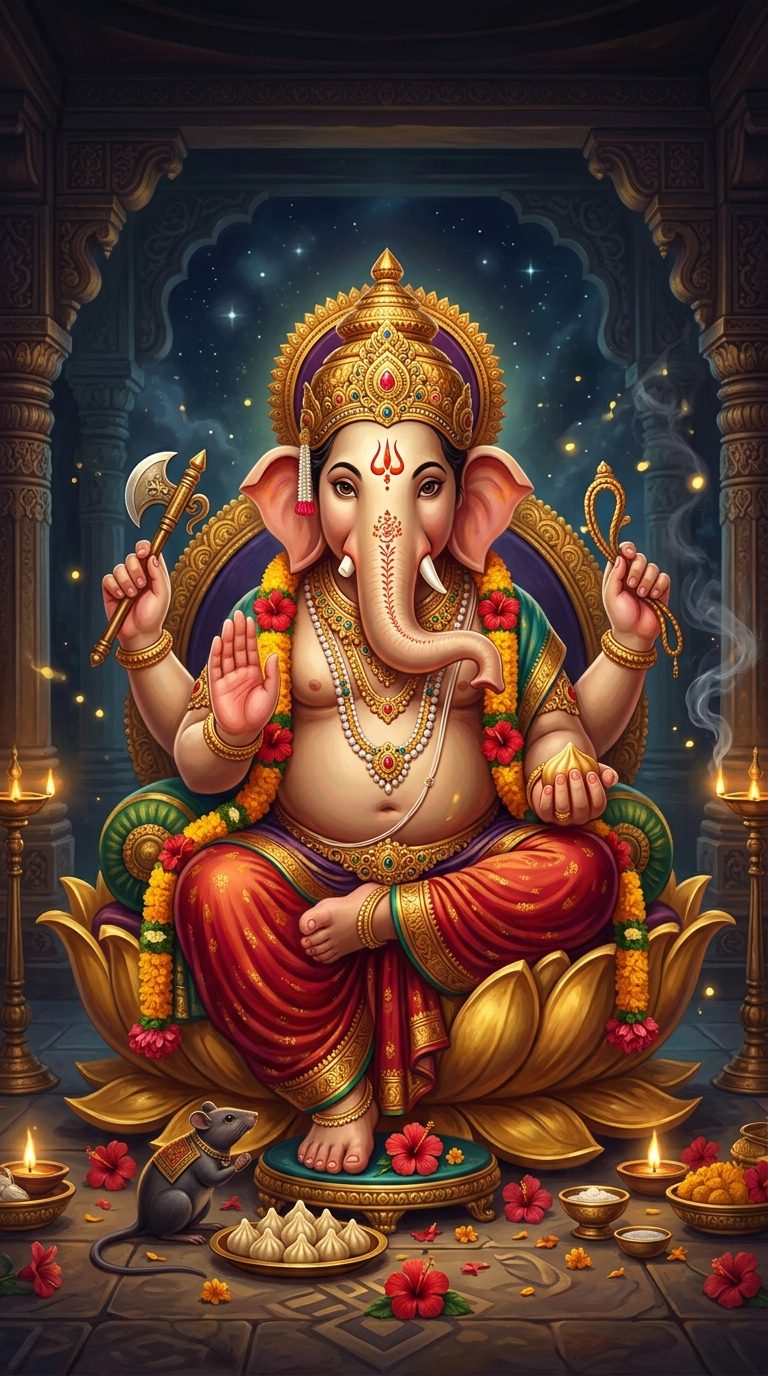
Lord Ganesha dancing joyfully with a cobra belt and anklet bells, celestial musicians playing drums around him
GaneshaStotram

Ganesha Bhujangam

Lyrics · Meaning · Audio

Adi Shankaracharya’s rhythmic hymn to the dancing Ganesha — bells jingling, trunk swaying, a serpent for a belt — that ends by praising him as the formless sound Om itself.

Attributed to Adi Shankaracharya

Listen

Ganesha Bhujangam

Son of Kali · Power of Ganesha

0:006:52
Deity
Ganesha
Type
Stotram
Verses
9
Language
Sanskrit

Ganesha Bhujangam Lyrics with Meaning

Each line shows an easy way to say it, with its English meaning. Turn on the Sanskrit, the exact pronunciation or the word-by-word meaning whenever you want to go deeper.

Verse 1

रणत्क्षुद्रघण्टानिनादाभिरामं चलत्ताण्डवोद्दण्डवत्पद्मतालम् ।

Ranat Kshudra Ghanta Ninadabhiramam Chalat Tandavoddandavat Padma Talam

raṇatkṣudraghaṇṭāninādābhirāmaṃ calattāṇḍavoddaṇḍavatpadmatālam

Delightful with the ringing of tiny bells, his lotus feet beating time in a vigorous dance,

    लसत्तुन्दिलाङ्गोपरिव्यालहारं गणाधीशमीशानसूनुं तमीडे ॥ १ ॥

    Lasat Tundilangopari Vyala Haram Ganadhisham Ishanasunum Tamide

    lasattundilāṅgoparivyālahāraṃ gaṇādhīśamīśānasūnuṃ tamīḍe

    a serpent shining as a garland on his round belly — I praise him, lord of the hosts, the son of Shiva.

      Verse 2

      ध्वनिध्वंसवीणालयोल्लासिवक्त्रं स्फुरच्छुण्डदण्डोल्लसद्बीजपूरम् ।

      Dhvani Dhvamsa Vina Layollasi Vaktram Sphurac Chunda Dandollasad Bijapuram

      dhvanidhvaṃsavīṇālayollāsivaktraṃ sphuracchuṇḍadaṇḍollasadbījapūram

      His face glowing in the rhythm of the veena, his swaying trunk holding a shining citron,

        गलद्दर्पसौगन्ध्यलोलालिमालं गणाधीशमीशानसूनुं तमीडे ॥ २ ॥

        Galad Darpa Saugandhya Lolali Malam Ganadhisham Ishanasunum Tamide

        galaddarpasaugandhyalolālimālaṃ gaṇādhīśamīśānasūnuṃ tamīḍe

        swarms of bees drawn to the fragrance flowing from his temples — I praise him, lord of the hosts, son of Shiva.

          Verse 3

          प्रकाशज्जपारक्तरत्नप्रसूनप्रवालप्रभातारुणज्योतिरेकम् ।

          Prakashaj Japa Rakta Ratna Prasuna Pravala Prabhatarunajyotirekam

          prakāśajjapāraktaratnaprasūnapravālaprabhātāruṇajyotirekam

          Radiant as red hibiscus, rubies, red blossoms, coral and the red light of dawn,

            प्रलम्बोदरं वक्रतुण्डैकदन्तं गणाधीशमीशानसूनुं तमीडे ॥ ३ ॥

            Pralambodaram Vakratundaikadantam Ganadhisham Ishanasunum Tamide

            pralambodaraṃ vakratuṇḍaikadantaṃ gaṇādhīśamīśānasūnuṃ tamīḍe

            big-bellied, with a curved trunk and a single tusk — I praise him, lord of the hosts, son of Shiva.

              Verse 4

              विचित्रस्फुरद्रत्नमालाकिरीटं किरीटोल्लसच्चन्द्ररेखाविभूषम् ।

              Vichitra Sphurad Ratna Mala Kiritam Kiritollasac Chandra Rekha Vibhusham

              vicitrasphuradratnamālākirīṭaṃ kirīṭollasaccandrarekhāvibhūṣam

              His crown set with dazzling, many-coloured jewels, a crescent moon shining on it,

                विभूषैकभूशं भवध्वंसहेतुं गणाधीशमीशानसूनुं तमीडे ॥ ४ ॥

                Vibhushaika Bhusham Bhava Dhvamsa Hetum Ganadhisham Ishanasunum Tamide

                vibhūṣaikabhūśaṃ bhavadhvaṃsahetuṃ gaṇādhīśamīśānasūnuṃ tamīḍe

                the ornament of all ornaments, the cause of release from worldly bondage — I praise him, lord of the hosts, son of Shiva.

                  Verse 5

                  उदञ्चद्भुजावल्लरीदृश्यमूलोच्चलद्भ्रूलताविभ्रमभ्राजदक्षम् ।

                  Udanchad Bhujavallari Drishyamuloc Chalad Bhrulata Vibhrama Bhrajadaksham

                  udañcadbhujāvallarīdṛśyamūloccaladbhrūlatāvibhramabhrājadakṣam

                  His vine-like arms raised high, his eyes shining with the playful movement of his brows,

                    मरुत्सुन्दरीचामरैः सेव्यमानं गणाधीशमीशानसूनुं तमीडे ॥ ५ ॥

                    Marut Sundari Chamaraih Sevyamanam Ganadhisham Ishanasunum Tamide

                    marutsundarīcāmaraiḥ sevyamānaṃ gaṇādhīśamīśānasūnuṃ tamīḍe

                    fanned with whisks by celestial maidens — I praise him, lord of the hosts, son of Shiva.

                      Verse 6

                      स्फुरन्निष्ठुरालोलपिङ्गाक्षितारं कृपाकोमलोदारलीलावतारम् ।

                      Sphuran Nishthuralola Pingakshi Taram Kripa Komalodara Lilavataram

                      sphuranniṣṭhurālolapiṅgākṣitāraṃ kṛpākomalodāralīlāvatāram

                      His tawny eyes darting fiercely, yet he comes in gentle, generous play out of compassion;

                        कलाबिन्दुगं गीयते योगिवर्यैर्गणाधीशमीशानसूनुं तमीडे ॥ ६ ॥

                        Kala Bindugam Giyate Yogivaryair Ganadhisham Ishanasunum Tamide

                        kalābindugaṃ gīyate yogivaryairgaṇādhīśamīśānasūnuṃ tamīḍe

                        the great yogis sing of him as dwelling in the subtle point of sound — I praise him, lord of the hosts, son of Shiva.

                          Verse 7

                          यमेकाक्षरं निर्मलं निर्विकल्पं गुणातीतमानन्दमाकारशून्यम् ।

                          Yamekaksharam Nirmalam Nirvikalpam Gunatitam Anandam Akara Shunyam

                          yamekākṣaraṃ nirmalaṃ nirvikalpaṃ guṇātītamānandamākāraśūnyam

                          He whom they call the one syllable — spotless, beyond thought, beyond qualities, pure bliss, without form,

                            परं पारमोङ्कारमाम्नायगर्भं वदन्ति प्रगल्भं पुराणं तमीडे ॥ ७ ॥

                            Param Param Omkaram Amnaya Garbham Vadanti Pragalbham Puranam Tamide

                            paraṃ pāramoṅkāramāmnāyagarbhaṃ vadanti pragalbhaṃ purāṇaṃ tamīḍe

                            supreme, the farther shore, Om, the womb of the Vedas, mighty and ancient — I praise him.

                              Verse 8

                              चिदानन्दसान्द्राय शान्ताय तुभ्यं नमो विश्वकर्त्रे च हर्त्रे च तुभ्यम् ।

                              Chidananda Sandraya Shantaya Tubhyam Namo Vishvakartre Cha Hartre Cha Tubhyam

                              cidānandasāndrāya śāntāya tubhyaṃ namo viśvakartre ca hartre ca tubhyam

                              Salutations to you, dense with consciousness and bliss, the peaceful one; salutations to you, creator and dissolver of the universe;

                                नमोऽनन्तलीलाय कैवल्यभासे नमो विश्वबीज प्रसीदेशसूनो ॥ ८ ॥

                                Namo Ananta Lilaya Kaivalya Bhase Namo Vishva Bija Prasidesha Suno

                                namo'nantalīlāya kaivalyabhāse namo viśvabīja prasīdeśasūno

                                salutations to the one of endless play, the light of liberation; salutations, seed of the universe — be gracious, son of Shiva.

                                  Closing verse

                                  इमं सुस्तवं प्रातरुत्थाय भक्त्या पठेद्यस्तु मर्त्यो लभेत्सर्वकामान् ।

                                  Imam Sustavam Pratarutthaya Bhaktya Pathed Yastu Martyo Labhet Sarva Kaman

                                  imaṃ sustavaṃ prātarutthāya bhaktyā paṭhedyastu martyo labhetsarvakāmān

                                  Whoever rises at dawn and recites this fine hymn with devotion gains all their wishes;

                                    गणेशप्रसादेन सिध्यन्ति वाचो गणेशे विभौ दुर्लभं किं प्रसन्ने ॥ ९ ॥

                                    Ganesha Prasadena Sidhyanti Vacho Ganeshe Vibhau Durlabham Kim Prasanne

                                    gaṇeśaprasādena sidhyanti vāco gaṇeśe vibhau durlabhaṃ kiṃ prasanne

                                    by Ganesha’s grace their words come true — when mighty Ganesha is pleased, what is out of reach?

                                      About Ganesha Bhujangam

                                      A bhujaṅga is a serpent, and bhujaṅgaprayāta — “the serpent’s movement” — is a flowing, rippling metre. Shankaracharya wrote several hymns in it, to Shiva, to Subrahmanya and to Ganesha. This one begins with Ganesha dancing.

                                      The first six verses are a joyful picture: tiny bells ringing, feet beating time, a pot belly with a snake wrapped around it, a trunk holding a citron fruit, bees humming around his fragrant temples, and celestial women fanning him. Each ends gaṇādhīśam īśānasūnuṃ tam īḍe — “I praise him, the lord of the hosts, the son of Shiva.”

                                      Then the hymn turns inward. Verse 7 calls him the one syllable Om, pure, beyond qualities and form; verse 8 salutes him as the creator and dissolver of the universe. The rhythm of the dance leads into stillness.

                                      The Stories Inside the Hymn

                                      The dancing Ganesha

                                      Ganesha is usually shown sitting, but there is a beloved tradition of Nritya Ganapati — Ganesha dancing, often with eight arms, one foot raised like his father Shiva Nataraja.

                                      This hymn is that image in sound: as you chant it, the metre itself seems to dance.

                                      How to Chant Ganesha Bhujangam

                                      When to chant

                                      • ✦Early morning, as the closing verse recommends
                                      • ✦Wednesdays and Ganesh Chaturthi
                                      • ✦Before music, dance or creative work

                                      How many times

                                      Once.

                                      1. 1

                                        Sit before Ganesha and offer a flower.

                                      2. 2

                                        Let the rhythm carry you through the first six verses — they are meant to be joyful.

                                      3. 3

                                        Slow down for verses 7 and 8, which describe his formless nature.

                                      4. 4

                                        End in a moment of silence.

                                      Pronunciation Guide

                                      The sounds that trip people up most in this hymn, and how to say them.

                                      gaṇādhīśam

                                      ga-naa-dhee-shum.

                                      īśānasūnuṃ

                                      ee-shaa-na-soo-num — “son of Shiva.”

                                      bījapūram

                                      bee-ja-poo-rum — the citron fruit.

                                      Power of Ganesha by Son of Kali

                                      The music

                                      Power of Ganesha

                                      by Son of Kali

                                      More for Ganesha

                                      Frequently Asked Questions

                                      Who wrote the Ganesha Bhujangam?

                                      It is attributed to Adi Shankaracharya.

                                      What does Bhujangam mean?

                                      It refers to the bhujangaprayata metre, “the movement of a serpent” — a flowing, rhythmic verse form.

                                      What are its benefits?

                                      The closing verse says that whoever recites it with devotion on rising gains all their wishes, their speech becomes powerful, and nothing is out of reach when Ganesha is pleased.

                                      Text: Traditional public-domain Sanskrit hymn. Easy reading, transliteration and English translation written for the Jaguar Medicine Tribe Mantra Library.

                                      Music: Recordings by Son of Kali, produced with AI-assisted vocals and instrumentation.

                                      Note: Benefits described here are traditional beliefs, shared for understanding — not medical or guaranteed outcomes.