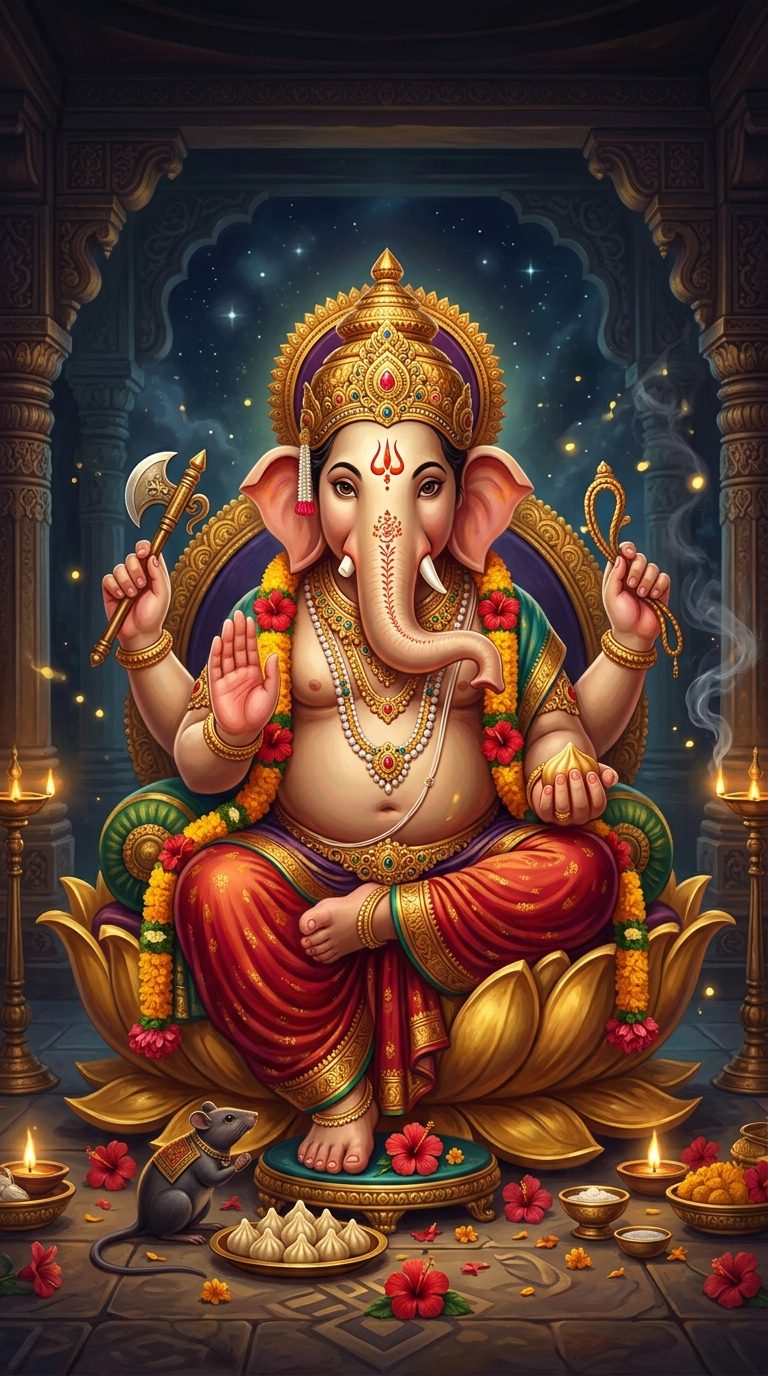
The Ganesha hymn for freedom from debt — each verse recalls a god who worshipped Ganesha before a great task, and ends “may the son of Parvati always destroy my debts.”
Traditional hymn (Krishnayamala Tantra tradition), spoken by Shiva
Listen
Runa Hartru Ganesha Stotram
Son of Kali · Runa Hartru
0:005:40
Deity
Ganesha
Type
Stotram
Verses
9
Language
Sanskrit
RunaHartruGaneshaStotramLyricswithMeaning
Each line shows an easy way to say it, with its English meaning. Turn on the Sanskrit, the exact pronunciation or the word-by-word meaning whenever you want to go deeper.
Worshipped properly by Shiva before he destroyed Tripura —
सदैव पार्वतीपुत्रः ऋणनाशं करोतु मे ॥ २ ॥
Sadaiva Parvati Putrah Rinanasham Karotu Me
sadaiva pārvatīputraḥ ṛṇanāśaṃ karotu me
may the son of Parvati always destroy my debts.
Verse 3
हिरण्यकश्यप्वादीनां वधार्थे विष्णुनार्चितः ।
Hiranyakashyapvadinam Vadharthe Vishnunarchitah
hiraṇyakaśyapvādīnāṃ vadhārthe viṣṇunārcitaḥ
Worshipped by Vishnu before slaying Hiranyakashipu and the other demons —
सदैव पार्वतीपुत्रः ऋणनाशं करोतु मे ॥ ३ ॥
Sadaiva Parvati Putrah Rinanasham Karotu Me
sadaiva pārvatīputraḥ ṛṇanāśaṃ karotu me
may the son of Parvati always destroy my debts.
Verse 4
महिषस्य वधे देव्या गणनाथः प्रपूजितः ।
Mahishasya Vadhe Devya Gananathah Prapujitah
mahiṣasya vadhe devyā gaṇanāthaḥ prapūjitaḥ
The lord of the hosts, worshipped by the Goddess before she slew Mahisha —
सदैव पार्वतीपुत्रः ऋणनाशं करोतु मे ॥ ४ ॥
Sadaiva Parvati Putrah Rinanasham Karotu Me
sadaiva pārvatīputraḥ ṛṇanāśaṃ karotu me
may the son of Parvati always destroy my debts.
Verse 5
तारकस्य वधात्पूर्वं कुमारेण प्रपूजितः ।
Tarakasya Vadhat Purvam Kumarena Prapujitah
tārakasya vadhātpūrvaṃ kumāreṇa prapūjitaḥ
Worshipped by Kumara (Kartikeya) before slaying Taraka —
सदैव पार्वतीपुत्रः ऋणनाशं करोतु मे ॥ ५ ॥
Sadaiva Parvati Putrah Rinanasham Karotu Me
sadaiva pārvatīputraḥ ṛṇanāśaṃ karotu me
may the son of Parvati always destroy my debts.
Verse 6
भास्करेण गणेशो हि पूजितश्छविसिद्धये ।
Bhaskarena Ganesho Hi Pujitash Chhavi Siddhaye
bhāskareṇa gaṇeśo hi pūjitaśchavisiddhaye
Ganesha, worshipped by the Sun to gain his brilliance —
सदैव पार्वतीपुत्रः ऋणनाशं करोतु मे ॥ ६ ॥
Sadaiva Parvati Putrah Rinanasham Karotu Me
sadaiva pārvatīputraḥ ṛṇanāśaṃ karotu me
may the son of Parvati always destroy my debts.
Verse 7
शशिना कान्तिवृद्ध्यर्थं पूजितो गणनायकः ।
Shashina Kanti Vriddhyartham Pujito Gananayakah
śaśinā kāntivṛddhyarthaṃ pūjito gaṇanāyakaḥ
The leader of the hosts, worshipped by the Moon to increase its glow —
सदैव पार्वतीपुत्रः ऋणनाशं करोतु मे ॥ ७ ॥
Sadaiva Parvati Putrah Rinanasham Karotu Me
sadaiva pārvatīputraḥ ṛṇanāśaṃ karotu me
may the son of Parvati always destroy my debts.
Verse 8
पालनाय च तपसां विश्वामित्रेण पूजितः ।
Palanaya Cha Tapasam Vishvamitrena Pujitah
pālanāya ca tapasāṃ viśvāmitreṇa pūjitaḥ
Worshipped by Vishvamitra to protect his penance —
सदैव पार्वतीपुत्रः ऋणनाशं करोतु मे ॥ ८ ॥
Sadaiva Parvati Putrah Rinanasham Karotu Me
sadaiva pārvatīputraḥ ṛṇanāśaṃ karotu me
may the son of Parvati always destroy my debts.
Closing verses
इदं त्वृणहरं स्तोत्रं तीव्रदारिद्र्यनाशनम् ।
Idam Tvrinaharam Stotram Tivra Daridrya Nashanam
idaṃ tvṛṇaharaṃ stotraṃ tīvradāridryanāśanam
This hymn that removes debt destroys even severe poverty.
एकवारं पठेन्नित्यं वर्षमेकं समाहितः ॥
Ekavaram Pathen Nityam Varshamekam Samahitah
ekavāraṃ paṭhennityaṃ varṣamekaṃ samāhitaḥ
Recite it once every day for one year, with a steady mind;
दारिद्र्यं दारुणं त्यक्त्वा कुबेरसमतां व्रजेत् ॥
Daridryam Darunam Tyaktva Kubera Samatam Vrajet
dāridryaṃ dāruṇaṃ tyaktvā kuberasamatāṃ vrajet
leaving behind harsh poverty, one becomes as prosperous as Kubera.
✦ ✦ ✦
AboutRunaHartruGaneshaStotram
Ṛṇa means debt, and hartṛ means “the one who takes away.” This short hymn asks Ganesha to remove debt — not only money owed, but every kind of burden we carry.
Its structure is simple and memorable. Each verse names a moment when a great being worshipped Ganesha before succeeding: Brahma before creating the world, Shiva before destroying the demon cities of Tripura, Vishnu before slaying Hiranyakashipu, the Goddess before defeating Mahisha, Kartikeya before killing Taraka, the Sun and the Moon for their radiance, and the sage Vishvamitra for his penance. Every verse ends with the same prayer: sadaiva pārvatīputraḥ ṛṇanāśaṃ karotu me.
The closing verses promise that reciting it daily for a year removes even severe poverty and makes one as prosperous as Kubera. It is sometimes also called the Runa Vimochana Ganesha Stotram, and both of your recordings are attached to this page.
✦ ✦ ✦
TheStoriesInsidetheHymn
EventhegodsbeginwithGanesha
The hymn makes a gentle argument: if Brahma, Vishnu, Shiva and the Goddess all honoured Ganesha before their greatest tasks, then surely we can ask him for help with ours.
Each verse is a reminder that no undertaking — cosmic or ordinary — is too large or too small for the remover of obstacles.
✦ ✦ ✦
HowtoChantRunaHartruGaneshaStotram
When to chant
✦Wednesdays and Sankashti Chaturthi
✦Daily for a year, as the hymn suggests
✦When struggling with debts or financial pressure
✦Before a business or money decision
How many times
Once daily; some devotees chant it 11 or 21 times on Wednesdays.
1
Offer red flowers, durva grass or a modaka to Ganesha, and light a lamp.
2
Chant each verse, joining the refrain from the heart.
3
Picture the weight you carry lifting from your shoulders.
4
Close with Om Gam Ganapataye Namah.
✦ ✦ ✦
PronunciationGuide
The sounds that trip people up most in this hymn, and how to say them.