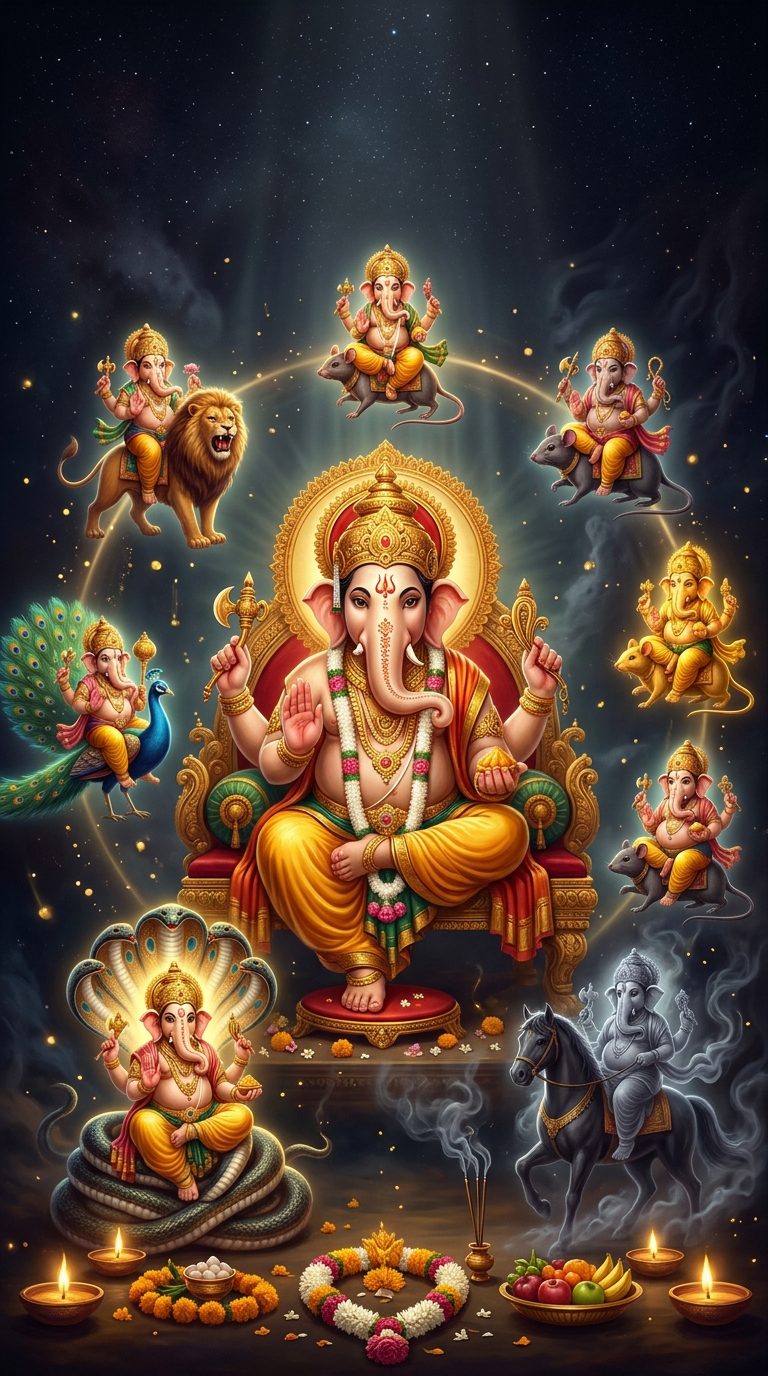
A hymn from the Mudgala Purana that names Ganesha’s eight great avatars — Vakratunda, Ekadanta, Mahodara, Gajanana, Lambodara, Vikata, Vighnaraja and Dhumravarna — each riding his own mount and each destroying one inner demon: jealousy, pride, delusion, greed, anger, lust, possessiveness and ego.
From the Mudgala Purana, spoken by the sage Angirasa
Listen
Sri Ganesha Avatara Stotram
Son of Kali · Power of Ganesha
0:005:15
Deity
Ganesha
Type
Stotram
Verses
21
Language
Sanskrit
SriGaneshaAvataraStotramLyricswithMeaning
Each line shows an easy way to say it, with its English meaning. Turn on the Sanskrit, the exact pronunciation or the word-by-word meaning whenever you want to go deeper.
Verse 1 — Angirasa speaks
अनन्ता अवताराश्च गणेशस्य महात्मनः ।
Ananta Avatarashcha Ganeshasya Mahatmanah
anantā avatārāśca gaṇeśasya mahātmanaḥ
Endless are the avatars of the great-souled Ganesha;
न शक्यते कथां वक्तुं मया वर्षशतैरपि ॥ १ ॥
Na Shakyate Katham Vaktum Maya Varshashatairapi
na śakyate kathāṃ vaktuṃ mayā varṣaśatairapi
I could not tell their story even in a hundred years.
Briefly I shall tell of the chief ones, foremost among them —
अवतारांश्च तस्याष्टौ विख्यातान् ब्रह्मधारकान् ॥ २ ॥
Avataramshcha Tasyashtau Vikhyatan Brahmadharakan
avatārāṃśca tasyāṣṭau vikhyātān brahmadhārakān
his eight famous avatars, who uphold Brahman.
Verse 3 — Vakratunda
वक्रतुण्डावतारश्च देहिनां ब्रह्मधारकः ।
Vakratundavatarashcha Dehinam Brahmadharakah
vakratuṇḍāvatāraśca dehināṃ brahmadhārakaḥ
The Vakratunda avatar upholds Brahman for embodied beings;
मत्सरासुरहन्ता स सिंहवाहनगः स्मृतः ॥ ३ ॥
Matsarasurahanta Sa Simhavahanagah Smritah
matsarāsurahantā sa siṃhavāhanagaḥ smṛtaḥ
slayer of Matsarasura, jealousy, he is remembered as riding a lion.
Verse 4 — Ekadanta
एकदन्तावतारो वै देहिनां ब्रह्मधारकः ।
Ekadantavataro Vai Dehinam Brahmadharakah
ekadantāvatāro vai dehināṃ brahmadhārakaḥ
The Ekadanta avatar upholds Brahman for embodied beings;
मदासुरस्य हन्ता स आखुवाहनगः स्मृतः ॥ ४ ॥
Madasurasya Hanta Sa Akhuvahanagah Smritah
madāsurasya hantā sa ākhuvāhanagaḥ smṛtaḥ
slayer of Madasura, pride, he is remembered as riding a mouse.
Verse 5 — Mahodara
महोदर इति ख्यातो ज्ञानब्रह्मप्रकाशकः ।
Mahodara Iti Khyato Jnanabrahmaprakashakah
mahodara iti khyāto jñānabrahmaprakāśakaḥ
Famed as Mahodara, the revealer of Brahman as knowledge,
मोहासुरस्य शत्रुर्वै आखुवाहनगः स्मृतः ॥ ५ ॥
Mohasurasya Shatrurvai Akhuvahanagah Smritah
mohāsurasya śatrurvai ākhuvāhanagaḥ smṛtaḥ
enemy of Mohasura, delusion, he is remembered as riding a mouse.
Verse 6 — Gajanana
गजाननः स विज्ञेयः सांख्येभ्यः सिद्धिदायकः ।
Gajananah Sa Vijneyah Samkhyebhyah Siddhidayakah
gajānanaḥ sa vijñeyaḥ sāṃkhyebhyaḥ siddhidāyakaḥ
Know him as Gajanana, who gives perfection to the followers of Sankhya,
लोभासुरप्रहर्ता च मूषकगः प्रकीर्तितः ॥ ६ ॥
Lobhasurapraharta Cha Mushakagah Prakirtitah
lobhāsuraprahartā ca mūṣakagaḥ prakīrtitaḥ
the striker of Lobhasura, greed, proclaimed as riding a mouse.
Verse 7 — Lambodara
लम्बोदरावतारो वै क्रोधसुरनिबर्हणः ।
Lambodaravataro Vai Krodhasuranibarhanah
lambodarāvatāro vai krodhasuranibarhaṇaḥ
The Lambodara avatar is the destroyer of Krodhasura, anger;
आखुगः शक्तिब्रह्मा सन् तस्य धारक उच्यते ॥ ७ ॥
Akhugah Shaktibrahma San Tasya Dharaka Uchyate
ākhugaḥ śaktibrahmā san tasya dhāraka ucyate
riding a mouse, he is said to be the upholder of Brahman as power.
Verse 8 — Vikata
विकटो नाम विख्यातः कामासुरप्रदाहकः ।
Vikato Nama Vikhyatah Kamasurapradahakah
vikaṭo nāma vikhyātaḥ kāmāsurapradāhakaḥ
Famed as Vikata, the burner of Kamasura, desire,
मयूरवाहनश्चायं सौरमात्मधरः स्मृतः ॥ ८ ॥
Mayuravahanashchayam Sauramatmadharah Smritah
mayūravāhanaścāyaṃ sauramātmadharaḥ smṛtaḥ
he rides a peacock and is remembered as bearing the Self of the Sun.
Verse 9 — Vighnaraja
विघ्नराजावतारश्च शेषवाहन उच्यते ।
Vighnarajavatarashcha Sheshavahana Uchyate
vighnarājāvatāraśca śeṣavāhana ucyate
The Vighnaraja avatar is said to ride the serpent Shesha;
ममासुरप्रहन्ता स विष्णुब्रह्मेति वाचकः ॥ ९ ॥
Mamasuraprahanta Sa Vishnubrahmeti Vachakah
mamāsuraprahantā sa viṣṇubrahmeti vācakaḥ
slayer of Mamasura, possessiveness, he is called Vishnu-Brahman.
Verse 10 — Dhumravarna
धूम्रवर्णावतारश्चाभिमानासुरनाशकः ।
Dhumravarnavatarashchabhimanasuranashakah
dhūmravarṇāvatāraścābhimānāsuranāśakaḥ
The Dhumravarna avatar is the destroyer of Abhimanasura, ego;
आखुवाहनतां प्राप्तः शिवात्मकः स उच्यते ॥ १० ॥
Akhuvahanatam Praptah Shivatmakah Sa Uchyate
ākhuvāhanatāṃ prāptaḥ śivātmakaḥ sa ucyate
he came to ride a mouse and is said to be of the nature of Shiva.
Verse 11
एतेऽष्टौ ते मया प्रोक्ता गणेशांशा विनायकाः ।
Eteshtau Te Maya Prokta Ganeshamsha Vinayakah
ete'ṣṭau te mayā proktā gaṇeśāṃśā vināyakāḥ
These eight Vinayakas, portions of Ganesha, I have told you;
एषां भजनमात्रेण स्वस्वब्रह्मप्रधारकाः ॥ ११ ॥
Esham Bhajanamatrena Svasvabrahmapradharakah
eṣāṃ bhajanamātreṇa svasvabrahmapradhārakāḥ
merely by worshipping them, one upholds Brahman in one’s own way.
Ganesha as the Self’s own bliss — Verse 12
स्वानन्दवासकारी स गणेशानः प्रकथ्यते ।
Svanandavasakari Sa Ganeshanah Prakathyate
svānandavāsakārī sa gaṇeśānaḥ prakathyate
He who makes his home in Svananda, the Self’s own bliss, is called Ganeshana;
स्वानन्दे योगिभिर्दृष्टो ब्रह्मणि नात्र संशयः ॥ १२ ॥
Svanande Yogibhirdrishto Brahmani Natra Samshayah
svānande yogibhirdṛṣṭo brahmaṇi nātra saṃśayaḥ
yogis see him in Svananda, in Brahman — of this there is no doubt.
Verse 13
तस्यावताररूपाश्चाष्टौ विघ्नहरणाः स्मृताः ।
Tasyavatararupashchashtau Vighnaharanah Smritah
tasyāvatārarūpāścāṣṭau vighnaharaṇāḥ smṛtāḥ
His eight avatar forms are remembered as removers of obstacles;
स्वानन्दभजनेनैव लीलास्तत्र भवन्ति हि ॥ १३ ॥
Svanandabhajanenaiva Lilastatra Bhavanti Hi
svānandabhajanenaiva līlāstatra bhavanti hi
through worship of Svananda alone their divine plays come about.
Verse 14
माया तत्र स्वयं लीना भविष्यति सुपुत्रक ।
Maya Tatra Svayam Lina Bhavishyati Suputraka
māyā tatra svayaṃ līnā bhaviṣyati suputraka
There Maya itself will dissolve, dear son;
संयोगे मौनभावश्च समाधिः प्राप्यते जनैः ॥ १४ ॥
Samyoge Maunabhavashcha Samadhih Prapyate Janaih
saṃyoge maunabhāvaśca samādhiḥ prāpyate janaiḥ
in union comes silence, and people attain samadhi.
Verse 15
अयोगे गणराजस्य भजने नैव सिद्ध्यति ।
Ayoge Ganarajasya Bhajane Naiva Siddhyati
ayoge gaṇarājasya bhajane naiva siddhyati
Without union, worship of the Lord of the ganas does not succeed;
मायाभेदमयं ब्रह्म निवृत्तिः प्राप्यते परा ॥ १५ ॥
Mayabhedamayam Brahma Nivrittih Prapyate Para
māyābhedamayaṃ brahma nivṛttiḥ prāpyate parā
Brahman, divided by Maya, comes to the supreme rest.
Verse 16
योगात्मकगणेशानो ब्रह्मणस्पतिवाचकः ।
Yogatmakaganeshano Brahmanaspativachakah
yogātmakagaṇeśāno brahmaṇaspativācakaḥ
Ganeshana, whose nature is yoga, is called Brahmanaspati;
तत्र शान्तिः समाख्याता योगरूपा जनैः कृता ॥ १६ ॥
Tatra Shantih Samakhyata Yogarupa Janaih Krita
tatra śāntiḥ samākhyātā yogarūpā janaiḥ kṛtā
there peace is declared — peace in the form of yoga, which people practise.
Verse 17
नानाशान्तिप्रभेदश्च स्थाने स्थाने प्रकथ्यते ।
Nanashantiprabhedashcha Sthane Sthane Prakathyate
nānāśāntiprabhedaśca sthāne sthāne prakathyate
Many kinds of peace are spoken of in different places;
शान्तीनां शान्तिरूपा सा योगशान्तिः प्रकीर्तिता ॥ १७ ॥
Shantinam Shantirupa Sa Yogashantih Prakirtita
śāntīnāṃ śāntirūpā sā yogaśāntiḥ prakīrtitā
the peace of all peaces is proclaimed to be the peace of yoga.
Verse 18
योगस्य योगता दृष्टा सर्वब्रह्म सुपुत्रक ।
Yogasya Yogata Drishta Sarvabrahma Suputraka
yogasya yogatā dṛṣṭā sarvabrahma suputraka
The union-ness of yoga is seen as all of Brahman, dear son;
न योगात्परमं ब्रह्म ब्रह्मभूतेन लभ्यते ॥ १८ ॥
Na Yogatparamam Brahma Brahmabhutena Labhyate
na yogātparamaṃ brahma brahmabhūtena labhyate
there is no Brahman higher than yoga; it is gained by one who has become Brahman.
Verse 19
एतदेव परं गुह्यं कथितं वत्स तेऽलिखम् ।
Etadeva Param Guhyam Kathitam Vatsa Telikham
etadeva paraṃ guhyaṃ kathitaṃ vatsa te'likham
This is the supreme secret, child, that I have told you entirely;
भज त्वं सर्वभावेन गणेशं ब्रह्मनायकम् ॥ १९ ॥
Bhaja Tvam Sarvabhavena Ganesham Brahmanayakam
bhaja tvaṃ sarvabhāvena gaṇeśaṃ brahmanāyakam
worship Ganesha, leader of Brahman, with your whole being.
The fruit of the hymn — Verse 20
पुत्रपौत्रादिप्रदं स्तोत्रमिदं शोकविनाशनम् ।
Putrapautradipradam Stotramidam Shokavinashanam
putrapautrādipradaṃ stotramidaṃ śokavināśanam
This hymn gives children and grandchildren, and destroys grief;
धनधान्यसमृद्ध्यादिप्रदं भावि न संशयः ॥ २० ॥
Dhanadhanyasamriddhyadipradam Bhavi Na Samshayah
dhanadhānyasamṛddhyādipradaṃ bhāvi na saṃśayaḥ
it will surely give wealth, grain and prosperity.
Verse 21
धर्मार्थकाममोक्षाणां साधनं ब्रह्मदायकम् ।
Dharmarthakamamokshanam Sadhanam Brahmadayakam
dharmārthakāmamokṣāṇāṃ sādhanaṃ brahmadāyakam
It is the means to dharma, wealth, desire and liberation, and grants Brahman;
भक्तिदृढकरं चैव भविष्यति न संशयः ॥ २१ ॥
Bhaktidridhakaram Chaiva Bhavishyati Na Samshayah
bhaktidṛḍhakaraṃ caiva bhaviṣyati na saṃśayaḥ
it will surely make devotion firm — of this there is no doubt.
✦ ✦ ✦
AboutSriGaneshaAvataraStotram
The Mudgala Purana, one of the two great Puranas devoted to Ganesha, tells that he has endless incarnations — but eight are the chief ones. In this hymn the sage Angirasa lists them.
Each avatar slays a demon, and each demon is an inner enemy: Vakratunda on a lion slays Matsara (jealousy); Ekadanta on a mouse slays Mada (pride); Mahodara slays Moha (delusion); Gajanana slays Lobha (greed); Lambodara slays Krodha (anger); Vikata on a peacock slays Kama (lust); Vighnaraja on the serpent Shesha slays Mama (possessiveness, “mine-ness”); and Dhumravarna slays Abhimana (ego).
The second half of the hymn turns philosophical: Ganesha as Svananda, the Self’s own bliss, seen by yogis in Brahman; and yoga — union — as the highest peace, beyond which there is no higher Brahman. It ends promising family, freedom from grief, prosperity, firm devotion and the four aims of life.
✦ ✦ ✦
TheStoriesInsidetheHymn
Eachdemonisahabitofthemind
The Mudgala Purana is unusually direct: its demons are named after the mind’s afflictions. Matsara is jealousy, Mada is pride, Moha is delusion, Lobha is greed, Krodha is anger, Kama is desire, Mama is “mine-ness”, and Abhimana is self-importance.
So each avatar story is also a teaching: when Ganesha conquers Lobhasura, he is shown conquering greed in the devotee’s own heart.
✦ ✦ ✦
HowtoChantSriGaneshaAvataraStotram
When to chant
✦Ganesh Chaturthi
✦Sankashti Chaturthi
✦Wednesdays
How many times
Once.
1
Offer durva grass or a modak to Ganesha.
2
As each avatar is named, think of the inner habit it overcomes.
3
Close with “Om Gam Ganapataye Namah.”
✦ ✦ ✦
PronunciationGuide
The sounds that trip people up most in this hymn, and how to say them.