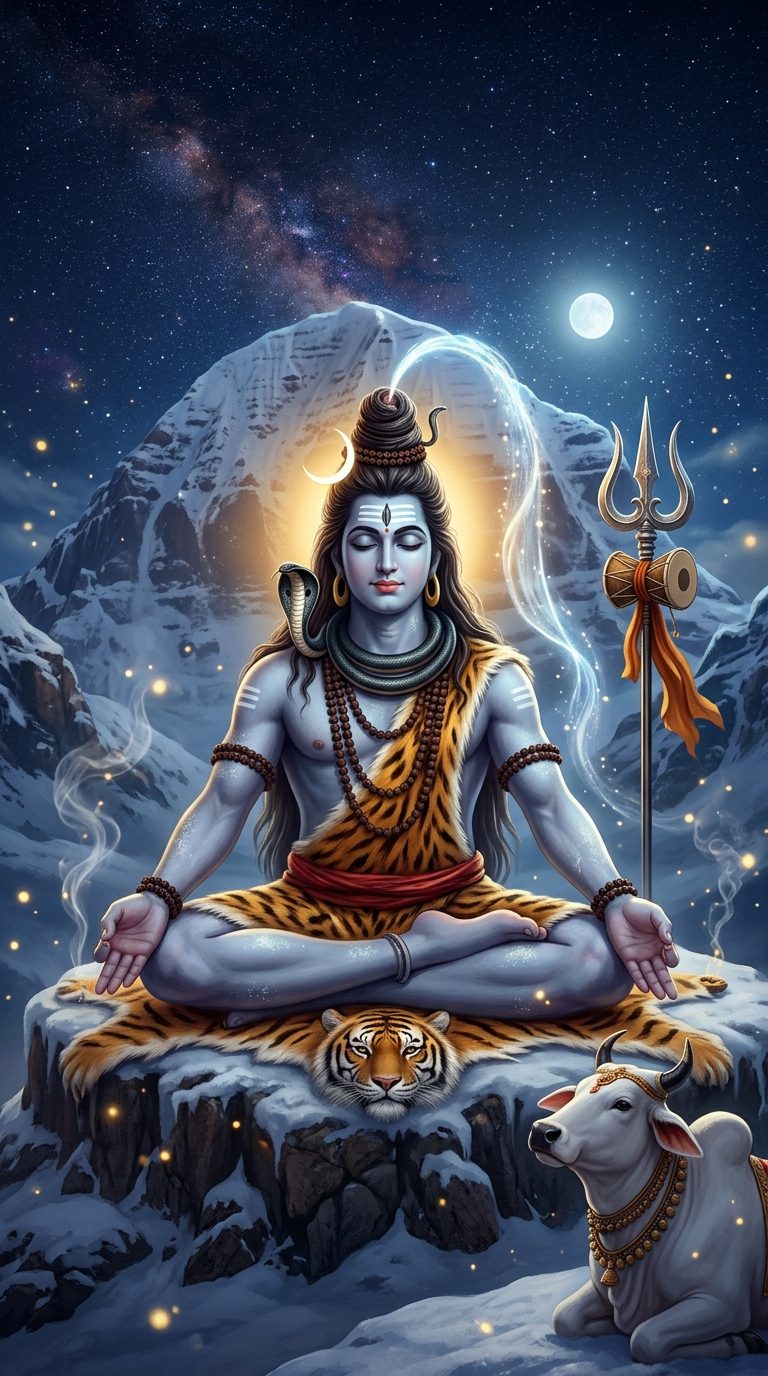
Shiva as Dakshinamurthy, the youthful silent teacher seated under a great banyan tree with his hand in the gesture of knowledge, four elderly sages before him
ShivaStotram

Dakshinamurthy Stotram

Lyrics · Meaning · Audio

Adi Shankaracharya’s profound hymn to Shiva as Dakshinamurthy, the silent teacher under the banyan tree — ten verses that teach, through vivid images, that the whole world shines within one’s own Self.

Composed by Adi Shankaracharya

Listen

Dakshinamurthy Stotram

Son of Kali · Power of Shiva

0:005:50
Deity
Shiva
Type
Stotram
Verses
10
Language
Sanskrit

Dakshinamurthy Stotram Lyrics with Meaning

Each line shows an easy way to say it, with its English meaning. Turn on the Sanskrit, the exact pronunciation or the word-by-word meaning whenever you want to go deeper.

Verse 1

विश्वं दर्पणदृश्यमाननगरीतुल्यं निजान्तर्गतं

Vishvam Darpana Drishyamana Nagari Tulyam Nijantargatam

viśvaṃ darpaṇadṛśyamānanagarītulyaṃ nijāntargataṃ

The universe, like a city seen in a mirror, exists within oneself,

    पश्यन्नात्मनि मायया बहिरिवोद्भूतं यथा निद्रया ।

    Pashyann Atmani Mayaya Bahirivodbhutam Yatha Nidraya

    paśyannātmani māyayā bahirivodbhūtaṃ yathā nidrayā

    yet through maya it seems to appear outside, as things do in a dream;

      यः साक्षात्कुरुते प्रबोधसमये स्वात्मानमेवाद्वयं

      Yah Sakshat Kurute Prabodha Samaye Svatmanam Evadvayam

      yaḥ sākṣātkurute prabodhasamaye svātmānamevādvayaṃ

      he who, at the moment of awakening, directly realises his own non-dual Self —

        तस्मै श्रीगुरुमूर्तये नम इदं श्रीदक्षिणामूर्तये ॥ १ ॥

        Tasmai Shri Guru Murtaye Nama Idam Shri Dakshinamurtaye

        tasmai śrīgurumūrtaye nama idaṃ śrīdakṣiṇāmūrtaye

        to him, the Guru in form, to blessed Dakshinamurthy, this salutation.

          Verse 2

          बीजस्यान्तरिवाङ्कुरो जगदिदं प्राङ्निर्विकल्पं पुन-

          Bijasyantarivankuro Jagadidam Pran Nirvikalpam Punar

          bījasyāntarivāṅkuro jagadidaṃ prāṅnirvikalpaṃ puna-

          Like a sprout hidden within a seed, this world at first is without any distinctions;

            र्मायाकल्पितदेशकालकलनावैचित्र्यचित्रीकृतम् ।

            Maya Kalpita Desha Kala Kalana Vaichitrya Chitrikritam

            rmāyākalpitadeśakālakalanāvaicitryacitrīkṛtam

            then, through space, time and change imagined by maya, it becomes wonderfully varied;

              मायावीव विजृम्भयत्यपि महायोगीव यः स्वेच्छया

              Mayaviva Vijrimbhayatyapi Mahayogiva Yah Svechchhaya

              māyāvīva vijṛmbhayatyapi mahāyogīva yaḥ svecchayā

              he who, like a magician or a great yogi, unfolds it all by his own will —

                तस्मै श्रीगुरुमूर्तये नम इदं श्रीदक्षिणामूर्तये ॥ २ ॥

                Tasmai Shri Guru Murtaye Nama Idam Shri Dakshinamurtaye

                tasmai śrīgurumūrtaye nama idaṃ śrīdakṣiṇāmūrtaye

                to him, the Guru in form, to blessed Dakshinamurthy, this salutation.

                  Verse 3

                  यस्यैव स्फुरणं सदात्मकमसत्कल्पार्थकं भासते

                  Yasyaiva Sphuranam Sadatmakam Asat Kalparthakam Bhasate

                  yasyaiva sphuraṇaṃ sadātmakamasatkalpārthakaṃ bhāsate

                  His shining alone, which is pure being, appears as the passing objects of the world;

                    साक्षात्तत्त्वमसीति वेदवचसा यो बोधयत्याश्रितान् ।

                    Sakshat Tattvamasiti Veda Vachasa Yo Bodhayatyashritan

                    sākṣāttattvamasīti vedavacasā yo bodhayatyāśritān

                    he awakens those who come to him with the Vedic teaching, “You are That”;

                      यत्साक्षात्करणाद्भवेन्न पुनरावृत्तिर्भवाम्भोनिधौ

                      Yat Sakshat Karanad Bhaven Na Punaravrittir Bhavambhonidhau

                      yatsākṣātkaraṇādbhavenna punarāvṛttirbhavāmbhonidhau

                      realising him, there is no more return to the ocean of birth and death —

                        तस्मै श्रीगुरुमूर्तये नम इदं श्रीदक्षिणामूर्तये ॥ ३ ॥

                        Tasmai Shri Guru Murtaye Nama Idam Shri Dakshinamurtaye

                        tasmai śrīgurumūrtaye nama idaṃ śrīdakṣiṇāmūrtaye

                        to him, the Guru in form, to blessed Dakshinamurthy, this salutation.

                          Verse 4

                          नानाच्छिद्रघटोदरस्थितमहादीपप्रभाभास्वरं

                          Nana Chhidra Ghatodara Sthita Mahadipa Prabha Bhasvaram

                          nānācchidraghaṭodarasthitamahādīpaprabhābhāsvaraṃ

                          Like the light of a great lamp inside a pot with many holes,

                            ज्ञानं यस्य तु चक्षुरादिकरणद्वारा बहिः स्पन्दते ।

                            Gyanam Yasya Tu Chakshuradi Karana Dvara Bahih Spandate

                            jñānaṃ yasya tu cakṣurādikaraṇadvārā bahiḥ spandate

                            his awareness streams outward through the eyes and the other senses;

                              जानामीति तमेव भान्तमनुभात्येतत्समस्तं जगत्

                              Janamiti Tameva Bhantam Anubhatyetat Samastam Jagat

                              jānāmīti tameva bhāntamanubhātyetatsamastaṃ jagat

                              the whole world shines only after him, the one who shines as “I know” —

                                तस्मै श्रीगुरुमूर्तये नम इदं श्रीदक्षिणामूर्तये ॥ ४ ॥

                                Tasmai Shri Guru Murtaye Nama Idam Shri Dakshinamurtaye

                                tasmai śrīgurumūrtaye nama idaṃ śrīdakṣiṇāmūrtaye

                                to him, the Guru in form, to blessed Dakshinamurthy, this salutation.

                                  Verse 5

                                  देहं प्राणमपीन्द्रियाण्यपि चलां बुद्धिं च शून्यं विदुः

                                  Deham Pranam Apindriyanyapi Chalam Buddhim Cha Shunyam Viduh

                                  dehaṃ prāṇamapīndriyāṇyapi calāṃ buddhiṃ ca śūnyaṃ viduḥ

                                  Some take the Self to be the body, the breath, the senses, the restless mind, or emptiness;

                                    स्त्रीबालान्धजडोपमास्त्वहमिति भ्रान्ता भृशं वादिनः ।

                                    Stri Balandha Jadopamas Tvahamiti Bhranta Bhrisham Vadinah

                                    strībālāndhajaḍopamāstvahamiti bhrāntā bhṛśaṃ vādinaḥ

                                    such debaters, who loudly insist “this is I,” are as confused as the inexperienced, the blind and the dull;

                                      मायाशक्तिविलासकल्पितमहाव्यामोहसंहारिणे

                                      Maya Shakti Vilasa Kalpita Maha Vyamoha Samharine

                                      māyāśaktivilāsakalpitamahāvyāmohasaṃhāriṇe

                                      he destroys the great delusion created by the play of maya’s power —

                                        तस्मै श्रीगुरुमूर्तये नम इदं श्रीदक्षिणामूर्तये ॥ ५ ॥

                                        Tasmai Shri Guru Murtaye Nama Idam Shri Dakshinamurtaye

                                        tasmai śrīgurumūrtaye nama idaṃ śrīdakṣiṇāmūrtaye

                                        to him, the Guru in form, to blessed Dakshinamurthy, this salutation.

                                          Verse 6

                                          राहुग्रस्तदिवाकरेन्दुसदृशो मायासमाच्छादनात्

                                          Rahugrasta Divakarendu Sadrisho Maya Samachchhadanat

                                          rāhugrastadivākarendusadṛśo māyāsamācchādanāt

                                          Like the sun or moon swallowed by Rahu in an eclipse, covered over by maya,

                                            सन्मात्रः करणोपसंहरणतो योऽभूत्सुषुप्तः पुमान् ।

                                            Sanmatrah Karanopasamharanato Yo Bhut Sushuptah Puman

                                            sanmātraḥ karaṇopasaṃharaṇato yo'bhūtsuṣuptaḥ pumān

                                            the person in deep sleep, senses withdrawn, remains as pure being alone;

                                              प्रागस्वाप्समिति प्रबोधसमये यः प्रत्यभिज्ञायते

                                              Prag Asvapsam Iti Prabodha Samaye Yah Pratyabhigyayate

                                              prāgasvāpsamiti prabodhasamaye yaḥ pratyabhijñāyate

                                              on waking he recognises, “I was asleep” — he who is that witness —

                                                तस्मै श्रीगुरुमूर्तये नम इदं श्रीदक्षिणामूर्तये ॥ ६ ॥

                                                Tasmai Shri Guru Murtaye Nama Idam Shri Dakshinamurtaye

                                                tasmai śrīgurumūrtaye nama idaṃ śrīdakṣiṇāmūrtaye

                                                to him, the Guru in form, to blessed Dakshinamurthy, this salutation.

                                                  Verse 7

                                                  बाल्यादिष्वपि जाग्रदादिषु तथा सर्वास्ववस्थास्वपि

                                                  Balyadishvapi Jagradadishu Tatha Sarvasvavasthasvapi

                                                  bālyādiṣvapi jāgradādiṣu tathā sarvāsvavasthāsvapi

                                                  Through childhood and every stage of life, through waking, dream and sleep, through every state,

                                                    व्यावृत्तास्वनुवर्तमानमहमित्यन्तः स्फुरन्तं सदा ।

                                                    Vyavrittasvanuvartamanam Ahamityantah Sphurantam Sada

                                                    vyāvṛttāsvanuvartamānamahamityantaḥ sphurantaṃ sadā

                                                    the one that continues unchanged while they come and go, shining always within as “I” —

                                                      स्वात्मानं प्रकटीकरोति भजतां यो मुद्रया भद्रया

                                                      Svatmanam Prakatikaroti Bhajatam Yo Mudraya Bhadraya

                                                      svātmānaṃ prakaṭīkaroti bhajatāṃ yo mudrayā bhadrayā

                                                      he reveals that Self to his devotees through the auspicious gesture of knowledge —

                                                        तस्मै श्रीगुरुमूर्तये नम इदं श्रीदक्षिणामूर्तये ॥ ७ ॥

                                                        Tasmai Shri Guru Murtaye Nama Idam Shri Dakshinamurtaye

                                                        tasmai śrīgurumūrtaye nama idaṃ śrīdakṣiṇāmūrtaye

                                                        to him, the Guru in form, to blessed Dakshinamurthy, this salutation.

                                                          Verse 8

                                                          विश्वं पश्यति कार्यकारणतया स्वस्वामिसम्बन्धतः

                                                          Vishvam Pashyati Karya Karanataya Sva Svami Sambandhatah

                                                          viśvaṃ paśyati kāryakāraṇatayā svasvāmisambandhataḥ

                                                          One who sees the world as cause and effect, as owner and owned,

                                                            शिष्याचार्यतया तथैव पितृपुत्राद्यात्मना भेदतः ।

                                                            Shishyacharyataya Tathaiva Pitri Putradyatmana Bhedatah

                                                            śiṣyācāryatayā tathaiva pitṛputrādyātmanā bhedataḥ

                                                            as student and teacher, as father and son — as a world of separate things —

                                                              स्वप्ने जाग्रति वा य एष पुरुषो मायापरिभ्रामितः

                                                              Svapne Jagrati Va Ya Esha Purusho Maya Paribhramitah

                                                              svapne jāgrati vā ya eṣa puruṣo māyāparibhrāmitaḥ

                                                              in dream or in waking, is that very Self, whirled around by maya —

                                                                तस्मै श्रीगुरुमूर्तये नम इदं श्रीदक्षिणामूर्तये ॥ ८ ॥

                                                                Tasmai Shri Guru Murtaye Nama Idam Shri Dakshinamurtaye

                                                                tasmai śrīgurumūrtaye nama idaṃ śrīdakṣiṇāmūrtaye

                                                                to him, the Guru in form, to blessed Dakshinamurthy, this salutation.

                                                                  Verse 9

                                                                  भूरम्भांस्यनलोऽनिलोऽम्बरमहर्नाथो हिमांशुः पुमान्

                                                                  Bhur Ambhamsy Analo Nilo Mbaram Aharnatho Himamshuh Puman

                                                                  bhūrambhāṃsyanalo'nilo'mbaramaharnātho himāṃśuḥ pumān

                                                                  Earth, water, fire, air, space, the sun, the moon and the individual soul —

                                                                    इत्याभाति चराचरात्मकमिदं यस्यैव मूर्त्यष्टकम् ।

                                                                    Ityabhati Characharatmakam Idam Yasyaiva Murtyashtakam

                                                                    ityābhāti carācarātmakamidaṃ yasyaiva mūrtyaṣṭakam

                                                                    this whole moving and unmoving world shines as his eightfold form alone;

                                                                      नान्यत्किञ्चन विद्यते विमृशतां यस्मात्परस्माद्विभो-

                                                                      Nanyat Kinchana Vidyate Vimrishatam Yasmat Parasmad Vibhos

                                                                      nānyatkiñcana vidyate vimṛśatāṃ yasmātparasmādvibho-

                                                                      for those who truly reflect, nothing at all exists apart from that supreme, all-pervading Lord —

                                                                        स्तस्मै श्रीगुरुमूर्तये नम इदं श्रीदक्षिणामूर्तये ॥ ९ ॥

                                                                        Tasmai Shri Guru Murtaye Nama Idam Shri Dakshinamurtaye

                                                                        stasmai śrīgurumūrtaye nama idaṃ śrīdakṣiṇāmūrtaye

                                                                        to him, the Guru in form, to blessed Dakshinamurthy, this salutation.

                                                                          Closing verse (Phala Shruti)

                                                                          सर्वात्मत्वमिति स्फुटीकृतमिदं यस्मादमुष्मिन् स्तवे

                                                                          Sarvatmatvam Iti Sphutikritam Idam Yasmad Amushmin Stave

                                                                          sarvātmatvamiti sphuṭīkṛtamidaṃ yasmādamuṣmin stave

                                                                          Because this hymn makes clear that the Self is the Self of all,

                                                                            तेनास्य श्रवणात्तदर्थमननाद्ध्यानाच्च सङ्कीर्तनात् ।

                                                                            Tenasya Shravanat Tadartha Mananad Dhyanach Cha Sankirtanat

                                                                            tenāsya śravaṇāttadarthamananāddhyānācca saṅkīrtanāt

                                                                            by hearing it, reflecting on its meaning, meditating on it and singing it,

                                                                              सर्वात्मत्वमहाविभूतिसहितं स्यादीश्वरत्वं स्वतः

                                                                              Sarvatmatva Maha Vibhuti Sahitam Syad Ishvaratvam Svatah

                                                                              sarvātmatvamahāvibhūtisahitaṃ syādīśvaratvaṃ svataḥ

                                                                              one naturally attains lordship, together with the great glory of being the Self of all,

                                                                                सिद्ध्येत्तत्पुनरष्टधा परिणतं चैश्वर्यमव्याहतम् ॥ १० ॥

                                                                                Siddhyet Tat Punar Ashtadha Parinatam Chaishvaryam Avyahatam

                                                                                siddhyettatpunaraṣṭadhā pariṇataṃ caiśvaryamavyāhatam

                                                                                and the unobstructed eightfold divine power is accomplished as well.

                                                                                  About Dakshinamurthy Stotram

                                                                                  Dakshinamurthy is Shiva as the supreme teacher (guru). He is pictured as a radiant youth seated under a banyan tree, facing south (dakṣiṇa), surrounded by elderly sages. He teaches them in complete silence — and through that silence their doubts dissolve. His right hand forms the cin-mudrā, thumb and index finger touching: the individual self united with the infinite.

                                                                                  This stotram by Adi Shankaracharya is one of the great texts of Advaita Vedanta, condensed into ten verses. Each uses a striking image — a city reflected in a mirror, a sprout inside a seed, a lamp shining through the holes of a pot, the sun hidden by an eclipse — to show that the world appears within consciousness, and that this consciousness is one’s own Self.

                                                                                  Every verse ends with the same salutation: tasmai śrī-gurumūrtaye nama idaṃ śrī-dakṣiṇāmūrtaye — “to him who is the Guru in form, to the blessed Dakshinamurthy, this salutation.” It is chanted by students of Vedanta, on Guru Purnima and on Thursdays, the day of the teacher.

                                                                                  The Stories Inside the Hymn

                                                                                  The silent teaching

                                                                                  The four sons of Brahma — Sanaka, Sanandana, Sanatana and Sanatkumara — were great scholars but still troubled by doubt. They came to Shiva, who sat before them in perfect silence under a banyan tree.

                                                                                  In that silence every question fell away. A famous verse says: “See the wonder — under the banyan tree the disciples are old and the guru is young; the teaching is silence, yet the disciples’ doubts are all destroyed.”

                                                                                  The mirror and the city

                                                                                  The first verse says the world is like a city seen in a mirror: it seems to be outside, but it is really appearing within the mirror. In the same way the world seems to be outside us, but it appears in consciousness, as in a dream.

                                                                                  When you wake up from a dream you realise it was all within you. The stotram says that true awakening is like that — recognising that the one Self was always the ground of everything.

                                                                                  How to Chant Dakshinamurthy Stotram

                                                                                  When to chant

                                                                                  • ✦Thursdays, the day of the guru
                                                                                  • ✦Guru Purnima
                                                                                  • ✦Before studying philosophy or scripture
                                                                                  • ✦Before meditation

                                                                                  How many times

                                                                                  Once through, slowly and thoughtfully.

                                                                                  1. 1

                                                                                    Read the meaning of each verse first — this hymn is a teaching.

                                                                                  2. 2

                                                                                    Sit in silence for a minute, like the sages before Dakshinamurthy.

                                                                                  3. 3

                                                                                    Chant with the recording, joining on the refrain at the end of each verse.

                                                                                  4. 4

                                                                                    After each verse, pause and reflect on its image.

                                                                                  5. 5

                                                                                    End by resting in silence.

                                                                                  Pronunciation Guide

                                                                                  The sounds that trip people up most in this hymn, and how to say them.

                                                                                  dakṣiṇāmūrtaye

                                                                                  duk-shi-naa-moor-ta-yay — “to the south-facing one.”

                                                                                  gurumūrtaye

                                                                                  gu-ru-moor-ta-yay — “to the guru in form.”

                                                                                  nama idaṃ

                                                                                  na-ma i-dum — “this salutation.”

                                                                                  tattvamasi

                                                                                  tut-tva-ma-si — “That thou art.”

                                                                                  Power of Shiva by Son of Kali

                                                                                  The music

                                                                                  Power of Shiva

                                                                                  by Son of Kali

                                                                                  More for Shiva

                                                                                  Frequently Asked Questions

                                                                                  Who is Dakshinamurthy?

                                                                                  Dakshinamurthy is Shiva as the supreme teacher, seated under a banyan tree facing south, teaching the sages through silence.

                                                                                  Who wrote the Dakshinamurthy Stotram?

                                                                                  It was composed by Adi Shankaracharya, the great teacher of Advaita Vedanta.

                                                                                  What is the Dakshinamurthy Stotram about?

                                                                                  It teaches, through vivid images, that the world appears within consciousness and that this consciousness is one’s own true Self — the core of Advaita Vedanta.

                                                                                  When should it be chanted?

                                                                                  On Thursdays (the day of the guru), on Guru Purnima, and before study or meditation.

                                                                                  Text: Dakshinamurthy Stotram by Adi Shankaracharya — public domain (Sanskrit Wikisource), with typographical errors corrected. Easy reading, transliteration and English translation written for the Jaguar Medicine Tribe Mantra Library.

                                                                                  Music: Recordings by Son of Kali, produced with AI-assisted vocals and instrumentation.

                                                                                  Note: Benefits described here are traditional beliefs, shared for understanding — not medical or guaranteed outcomes.