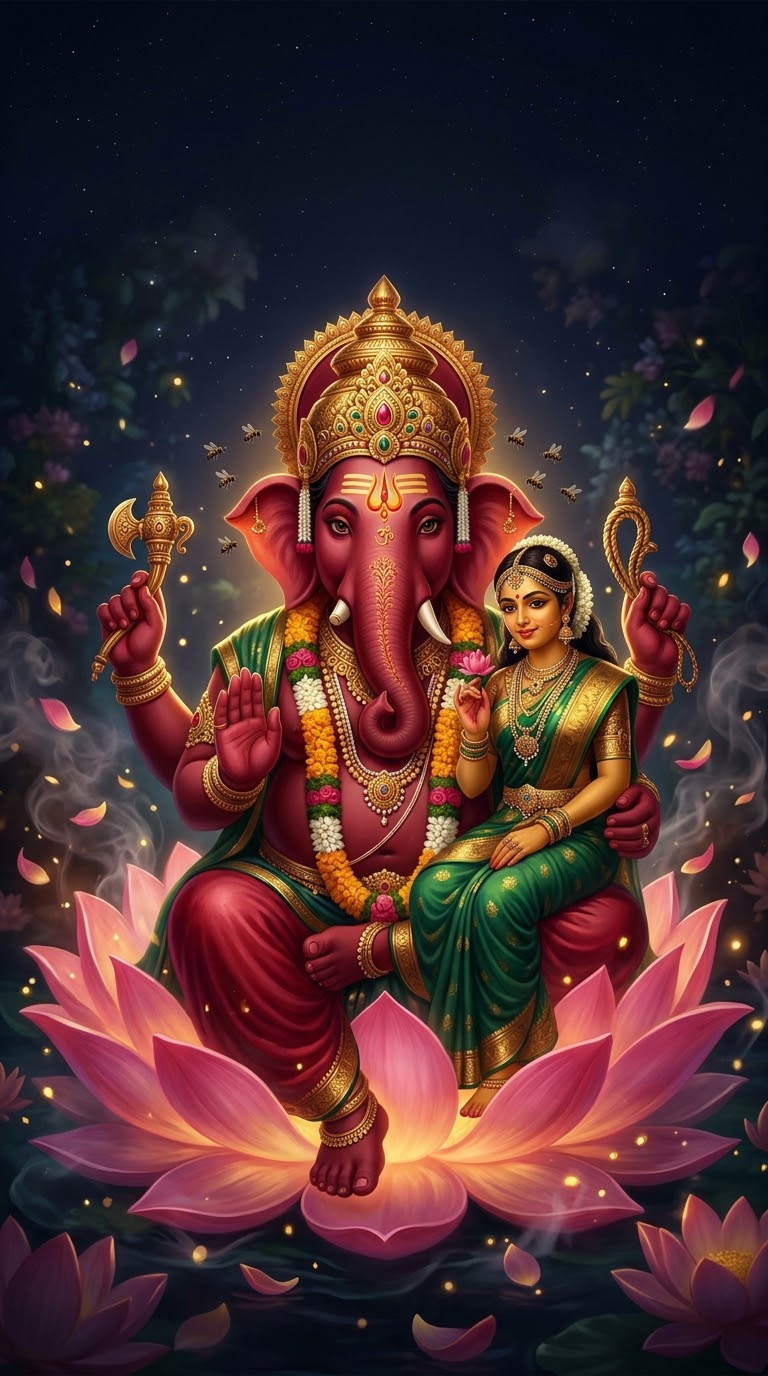
Ucchishta Ganapati, deep red and four-armed, seated on a lotus with his Shakti beside him, bees circling his temples in golden light

Ganesha · Stotram

Ucchishta Ganapati Stotram

Lyrics · Meaning · Audio

Twenty verses to Ucchishta Ganapati, the tantric form of Ganesha. After describing his form and taking refuge in him, the hymn retells his childhood play: tugging at Shiva’s moon, racing his brother Skanda, fanning bees away with his ears. It ends with a promise of freedom from poverty.

Traditional (tantric Ganapatya tradition)

Listen

Ucchishta Ganapati Stotram

Son of Kali · Power of Ganesha

0:004:40
Deity
Ganesha
Type
Stotram
Verses
20
Language
Sanskrit

Ucchishta Ganapati Stotram Lyrics with Meaning

Each line shows an easy way to say it, with its English meaning. Turn on the Sanskrit, the exact pronunciation or the word-by-word meaning whenever you want to go deeper.

Verse 1

नमामि देवं सकलार्थदं तं

Namami Devam Sakalarthadam Tam

namāmi devaṃ sakalārthadaṃ taṃ

I bow to that god who grants every aim,

    सुवर्णवर्णं भुजगोपवीतम् ।

    Suvarnavarnam Bhujagopavitam

    suvarṇavarṇaṃ bhujagopavītam

    golden in colour, with a serpent for his sacred thread,

      गजाननं भास्करमेकदन्तं

      Gajananam Bhaskaramekadantam

      gajānanaṃ bhāskaramekadantaṃ

      elephant-faced, shining like the sun, single-tusked,

        लम्बोदरं वारिभवासनं च ॥ १ ॥

        Lambodaram Varibhavasanam Cha

        lambodaraṃ vāribhavāsanaṃ ca

        big-bellied and seated on a lotus.

          Verse 2

          केयूरिणं हारकिरीटजुष्टं

          Keyurinam Harakiritajushtam

          keyūriṇaṃ hārakirīṭajuṣṭaṃ

          He wears armlets and is adorned with necklace and crown;

            चतुर्भुजं पाशवराभयानि ।

            Chaturbhujam Pashavarabhayani

            caturbhujaṃ pāśavarābhayāni

            four-armed, he holds the noose and shows the gestures of blessing and fearlessness,

              सृणिं च हस्तं गणपं त्रिनेत्रं

              Srinim Cha Hastam Ganapam Trinetram

              sṛṇiṃ ca hastaṃ gaṇapaṃ trinetraṃ

              with the elephant goad in his hand: the three-eyed lord of the Ganas,

                सचामरस्त्रीयुगलेन युक्तम् ॥ २ ॥

                Sachamarastriyugalena Yuktam

                sacāmarastrīyugalena yuktam

                attended by two women waving fly-whisks.

                  Verse 3

                  षडक्षरात्मानमनल्पभूषं

                  Shadaksharatmanamanalpabhusham

                  ṣaḍakṣarātmānamanalpabhūṣaṃ

                  His very self is the six-syllable mantra; richly adorned,

                    मुनीश्वरैर्भार्गवपूर्वकैश्च ।

                    Munishvarairbhargavapurvakaishcha

                    munīśvarairbhārgavapūrvakaiśca

                    he is served by the great sages, Bhargava first among them:

                      संसेवितं देवमनाथकल्पं

                      Samsevitam Devamanathakalpam

                      saṃsevitaṃ devamanāthakalpaṃ

                      that god, a wish-fulfilling tree for the helpless,

                        रूपं मनोज्ञं शरणं प्रपद्ये ॥ ३ ॥

                        Rupam Manojnam Sharanam Prapadye

                        rūpaṃ manojñaṃ śaraṇaṃ prapadye

                        that lovely form: in him I take refuge.

                          Verse 4

                          वेदान्तवेद्यं जगतामधीशं

                          Vedantavedyam Jagatamadhisham

                          vedāntavedyaṃ jagatāmadhīśaṃ

                          Known through the Vedanta, lord of the worlds,

                            देवादिवन्द्यं सुकृतैकगम्यम् ।

                            Devadivandyam Sukritaikagamyam

                            devādivandyaṃ sukṛtaikagamyam

                            worshipped by the gods and all beings, reached only through good deeds,

                              स्तम्बेरमास्यं ननु चन्द्रचूडं

                              Stamberamasyam Nanu Chandrachudam

                              stamberamāsyaṃ nanu candracūḍaṃ

                              elephant-faced and crowned with the moon:

                                विनायकं तं शरणं प्रपद्ये ॥ ४ ॥

                                Vinayakam Tam Sharanam Prapadye

                                vināyakaṃ taṃ śaraṇaṃ prapadye

                                in that Vinayaka I take refuge.

                                  Verse 5

                                  भवाख्यदावानलदह्यमानं

                                  Bhavakhyadavanaladahyamanam

                                  bhavākhyadāvānaladahyamānaṃ

                                  When his devotee is burning in the forest fire called worldly life,

                                    भक्तं स्वकीयं परिषिञ्चते यः ।

                                    Bhaktam Svakiyam Parishinchate Yah

                                    bhaktaṃ svakīyaṃ pariṣiñcate yaḥ

                                    he sprinkles his own devotee, cooling him,

                                      गण्डस्रुताम्भोभिरनन्यतुल्यं

                                      Gandasrutambhobhirananyatulyam

                                      gaṇḍasrutāmbhobhirananyatulyaṃ

                                      with the matchless waters that flow from his temples.

                                        वन्दे गणेशं च तमोऽरिनेत्रम् ॥ ५ ॥

                                        Vande Ganesham Cha Tamorinetram

                                        vande gaṇeśaṃ ca tamo'rinetram

                                        I worship Ganesha, whose eyes are the foes of darkness, the sun and moon.

                                          Verse 6

                                          शिवस्य मौलाववलोक्य चन्द्रं

                                          Shivasya Maulavavalokya Chandram

                                          śivasya maulāvavalokya candraṃ

                                          Seeing the crescent moon on Shiva’s head,

                                            सुशुण्डया मुग्धतया स्वकीयम् ।

                                            Sushundaya Mugdhataya Svakiyam

                                            suśuṇḍayā mugdhatayā svakīyam

                                            in childlike innocence, with his fine trunk,

                                              भग्नं विषाणं परिभाव्य चित्ते

                                              Bhagnam Vishanam Paribhavya Chitte

                                              bhagnaṃ viṣāṇaṃ paribhāvya citte

                                              thinking in his heart it was his own broken tusk,

                                                आकृष्टचन्द्रो गणपोऽवतान्नः ॥ ६ ॥

                                                Akrishtachandro Ganapovatannah

                                                ākṛṣṭacandro gaṇapo'vatānnaḥ

                                                he tugged at the moon. May that Ganapati protect us.

                                                  Verse 7

                                                  पितुर्जटाजूटतटे सदैव

                                                  Piturjatajutatate Sadaiva

                                                  piturjaṭājūṭataṭe sadaiva

                                                  On the shore of his father’s matted locks,

                                                    भागीरथी तत्र कुतूहलेन ।

                                                    Bhagirathi Tatra Kutuhalena

                                                    bhāgīrathī tatra kutūhalena

                                                    where the Ganga flows, he wanted, out of curiosity,

                                                      विहर्तुकामः स महीध्रपुत्र्या

                                                      Vihartukamah Sa Mahidhraputrya

                                                      vihartukāmaḥ sa mahīdhraputryā

                                                      to go and play, and was stopped by the Mountain’s daughter, his mother.

                                                        निवारितः पातु सदा गजास्यः ॥ ७ ॥

                                                        Nivaritah Patu Sada Gajasyah

                                                        nivāritaḥ pātu sadā gajāsyaḥ

                                                        May that elephant-faced one always protect us.

                                                          Verse 8

                                                          लम्बोदरो देवकुमारसङ्घैः

                                                          Lambodaro Devakumarasanghaih

                                                          lambodaro devakumārasaṅghaiḥ

                                                          Big-bellied Ganesha, playing with a band of divine children,

                                                            क्रीडन्कुमारं जितवान्निजेन ।

                                                            Kridankumaram Jitavannijena

                                                            krīḍankumāraṃ jitavānnijena

                                                            beat his brother Kumara at their game by his own skill,

                                                              करेण चोत्तोल्य ननर्त रम्यं

                                                              Karena Chottolya Nanarta Ramyam

                                                              kareṇa cottolya nanarta ramyaṃ

                                                              then lifted him up with his trunk and danced for joy.

                                                                दन्तावलास्यो भयतः स पायात् ॥ ८ ॥

                                                                Dantavalasyo Bhayatah Sa Payat

                                                                dantāvalāsyo bhayataḥ sa pāyāt

                                                                May that elephant-faced one protect us from fear.

                                                                  Verse 9

                                                                  आगत्य योच्चैर्हरिनाभिपद्मं

                                                                  Agatya Yochchairharinabhipadmam

                                                                  āgatya yoccairharinābhipadmaṃ

                                                                  Coming close, he saw the tall lotus rising from Vishnu’s navel,

                                                                    ददर्श तत्राशु करेण तच्च ।

                                                                    Dadarsha Tatrashu Karena Tachcha

                                                                    dadarśa tatrāśu kareṇa tacca

                                                                    and quickly reached for it with his trunk,

                                                                      उद्धर्तुमिच्छन्विधिवादवाक्यं

                                                                      Uddhartumichchhanvidhivadavakyam

                                                                      uddhartumicchanvidhivādavākyaṃ

                                                                      wanting to pluck it out; but hearing Brahma’s words of protest,

                                                                        मुमोच भूत्वा चतुरो गणेशः ॥ ९ ॥

                                                                        Mumocha Bhutva Chaturo Ganeshah

                                                                        mumoca bhūtvā caturo gaṇeśaḥ

                                                                        wise Ganesha let it go.

                                                                          Verse 10

                                                                          निरन्तरं संस्कृतदानपट्टे

                                                                          Nirantaram Samskritadanapatte

                                                                          nirantaraṃ saṃskṛtadānapaṭṭe

                                                                          On the fragrant stream that flows from his temples,

                                                                            लग्नां तु गुञ्जद्भ्रमरावलीं वै ।

                                                                            Lagnam Tu Gunjadbhramaravalim Vai

                                                                            lagnāṃ tu guñjadbhramarāvalīṃ vai

                                                                            a humming line of bees settles again and again,

                                                                              तं श्रोत्रतालैरपसारयन्तं

                                                                              Tam Shrotratalairapasarayantam

                                                                              taṃ śrotratālairapasārayantaṃ

                                                                              and he fans them away with the flapping of his ears.

                                                                                स्मरेद्गजास्यं निजहृत्सरोजे ॥ १० ॥

                                                                                Smaredgajasyam Nijahritsaroje

                                                                                smaredgajāsyaṃ nijahṛtsaroje

                                                                                Remember that elephant-faced one in the lotus of your heart.

                                                                                  About Ucchishta Ganapati Stotram

                                                                                  Ucchishta Ganapati is one of the tantric forms of Ganesha. Ucchishta means “leftover”, as of food: unlike most worship, his practice may be done without the usual rules of ritual purity, even with food in the mouth. He is shown four-armed, often red, with his Shakti at his side.

                                                                                  The first five verses describe his form: golden, elephant-faced, single-tusked, holding noose and goad, with the six-syllable mantra as his very self. The middle verses are full of tender, playful stories: baby Ganesha pulls at the moon on Shiva’s head thinking it is his broken tusk, wants to play in the Ganga in his father’s hair, beats Skanda at a game and dances with him, and fans away the bees drawn to his temples.

                                                                                  Later verses honour him as the scribe who wrote down Vyasa’s Mahabharata with his own tusk, as the source of speech, and as the highest form of Shiva himself. The last verse promises Lakshmi’s constant presence and the end of poverty.

                                                                                  The Stories Inside the Hymn

                                                                                  The scribe of the Mahabharata

                                                                                  When the sage Vyasa wanted to set down the Mahabharata, he asked Ganesha to be his scribe. Ganesha agreed on one condition: that Vyasa never pause in his dictation.

                                                                                  By some accounts Ganesha broke off his own tusk to use as a pen when his stylus failed. Verse 17 of this hymn remembers that tusk, “ancient and auspicious”, which wrote down the whole epic.

                                                                                  How to Chant Ucchishta Ganapati Stotram

                                                                                  When to chant

                                                                                  • ✦Wednesdays
                                                                                  • ✦Sankashti Chaturthi
                                                                                  • ✦Before new ventures or in times of money trouble

                                                                                  How many times

                                                                                  Once a day, or 21 times on Chaturthi.

                                                                                  1. 1

                                                                                    Offer a red flower or a sweet before an image of Ganesha.

                                                                                  2. 2

                                                                                    Recite the opening verses slowly as a meditation on his form.

                                                                                  3. 3

                                                                                    Enjoy the stories in the middle verses, then end with the promise of the last verse.

                                                                                  Pronunciation Guide

                                                                                  The sounds that trip people up most in this hymn, and how to say them.

                                                                                  ucchiṣṭa

                                                                                  uch-chish-ta: “leftover”, the name of this tantric form.

                                                                                  gajāsyaḥ

                                                                                  ga-jaas-yah: “elephant-faced”.

                                                                                  śaraṇaṃ prapadye

                                                                                  sha-ra-nam pra-pad-yay: “I take refuge”.

                                                                                  Power of Ganesha by Son of Kali

                                                                                  The music

                                                                                  Power of Ganesha

                                                                                  by Son of Kali

                                                                                  More for Ganesha

                                                                                  Frequently Asked Questions

                                                                                  Who is Ucchishta Ganapati?

                                                                                  A tantric form of Ganesha, usually red and four-armed with his Shakti beside him. His name means “Ganapati of the leftover”, because his worship may be done without the usual rules of ritual purity.

                                                                                  What are the benefits of the Ucchishta Ganapati Stotram?

                                                                                  Its last verse says that whoever recites it with devotion and a pure heart is served constantly by Lakshmi, and asks Ganesha to tear apart all poverty.

                                                                                  Which stories does it tell?

                                                                                  Ganesha’s childhood play with Shiva’s moon and the Ganga, his game with Skanda, the lotus at Vishnu’s navel, his fanning away bees, and his writing down the Mahabharata with his tusk.

                                                                                  What is the six-syllable mantra mentioned in verse 3?

                                                                                  Ganesha is described as having a six-syllable mantra as his very self. Tradition passes on the exact mantra through initiation, so it is not given here.

                                                                                  Text: Traditional Sanskrit hymn (public domain), following the text as sung on the recording. Easy reading and English translation written for the Jaguar Medicine Tribe Mantra Library.

                                                                                  Music: Recordings by Son of Kali, produced with AI-assisted vocals and instrumentation.

                                                                                  Note: Benefits described here are traditional beliefs, shared for understanding — not medical or guaranteed outcomes.