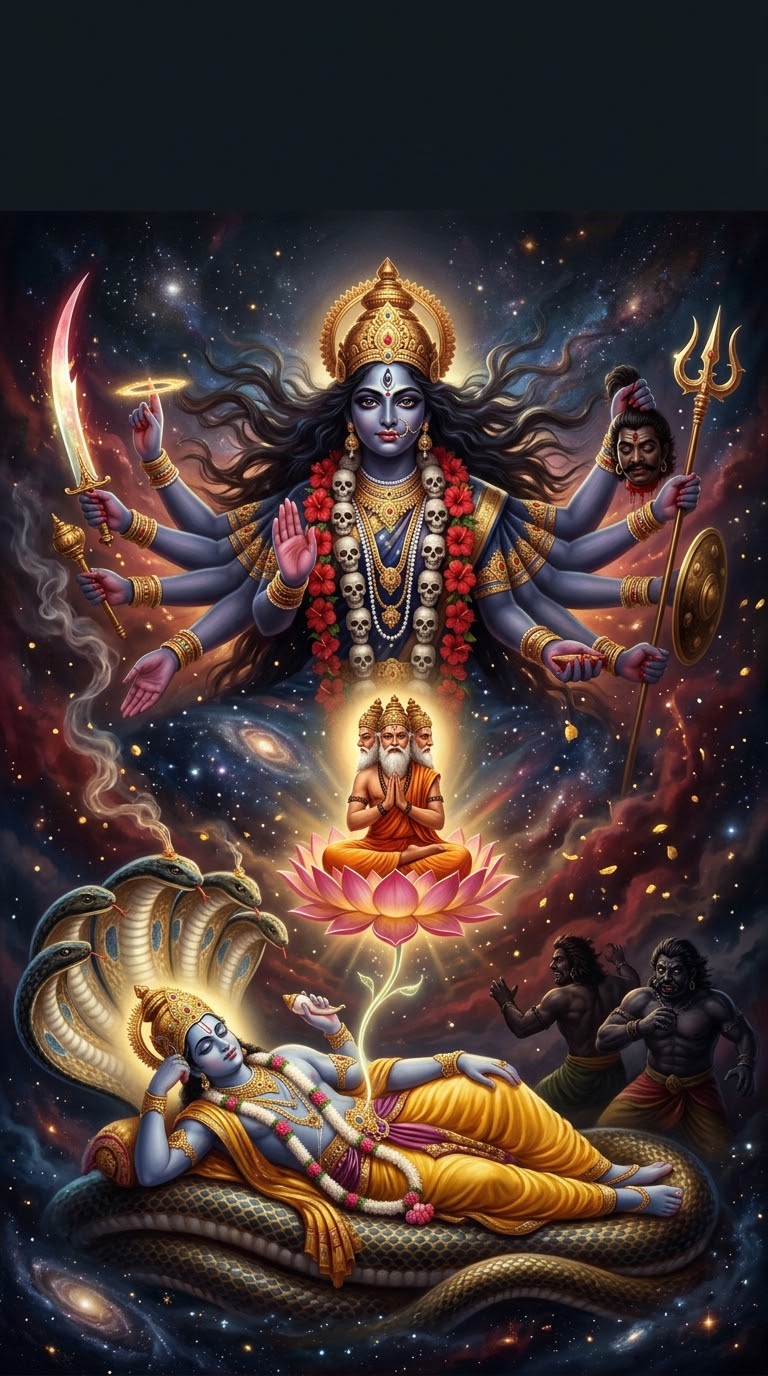
Mahakali, dark and vast, rising from the cosmic ocean over the sleeping Vishnu, Brahma on a lotus praising her with folded hands

Kali · Stotram

Shri Mahakali Stotram (Brahma’s Hymn)

Lyrics · Meaning · Audio

Two meditation verses on Kali’s fierce form, followed by Brahma’s great hymn from the first chapter of the Devi Mahatmya. Trapped by two demons, Brahma praises the Goddess as Mahakali, the power behind all creation, preservation and dissolution, and the Sleep that holds even Vishnu.

From the Devi Mahatmya (Markandeya Purana), chapter 1

Listen

Shri Mahakali Stotram (Brahma’s Hymn)

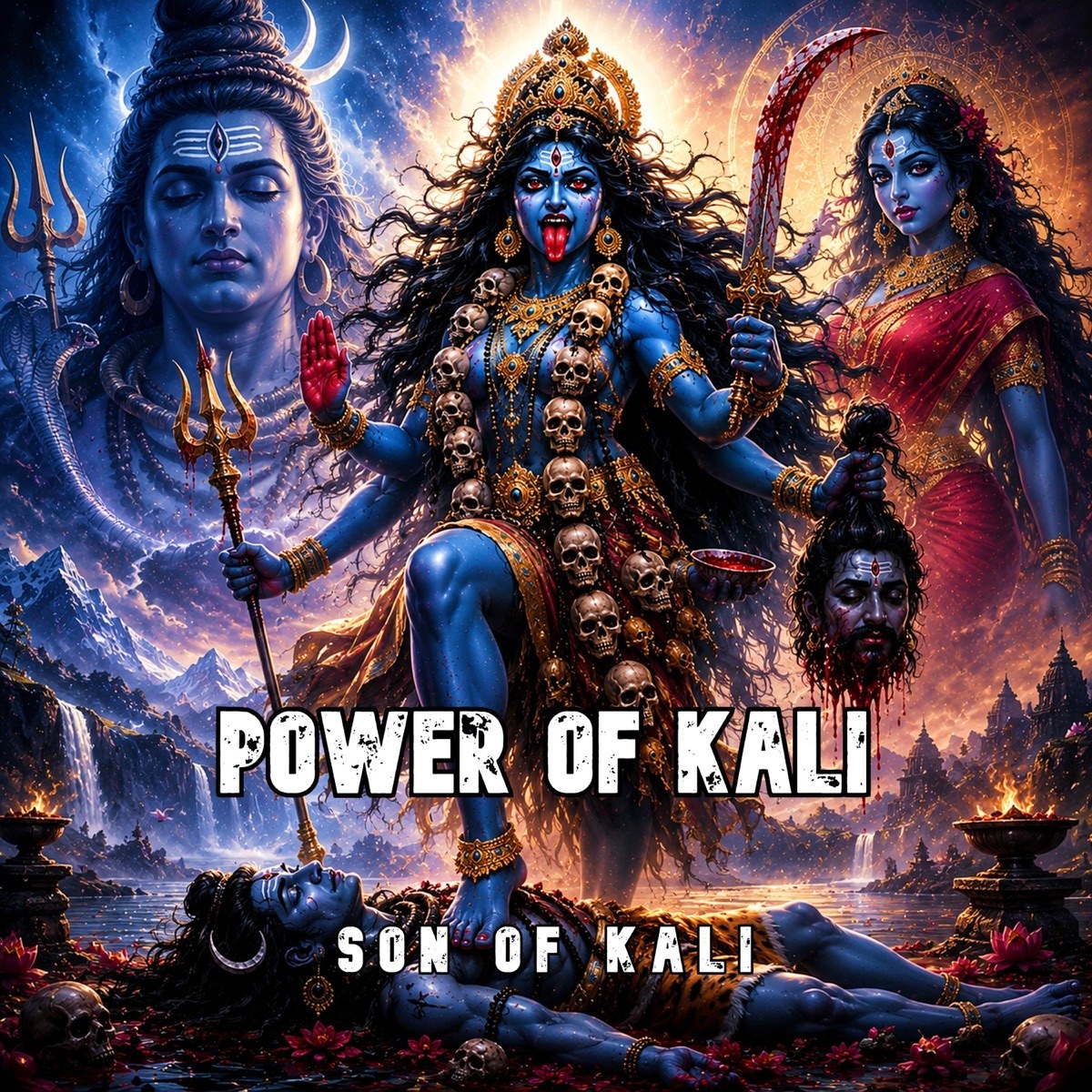
Son of Kali · Power of Kali

0:007:29
Deity
Kali
Type
Stotram
Verses
17
Language
Sanskrit

Shri Mahakali Stotram (Brahma’s Hymn) Lyrics with Meaning

Each line shows an easy way to say it, with its English meaning. Turn on the Sanskrit, the exact pronunciation or the word-by-word meaning whenever you want to go deeper.

Dhyanam 1 — Meditation on Kali

शवारूढां महाभीमां घोरदंष्ट्रां वरप्रदां

Shavarudham Mahabhimam Ghoradamshtram Varapradam

śavārūḍhāṃ mahābhīmāṃ ghoradaṃṣṭrāṃ varapradāṃ

Riding on a corpse, terrifying, with fearsome fangs, yet the giver of boons,

    हास्ययुक्तां त्रिणेत्राञ्च कपाल कर्त्रिका कराम् ।

    Hasyayuktam Trinetrancha Kapala Kartrika Karam

    hāsyayuktāṃ triṇetrāñca kapāla kartrikā karām

    laughing, three-eyed, holding a skull-cup and a cleaver,

      मुक्तकेशीं ललज्जिह्वां पिबन्तीं रुधिरं मुहुः

      Muktakeshim Lalajjihvam Pibantim Rudhiram Muhuh

      muktakeśīṃ lalajjihvāṃ pibantīṃ rudhiraṃ muhuḥ

      her hair loose, her tongue lolling, drinking blood again and again,

        चतुर्बाहुयुतां देवीं वराभयकरां स्मरेत् ॥

        Chaturbahuyutam Devim Varabhayakaram Smaret

        caturbāhuyutāṃ devīṃ varābhayakarāṃ smaret

        four-armed, her hands granting boons and fearlessness: so one should remember the Goddess.

          Dhyanam 2 — Meditation on Kali

          शवारूढां महाभीमां घोरदंष्ट्रां हसन्मुखीं

          Shavarudham Mahabhimam Ghoradamshtram Hasanmukhim

          śavārūḍhāṃ mahābhīmāṃ ghoradaṃṣṭrāṃ hasanmukhīṃ

          Riding on a corpse, terrifying, fearsome-fanged, with a smiling face,

            चतुर्भुजां खड्गमुण्डवराभयकरां शिवाम् ।

            Chaturbhujam Khadgamundavarabhayakaram Shivam

            caturbhujāṃ khaḍgamuṇḍavarābhayakarāṃ śivām

            four-armed, holding sword and severed head, granting boons and fearlessness, the auspicious one,

              मुण्डमालाधरां देवीं ललज्जिह्वां दिगम्बरां

              Mundamaladharam Devim Lalajjihvam Digambaram

              muṇḍamālādharāṃ devīṃ lalajjihvāṃ digambarāṃ

              wearing a garland of heads, tongue lolling, clothed only in space:

                एवं सञ्चिन्तयेत्कालीं श्मशानालयवासिनीम् ॥

                Evam Sanchintayetkalim Shmashanalayavasinim

                evaṃ sañcintayetkālīṃ śmaśānālayavāsinīm

                so one should meditate on Kali, who dwells in the cremation ground.

                  Verse 1 — Brahma’s hymn begins

                  विश्वेश्वरीं जगद्धात्रीं स्थितिसंहारकारिणीम् ।

                  Vishveshvarim Jagaddhatrim Sthitisamharakarinim

                  viśveśvarīṃ jagaddhātrīṃ sthitisaṃhārakāriṇīm

                  The Queen of the universe, who holds up the world, cause of its keeping and its ending,

                    निद्रां भगवतीं विष्णोरतुलां तेजसः प्रभाम् ॥ १ ॥

                    Nidram Bhagavatim Vishnoratulam Tejasah Prabham

                    nidrāṃ bhagavatīṃ viṣṇoratulāṃ tejasaḥ prabhām

                    the blessed Goddess of Sleep who holds Vishnu, the matchless splendour of light:

                      Verse 2

                      त्वं स्वाहा त्वं स्वधा त्वं हि वषट्कारः स्वरात्मिका ।

                      Tvam Svaha Tvam Svadha Tvam Hi Vashatkarah Svaratmika

                      tvaṃ svāhā tvaṃ svadhā tvaṃ hi vaṣaṭkāraḥ svarātmikā

                      you are Svaha, you are Svadha, you are the sacred cry Vashat, the very soul of sound;

                        सुधा त्वमक्षरे नित्ये त्रिधा मात्रात्मिका स्थिता ॥ २ ॥

                        Sudha Tvamakshare Nitye Tridha Matratmika Sthita

                        sudhā tvamakṣare nitye tridhā mātrātmikā sthitā

                        you are nectar, imperishable, eternal one, abiding as the three measures of Om.

                          Verse 3

                          अर्धमात्रास्थिता नित्या यानुच्चार्या विशेषतः ।

                          Ardhamatrasthita Nitya Yanuchcharya Visheshatah

                          ardhamātrāsthitā nityā yānuccāryā viśeṣataḥ

                          You are the eternal half-measure beyond them, which can never be spoken aloud;

                            त्वमेव सन्ध्या सावित्री त्वं देवी जननी परा ॥ ३ ॥

                            Tvameva Sandhya Savitri Tvam Devi Janani Para

                            tvameva sandhyā sāvitrī tvaṃ devī jananī parā

                            you alone are Sandhya and Savitri, you, Goddess, are the supreme Mother.

                              Verse 4

                              त्वयैतद्धार्यते विश्वं त्वयैतत्सृज्यते जगत् ।

                              Tvayaitaddharyate Vishvam Tvayaitatsrijyate Jagat

                              tvayaitaddhāryate viśvaṃ tvayaitatsṛjyate jagat

                              By you this universe is upheld, by you this world is created,

                                त्वयैतत्पाल्यते देवि त्वमत्स्यन्ते च सर्वदा ॥ ४ ॥

                                Tvayaitatpalyate Devi Tvamatsyante Cha Sarvada

                                tvayaitatpālyate devi tvamatsyante ca sarvadā

                                by you it is protected, Goddess, and at the end you always consume it.

                                  Verse 5

                                  विसृष्टौ सृष्टिरूपा त्वं स्थितिरूपा च पालने ।

                                  Visrishtau Srishtirupa Tvam Sthitirupa Cha Palane

                                  visṛṣṭau sṛṣṭirūpā tvaṃ sthitirūpā ca pālane

                                  At creation you are its creating form; in its keeping, its form of keeping;

                                    तथा संहृतिरूपान्ते जगतोऽस्य जगन्मये ॥ ५ ॥

                                    Tatha Samhritirupante Jagatosya Jaganmaye

                                    tathā saṃhṛtirūpānte jagato'sya jaganmaye

                                    and at the end, its form of dissolving, you who are this whole world.

                                      Verse 6

                                      महाविद्या महामाया महामेधा महास्मृतिः ।

                                      Mahavidya Mahamaya Mahamedha Mahasmritih

                                      mahāvidyā mahāmāyā mahāmedhā mahāsmṛtiḥ

                                      Great Knowledge, Great Illusion, Great Intelligence, Great Memory,

                                        महामोहा च भवती महादेवी महेश्वरी ॥ ६ ॥

                                        Mahamoha Cha Bhavati Mahadevi Maheshvari

                                        mahāmohā ca bhavatī mahādevī maheśvarī

                                        and Great Delusion too are you, Great Goddess, Great Queen.

                                          Verse 7

                                          प्रकृतिस्त्वं च सर्वस्य गुणत्रयविभाविनी ।

                                          Prakritistvam Cha Sarvasya Gunatrayavibhavini

                                          prakṛtistvaṃ ca sarvasya guṇatrayavibhāvinī

                                          You are the nature of all things, unfolding the three gunas;

                                            कालरात्रिर्महारात्रिर्मोहरात्रिश्च दारुणा ॥ ७ ॥

                                            Kalaratrirmaharatrirmoharatrishcha Daruna

                                            kālarātrirmahārātrirmoharātriśca dāruṇā

                                            you are the Night of Time, the Great Night and the terrible Night of Delusion.

                                              Verse 8

                                              त्वं श्रीस्त्वमीश्वरी त्वं ह्रीस्त्वं बुद्धिर्बोधलक्षणा ।

                                              Tvam Shristvamishvari Tvam Hristvam Buddhirbodhalakshana

                                              tvaṃ śrīstvamīśvarī tvaṃ hrīstvaṃ buddhirbodhalakṣaṇā

                                              You are Shri, you are the Queen, you are modesty, you are intelligence whose mark is understanding,

                                                लज्जा पुष्टिस्तथा तुष्टिस्त्वं शान्तिः क्षान्तिरेव च ॥ ८ ॥

                                                Lajja Pushtistatha Tushtistvam Shantih Kshantireva Cha

                                                lajjā puṣṭistathā tuṣṭistvaṃ śāntiḥ kṣāntireva ca

                                                shyness, nourishment and contentment; you are peace and patience too.

                                                  Verse 9

                                                  खड्गिनी शूलिनी घोरा गदिनी चक्रिणी तथा ।

                                                  Khadgini Shulini Ghora Gadini Chakrini Tatha

                                                  khaḍginī śūlinī ghorā gadinī cakriṇī tathā

                                                  Terrible one, you bear the sword and the trident, the mace and the discus,

                                                    शङ्खिनी चापिनी बाणभुशुण्डीपरिघायुधा ॥ ९ ॥

                                                    Shankhini Chapini Banabhushundiparighayudha

                                                    śaṅkhinī cāpinī bāṇabhuśuṇḍīparighāyudhā

                                                    the conch and the bow, with arrows, sling and iron club for weapons.

                                                      Verse 10

                                                      सौम्या सौम्यतराशेषा सौम्येभ्यस्त्वतिसुन्दरी ।

                                                      Saumya Saumyatarashesha Saumyebhyastvatisundari

                                                      saumyā saumyatarāśeṣā saumyebhyastvatisundarī

                                                      You are gentle, gentler than all gentle things, more beautiful than all that is lovely;

                                                        परापराणां परमा त्वमेव परमेश्वरी ॥ १० ॥

                                                        Paraparanam Parama Tvameva Parameshvari

                                                        parāparāṇāṃ paramā tvameva parameśvarī

                                                        beyond both the high and the low, you alone are the Supreme Queen.

                                                          Verse 11

                                                          यच्च किञ्चित् क्वचिद्वस्तु सदसद्वाखिलात्मिके ।

                                                          Yachcha Kinchit Kvachidvastu Sadasadvakhilatmike

                                                          yacca kiñcit kvacidvastu sadasadvākhilātmike

                                                          Whatever thing exists anywhere, real or unreal, O soul of all,

                                                            तस्य सर्वस्य या शक्तिः सा त्वं किं स्तूयसे तदा ॥ ११ ॥

                                                            Tasya Sarvasya Ya Shaktih Sa Tvam Kim Stuyase Tada

                                                            tasya sarvasya yā śaktiḥ sā tvaṃ kiṃ stūyase tadā

                                                            the power of all of it is you. How then can you be praised?

                                                              Verse 12

                                                              यया त्वया जगत्स्रष्टा जगत्पात्यत्ति यो जगत् ।

                                                              Yaya Tvaya Jagatsrashta Jagatpatyatti Yo Jagat

                                                              yayā tvayā jagatsraṣṭā jagatpātyatti yo jagat

                                                              By you even he who creates the world, protects it and devours it

                                                                सोऽपि निद्रावशं नीतः कस्त्वां स्तोतुमिहेश्वरः ॥ १२ ॥

                                                                Sopi Nidravasham Nitah Kastvam Stotumiheshvarah

                                                                so'pi nidrāvaśaṃ nītaḥ kastvāṃ stotumiheśvaraḥ

                                                                has been put under the power of sleep. Who here is able to praise you?

                                                                  Verse 13

                                                                  विष्णुः शरीरग्रहणमहमीशान एव च ।

                                                                  Vishnuh Shariragrahanamahamishana Eva Cha

                                                                  viṣṇuḥ śarīragrahaṇamahamīśāna eva ca

                                                                  Vishnu, I myself and Shiva too

                                                                    कारितास्ते यतोऽतस्त्वां कः स्तोतुं शक्तिमान् भवेत् ॥ १३ ॥

                                                                    Karitaste Yatotastvam Kah Stotum Shaktiman Bhavet

                                                                    kāritāste yato'tastvāṃ kaḥ stotuṃ śaktimān bhavet

                                                                    were made by you to take on bodies; so who could have the power to praise you?

                                                                      Verse 14

                                                                      सा त्वमित्थं प्रभावैः स्वैरुदारैर्देवि संस्तुता ।

                                                                      Sa Tvamittham Prabhavaih Svairudarairdevi Samstuta

                                                                      sā tvamitthaṃ prabhāvaiḥ svairudārairdevi saṃstutā

                                                                      Goddess, now that you are praised in this way for your own exalted powers,

                                                                        मोहयैतौ दुराधर्षावसुरौ मधुकैटभौ ॥ १४ ॥

                                                                        Mohayaitau Duradharshavasurau Madhukaitabhau

                                                                        mohayaitau durādharṣāvasurau madhukaiṭabhau

                                                                        bewilder these two unassailable demons, Madhu and Kaitabha.

                                                                          Verse 15

                                                                          प्रबोधं च जगत्स्वामी नीयतामच्युतो लघु ।

                                                                          Prabodham Cha Jagatsvami Niyatamachyuto Laghu

                                                                          prabodhaṃ ca jagatsvāmī nīyatāmacyuto laghu

                                                                          Let the Lord of the world, unfailing Vishnu, be woken quickly,

                                                                            बोधश्च क्रियतामस्य हन्तुमेतौ महासुरौ ॥ १५ ॥

                                                                            Bodhashcha Kriyatamasya Hantumetau Mahasurau

                                                                            bodhaśca kriyatāmasya hantumetau mahāsurau

                                                                            and let him be made aware, so that he may slay these two great demons.

                                                                              About Shri Mahakali Stotram (Brahma’s Hymn)

                                                                              The first chapter of the Devi Mahatmya tells how, at the end of an age, Vishnu lay asleep on the cosmic ocean. From the dirt of his ears two demons, Madhu and Kaitabha, were born and set out to kill Brahma, who sat on the lotus growing from Vishnu’s navel. Brahma could not wake Vishnu, because Vishnu was held by Yoganidra, the Goddess as cosmic Sleep. So Brahma praised her.

                                                                              This hymn is that praise. It names the Goddess as everything: the sacred sounds of ritual, the syllables of Om and the silent half-measure beyond them, the power that creates, keeps and dissolves the world, the great Night of Time. She is fearsome, bearing every weapon, yet gentler than anything gentle. Even Vishnu, Brahma and Shiva owe their bodies to her, so who could praise her fully?

                                                                              Because this first episode belongs to the Goddess as Mahakali, the hymn is sung as the Mahakali Stotram. On this recording it is introduced by two classical dhyana verses that picture Kali on the cremation ground.

                                                                              The Stories Inside the Hymn

                                                                              Madhu and Kaitabha

                                                                              Moved by Brahma’s hymn, the Goddess withdrew from Vishnu’s eyes, mouth, arms and heart, and he woke. He fought the two demons for five thousand years without winning.

                                                                              Then the Goddess bewildered them, and in their pride they offered Vishnu a boon. He asked for their deaths. They agreed, on condition that he kill them where the earth was not flooded, so Vishnu set them on his thighs and cut off their heads.

                                                                              How to Chant Shri Mahakali Stotram (Brahma’s Hymn)

                                                                              When to chant

                                                                              • ✦Navaratri, especially the first three nights
                                                                              • ✦Tuesdays and new moon nights
                                                                              • ✦Before reading the Devi Mahatmya

                                                                              How many times

                                                                              Once, or three times during Navaratri.

                                                                              1. 1

                                                                                Begin with the two dhyana verses, picturing Kali clearly.

                                                                              2. 2

                                                                                Chant Brahma’s hymn slowly, as words of awe, not of request.

                                                                              3. 3

                                                                                End with a few minutes of silence, resting in the “half-measure” beyond sound.

                                                                              Pronunciation Guide

                                                                              The sounds that trip people up most in this hymn, and how to say them.

                                                                              viśveśvarīm

                                                                              vish-vesh-va-reem: “Queen of the universe”.

                                                                              vaṣaṭkāraḥ

                                                                              va-shat-kaa-rah: the sacrificial cry “Vashat”.

                                                                              ardhamātrā

                                                                              ar-dha-maa-traa: the silent “half-measure” after Om.

                                                                              Power of Kali by Son of Kali

                                                                              The music

                                                                              Power of Kali

                                                                              by Son of Kali

                                                                              More for Kali

                                                                              You May Also Like

                                                                              Frequently Asked Questions

                                                                              Where does the Mahakali Stotram come from?

                                                                              The hymn is Brahma’s praise of the Goddess in the first chapter of the Devi Mahatmya (Markandeya Purana), the episode that belongs to Mahakali. The two opening dhyana verses are classical meditations on Kali.

                                                                              What does “Tvam Svaha Tvam Svadha” mean?

                                                                              “You are Svaha, you are Svadha”: you are the very calls with which offerings are made to the gods and to the ancestors. The Goddess is the power inside every ritual.

                                                                              Why does Brahma praise the Goddess here?

                                                                              Two demons, Madhu and Kaitabha, were about to kill him, and only Vishnu could stop them. Vishnu was held asleep by the Goddess, so Brahma asked her to release him.

                                                                              What is the “half-measure” in verse 3?

                                                                              Om has three sounds, A, U and M. The half-measure is the silent resonance after them, which cannot be spoken. The hymn says the Goddess is that silence too.

                                                                              Text: Traditional Sanskrit hymn (public domain), following the text as sung on the recording. Easy reading and English translation written for the Jaguar Medicine Tribe Mantra Library.

                                                                              Music: Recordings by Son of Kali, produced with AI-assisted vocals and instrumentation.

                                                                              Note: Benefits described here are traditional beliefs, shared for understanding — not medical or guaranteed outcomes.