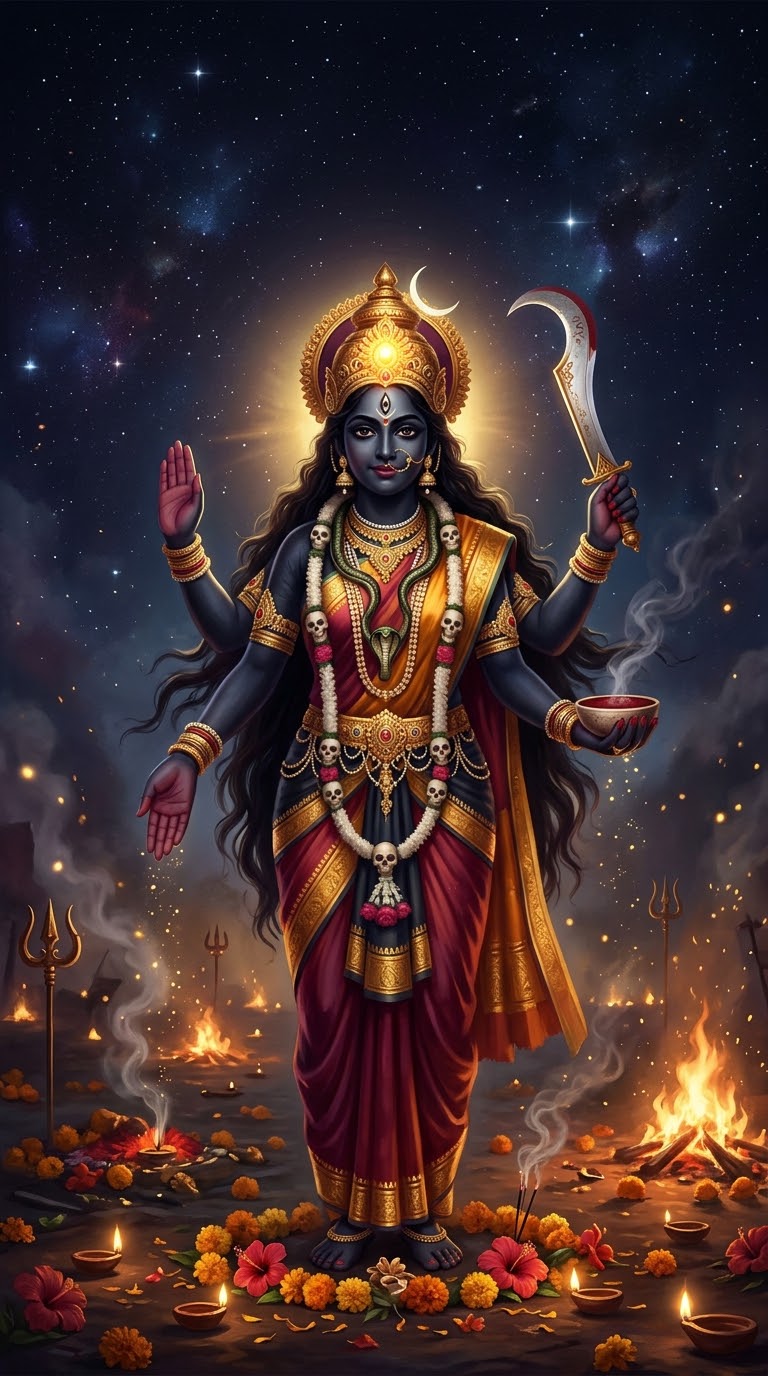
Dark-skinned Kali crowned with a crescent moon, a jewel blazing like a sun on her brow, standing in a cremation ground under a night sky full of stars

Kali · Stuti

Sri Kali Stuti

Lyrics · Meaning · Audio

Fifteen quick, rhythmic verses that hold both sides of Kali together: the dark Goddess of the cremation ground, garlanded with bones and skulls, and the tender Mother, Sati and Parvati, who gives birth, protects and frees us from delusion.

Traditional

Listen

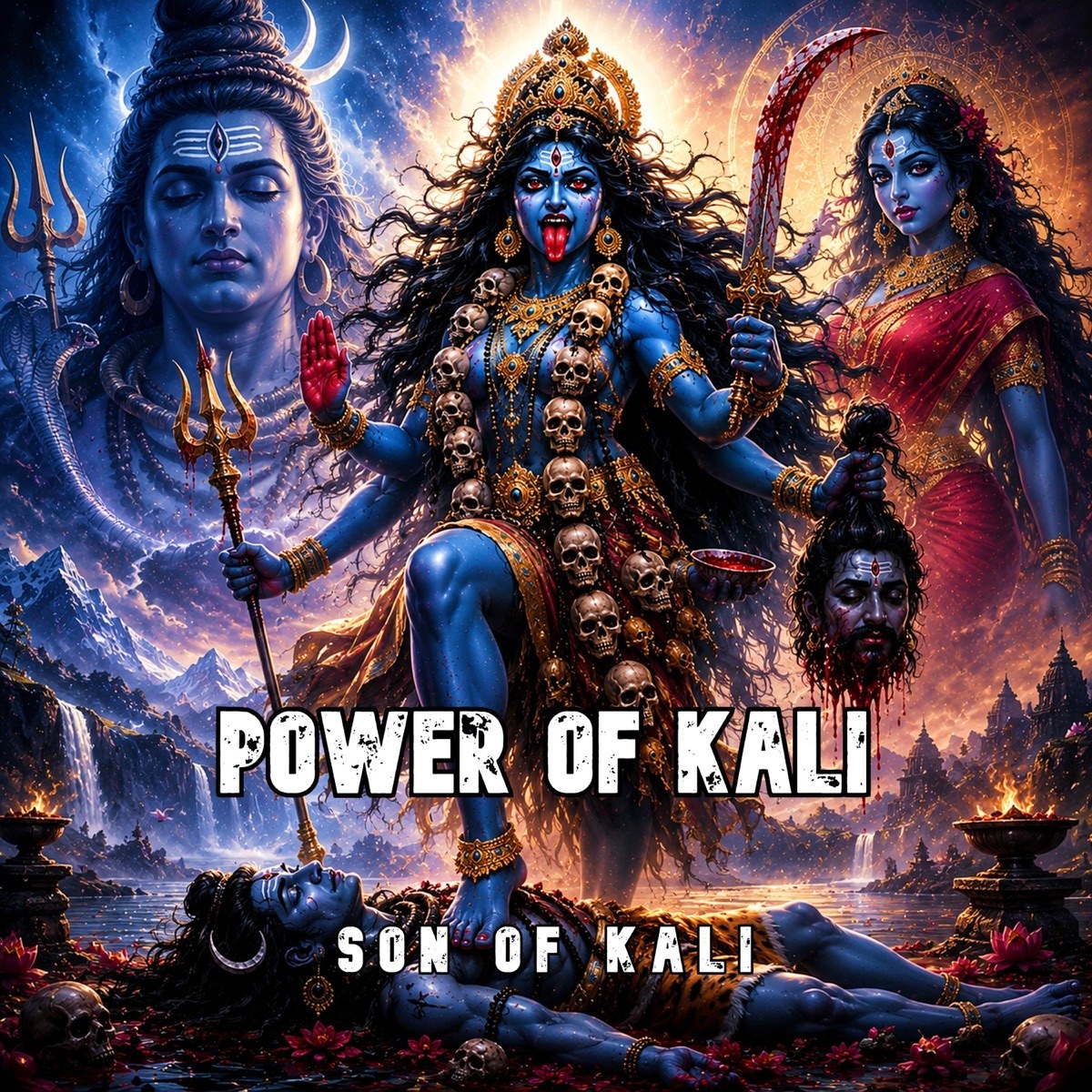
Sri Kali Stuti

Son of Kali · Power of Kali

0:005:44
Deity
Kali
Type
Stuti
Verses
15
Language
Sanskrit

Sri Kali Stuti Lyrics with Meaning

Each line shows an easy way to say it, with its English meaning. Turn on the Sanskrit, the exact pronunciation or the word-by-word meaning whenever you want to go deeper.

Verse 1

नमामि कृष्णरूपिणीं कृष्णाङ्गयष्टिधारिणीम् ।

Namami Krishnarupinim Krishnangayashtidharinim

namāmi kṛṣṇarūpiṇīṃ kṛṣṇāṅgayaṣṭidhāriṇīm

I bow to her whose form is dark, whose slender body is dark as night,

    समग्रतत्त्वसागरं अपारपारगह्वराम् ॥ १ ॥

    Samagratattvasagaram Aparaparagahvaram

    samagratattvasāgaraṃ apārapāragahvarām

    the ocean of every truth, a depth whose far shore cannot be reached.

      Verse 2

      शिवाप्रभां समुज्ज्वलां स्फुरच्छशाङ्कशेखराम् ।

      Shivaprabham Samujjvalam Sphurachchhashankashekharam

      śivāprabhāṃ samujjvalāṃ sphuracchaśāṅkaśekharām

      She glows with auspicious light, blazing, crowned with the shimmering moon;

        ललाटरत्नभास्करां जगत्प्रदीप्तिभास्कराम् ॥ २ ॥

        Lalataratnabhaskaram Jagatpradiptibhaskaram

        lalāṭaratnabhāskarāṃ jagatpradīptibhāskarām

        the jewel on her brow is a sun, a sun that lights up the world.

          Verse 3

          महेन्द्रकश्यपार्चितां सनत्कुमारसंस्तुताम् ।

          Mahendrakashyaparchitam Sanatkumarasamstutam

          mahendrakaśyapārcitāṃ sanatkumārasaṃstutām

          Worshipped by great Indra and the sage Kashyapa, praised by Sanatkumara,

            सुरासुरेन्द्रवन्दितां यथार्थनिर्मलाद्भुताम् ॥ ३ ॥

            Surasurendravanditam Yatharthanirmaladbhutam

            surāsurendravanditāṃ yathārthanirmalādbhutām

            honoured by the lords of gods and demons alike: truly pure and full of wonder.

              Verse 4

              अतर्क्यरोचिरूर्जितां विकारदोषवर्जिताम् ।

              Atarkyarochirurjitam Vikaradoshavarjitam

              atarkyarocirūrjitāṃ vikāradoṣavarjitām

              Mighty with a splendour beyond all reasoning, free of every change and flaw,

                मुमुक्षुभिर्विचिन्तितां विशेषतत्त्वसूचिताम् ॥ ४ ॥

                Mumukshubhirvichintitam Visheshatattvasuchitam

                mumukṣubhirvicintitāṃ viśeṣatattvasūcitām

                contemplated by those who long for liberation, revealed by the highest truth.

                  Verse 5

                  मृतास्थिनिर्मितस्रजां मृगेन्द्रवाहनाग्रजाम् ।

                  Mritasthinirmitasrajam Mrigendravahanagrajam

                  mṛtāsthinirmitasrajāṃ mṛgendravāhanāgrajām

                  Wearing a garland made from the bones of the dead, elder sister of the lion-riding Goddess,

                    सुशुद्धतत्त्वतोषणां त्रिवेदपारभूषणाम् ॥ ५ ॥

                    Sushuddhatattvatoshanam Trivedaparabhushanam

                    suśuddhatattvatoṣaṇāṃ trivedapārabhūṣaṇām

                    delighted by the purest truth, the ornament beyond the three Vedas.

                      Verse 6

                      भुजङ्गहारहारिणीं कपालखण्डधारिणीम् ।

                      Bhujangaharaharinim Kapalakhandadharinim

                      bhujaṅgahārahāriṇīṃ kapālakhaṇḍadhāriṇīm

                      Lovely with a necklace of serpents, holding a broken skull,

                        सुधार्मिकौपकारिणीं सुरेन्द्रवैरिघातिनीम् ॥ ६ ॥

                        Sudharmikaupakarinim Surendravairighatinim

                        sudhārmikaupakāriṇīṃ surendravairighātinīm

                        helper of the righteous, slayer of the enemies of the gods.

                          Verse 7

                          कुठारपाशचापिनीं कृतान्तकामभेदिनीम् ।

                          Kutharapashachapinim Kritantakamabhedinim

                          kuṭhārapāśacāpinīṃ kṛtāntakāmabhedinīm

                          Bearing axe, noose and bow, she breaks the power of Death and of Desire;

                            शुभां कपालमालिनीं सुवर्णकल्पशाखिनीम् ॥ ७ ॥

                            Shubham Kapalamalinim Suvarnakalpashakhinim

                            śubhāṃ kapālamālinīṃ suvarṇakalpaśākhinīm

                            auspicious one garlanded with skulls, a golden wish-fulfilling tree.

                              Verse 8

                              श्मशानभूमिवासिनीं द्विजेन्द्रमौलिभाविनीम् ।

                              Shmashanabhumivasinim Dvijendramaulibhavinim

                              śmaśānabhūmivāsinīṃ dvijendramaulibhāvinīm

                              She dwells in the cremation ground and wears the moon upon her crown;

                                तमोऽन्धकारयामिनीं शिवस्वभावकामिनीम् ॥ ८ ॥

                                Tamondhakarayaminim Shivasvabhavakaminim

                                tamo'ndhakārayāminīṃ śivasvabhāvakāminīm

                                she is the night of blinding darkness, the beloved who shares Shiva’s own nature.

                                  Verse 9

                                  सहस्रसूर्यराजिकां धनञ्जयोग्रकारिकाम् ।

                                  Sahasrasuryarajikam Dhananjayograkarikam

                                  sahasrasūryarājikāṃ dhanañjayograkārikām

                                  Shining like a thousand suns, fierce as fire in all she does,

                                    सुशुद्धकालकन्दलां सुभृङ्गबृन्दमञ्जुलाम् ॥ ९ ॥

                                    Sushuddhakalakandalam Subhringabrindamanjulam

                                    suśuddhakālakandalāṃ subhṛṅgabṛndamañjulām

                                    a pure dark shoot of Time, lovely as a swarm of black bees.

                                      Verse 10

                                      प्रजायिनीं प्रजावतीं नमामि मातरं सतीम् ।

                                      Prajayinim Prajavatim Namami Mataram Satim

                                      prajāyinīṃ prajāvatīṃ namāmi mātaraṃ satīm

                                      I bow to the Mother who gives birth, mother of countless children, to Sati,

                                        स्वकर्मकारणे गतिं हरप्रियां च पार्वतीम् ॥ १० ॥

                                        Svakarmakarane Gatim Harapriyam Cha Parvatim

                                        svakarmakāraṇe gatiṃ harapriyāṃ ca pārvatīm

                                        our refuge as our own karma unfolds, Parvati, beloved of Shiva.

                                          Verse 11

                                          अनन्तशक्तिकान्तिदां यशोऽर्थभुक्तिमुक्तिदाम् ।

                                          Anantashaktikantidam Yashorthabhuktimuktidam

                                          anantaśaktikāntidāṃ yaśo'rthabhuktimuktidām

                                          Giver of endless strength and beauty, of fame and wealth, of enjoyment and liberation,

                                            पुनः पुनर्जगद्धितां नमाम्यहं सुरार्चिताम् ॥ ११ ॥

                                            Punah Punarjagaddhitam Namamyaham Surarchitam

                                            punaḥ punarjagaddhitāṃ namāmyahaṃ surārcitām

                                            who works again and again for the good of the world: I bow to her whom the gods worship.

                                              Verse 12

                                              जयेश्वरि त्रिलोचने प्रसीद देवि पाहि माम् ।

                                              Jayeshvari Trilochane Prasida Devi Pahi Mam

                                              jayeśvari trilocane prasīda devi pāhi mām

                                              Victory to you, Queen, three-eyed one! Be gracious, Goddess, protect me.

                                                जयन्ति ते स्तुवन्ति ये शुभं लभन्त्यमोक्षतः ॥ १२ ॥

                                                Jayanti Te Stuvanti Ye Shubham Labhantyamokshatah

                                                jayanti te stuvanti ye śubhaṃ labhantyamokṣataḥ

                                                Those who praise you are victorious; they gain every good, right up to liberation.

                                                  Verse 13

                                                  सदैव ते हतद्विषः परं भवन्ति सज्जुषः ।

                                                  Sadaiva Te Hatadvishah Param Bhavanti Sajjushah

                                                  sadaiva te hatadviṣaḥ paraṃ bhavanti sajjuṣaḥ

                                                  Their enemies are always destroyed, and they are blessed with the company of the good.

                                                    जराः परे शिवेऽधुना प्रसाधि मां करोमि किम् ॥ १३ ॥

                                                    Jarah Pare Shivedhuna Prasadhi Mam Karomi Kim

                                                    jarāḥ pare śive'dhunā prasādhi māṃ karomi kim

                                                    Old age is upon me, supreme auspicious one; set me right now. What else can I do?

                                                      Verse 14

                                                      अतीव मोहितात्मनो वृथा विचेष्टितस्य मे ।

                                                      Ativa Mohitatmano Vritha Vicheshtitasya Me

                                                      atīva mohitātmano vṛthā viceṣṭitasya me

                                                      My soul is deeply deluded and my strivings have been in vain;

                                                        कुरु प्रसादितं मनो यथास्मि जन्मभञ्जनः ॥ १४ ॥

                                                        Kuru Prasaditam Mano Yathasmi Janmabhanjanah

                                                        kuru prasāditaṃ mano yathāsmi janmabhañjanaḥ

                                                        make my mind serene, so that I may break the cycle of birth.

                                                          Verse 15 — The fruit of the hymn

                                                          तथा भवन्तु तावका यथैव घोषितालकाः ।

                                                          Tatha Bhavantu Tavaka Yathaiva Ghoshitalakah

                                                          tathā bhavantu tāvakā yathaiva ghoṣitālakāḥ

                                                          May your devotees become just as you have proclaimed.

                                                            इमां स्तुतिं ममेरितां पठन्ति कालिसाधकाः ।

                                                            Imam Stutim Mameritam Pathanti Kalisadhakah

                                                            imāṃ stutiṃ mameritāṃ paṭhanti kālisādhakāḥ

                                                            Those who walk Kali’s path and recite this hymn I have offered

                                                              न ते पुनः सुदुस्तरे पतन्ति मोहगह्वरे ॥ १५ ॥

                                                              Na Te Punah Sudustare Patanti Mohagahvare

                                                              na te punaḥ sudustare patanti mohagahvare

                                                              never fall again into the abyss of delusion, so hard to cross.

                                                                About Sri Kali Stuti

                                                                This stuti is written in the panchachamara metre, a fast, regular pattern of short and long syllables that gives the hymn its drum-like rhythm. Each verse is a chain of epithets ending in “-ām”, all describing the one Goddess.

                                                                The images swing between the terrible and the tender. Kali is dark as night, crowned with the moon, wearing a garland of bones and a necklace of serpents, holding a broken skull, axe, noose and bow. In the same breath she is the Mother who gives birth, Sati and Parvati, the beloved of Shiva and a wish-fulfilling tree.

                                                                The last verses turn personal. The singer admits that their mind is deluded and their efforts have been in vain, and asks Kali to make the mind serene and break the cycle of birth. The final verse promises that those who recite this hymn will not fall into delusion again.

                                                                How to Chant Sri Kali Stuti

                                                                When to chant

                                                                • ✦Tuesdays and Saturdays
                                                                • ✦New moon nights
                                                                • ✦Kali Puja and Navaratri

                                                                How many times

                                                                Once, or three times on new moon nights.

                                                                1. 1

                                                                  Light a lamp before an image of Kali.

                                                                2. 2

                                                                  Keep a steady, even beat; the metre carries you.

                                                                3. 3

                                                                  At verses 13 and 14, speak them as your own prayer for a clear mind.

                                                                Pronunciation Guide

                                                                The sounds that trip people up most in this hymn, and how to say them.
                                                                kṛṣṇarūpiṇīm

                                                                krish-na-roo-pi-neem: “whose form is dark”.

                                                                namāmi

                                                                na-maa-mi: “I bow”.

                                                                kapālamālinīm

                                                                ka-paa-la-maa-li-neem: “garlanded with skulls”.

                                                                Power of Kali by Son of Kali

                                                                The music

                                                                Power of Kali

                                                                by Son of Kali

                                                                More for Kali

                                                                Frequently Asked Questions

                                                                What is the Kali Stuti about?

                                                                It praises Kali as both the fierce Goddess of the cremation ground and the loving Mother who gives birth, protects and frees from delusion.

                                                                Why does it have such a strong rhythm?

                                                                It is written in the panchachamara metre, which alternates short and long syllables at a fast, regular pace, like a drumbeat.

                                                                What does the hymn promise?

                                                                The last verse says that Kali’s devotees who recite it will never again fall into the abyss of delusion.

                                                                Is the chorus on the recording part of the text?

                                                                The refrain “Om Kali Kali Namostute, Jaya Bhadrakali Mahakali” is added for chanting on the recording. The hymn itself is the 15 verses shown here.

                                                                Text: Traditional Sanskrit hymn (public domain), following the text as sung on the recording. Easy reading and English translation written for the Jaguar Medicine Tribe Mantra Library.

                                                                Music: Recordings by Son of Kali, produced with AI-assisted vocals and instrumentation.

                                                                Note: Benefits described here are traditional beliefs, shared for understanding — not medical or guaranteed outcomes.