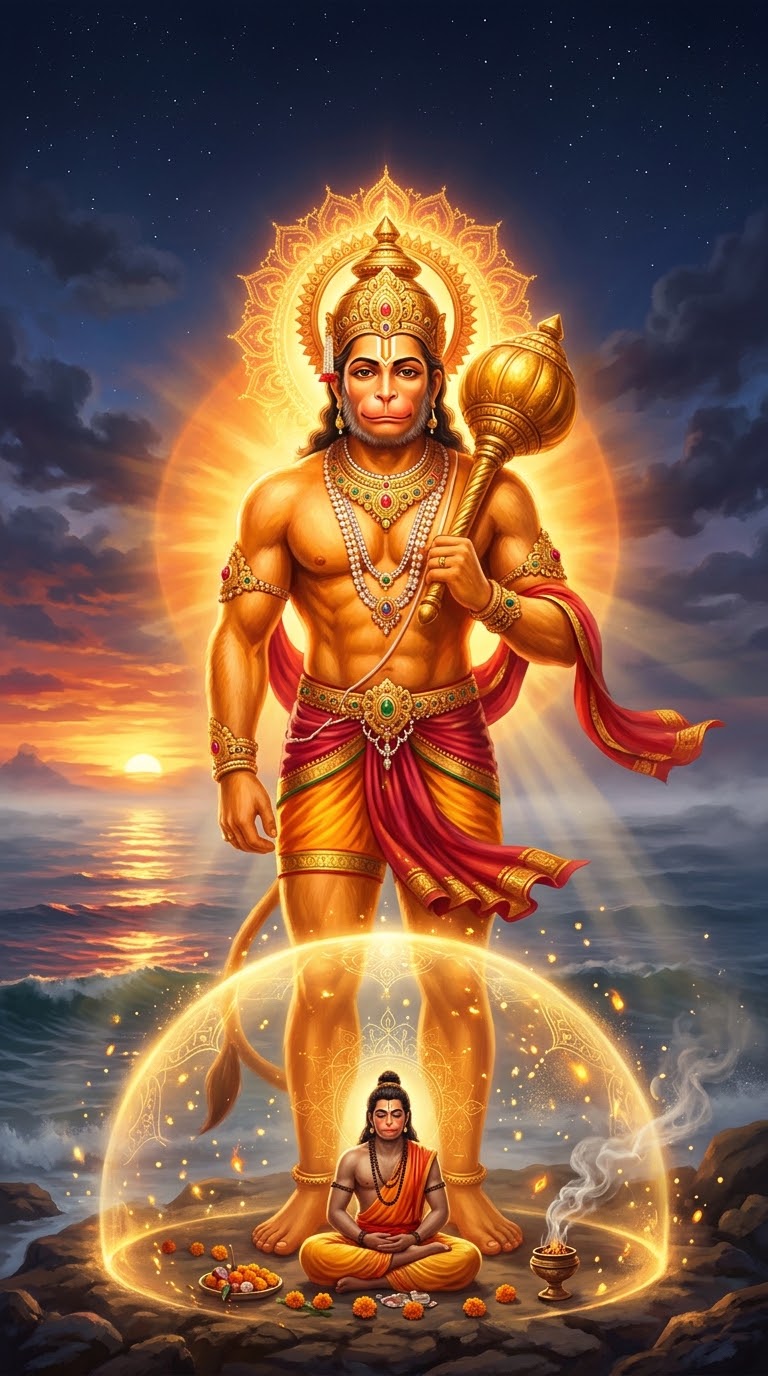
Hanuman standing tall in golden light, a glowing shield of protection around a devotee seated in meditation at his feet

Hanuman · Kavacham

Sri Hanumat Kavacham

Lyrics · Meaning · Audio

An armour of protection made from Hanuman’s names. After four verses of meditation on him, the kavacham places a different name of Hanuman on each part of the body, from the feet to the head, and then on every hour of the day.

Traditional

Listen

Sri Hanumat Kavacham

Son of Kali · Power of Hanuman

0:007:06
Deity
Hanuman
Type
Kavacham
Verses
16
Language
Sanskrit

Sri Hanumat Kavacham Lyrics with Meaning

Each line shows an easy way to say it, with its English meaning. Turn on the Sanskrit, the exact pronunciation or the word-by-word meaning whenever you want to go deeper.

Verse 1 — Dhyanam

उल्लङ्घ्य सिन्धोः सलिलं सलीलं

Ullanghya Sindhoh Salilam Salilam

ullaṅghya sindhoḥ salilaṃ salīlaṃ

He leapt across the waters of the ocean as if at play,

    यः शोकवह्निं जनकात्मजायाः ।

    Yah Shokavahnim Janakatmajayah

    yaḥ śokavahniṃ janakātmajāyāḥ

    and took the fire of grief of Janaka’s daughter, Sita;

      आदाय तेनैव ददाह लङ्कां

      Adaya Tenaiva Dadaha Lankam

      ādāya tenaiva dadāha laṅkāṃ

      with that same fire he burned Lanka.

        नमामि तं प्राञ्जलिराञ्जनेयम् ॥ १ ॥

        Namami Tam Pranjaliranjaneyam

        namāmi taṃ prāñjalirāñjaneyam

        With joined palms I bow to him, Anjaneya.

          Verse 2 — Dhyanam

          मनोजवं मारुततुल्यवेगं

          Manojavam Marutatulyavegam

          manojavaṃ mārutatulyavegaṃ

          Swift as thought, fast as the wind,

            जितेन्द्रियं बुद्धिमतां वरिष्ठम् ।

            Jitendriyam Buddhimatam Varishtham

            jitendriyaṃ buddhimatāṃ variṣṭham

            master of the senses, foremost of the wise,

              वातात्मजं वानरयूथमुख्यं

              Vatatmajam Vanarayuthamukhyam

              vātātmajaṃ vānarayūthamukhyaṃ

              son of the Wind, chief of the monkey hosts,

                श्रीरामदूतं शिरसा नमामि ॥ २ ॥

                Shriramadutam Shirasa Namami

                śrīrāmadūtaṃ śirasā namāmi

                messenger of Shri Rama: I bow my head to him.

                  Verse 3 — Dhyanam

                  उद्यदादित्यसङ्काशं उदारभुजविक्रमम् ।

                  Udyadadityasankasham Udarabhujavikramam

                  udyadādityasaṅkāśaṃ udārabhujavikramam

                  Bright as the rising sun, mighty in his generous arms,

                    कन्दर्पकोटिलावण्यं सर्वविद्याविशारदम् ॥ ३ ॥

                    Kandarpakotilavanyam Sarvavidyavisharadam

                    kandarpakoṭilāvaṇyaṃ sarvavidyāviśāradam

                    lovelier than ten million gods of love, master of every science.

                      Verse 4 — Dhyanam

                      श्रीरामहृदयानन्दं भक्तकल्पमहीरुहम् ।

                      Shriramahridayanandam Bhaktakalpamahiruham

                      śrīrāmahṛdayānandaṃ bhaktakalpamahīruham

                      Joy of Shri Rama’s heart, a wish-granting tree for his devotees,

                        अभयं वरदं दोर्भ्यां कलये मारुतात्मजम् ॥ ४ ॥

                        Abhayam Varadam Dorbhyam Kalaye Marutatmajam

                        abhayaṃ varadaṃ dorbhyāṃ kalaye mārutātmajam

                        his two hands granting fearlessness and blessings: I meditate on the Wind’s son.

                          Verse 5 — The name of Rama

                          श्रीराम राम रामेति रमे रामे मनोरमे ।

                          Shrirama Rama Rameti Rame Rame Manorame

                          śrīrāma rāma rāmeti rame rāme manorame

                          Saying “Shri Rama, Rama, Rama”, I delight in Rama, delight of the mind.

                            सहस्रनाम तत्तुल्यं रामनाम वरानने ॥ ५ ॥

                            Sahasranama Tattulyam Ramanama Varanane

                            sahasranāma tattulyaṃ rāmanāma varānane

                            Rama’s name, O fair-faced one, is equal to the thousand names.

                              Verse 6 — The armour

                              पादौ वायुसुतः पातु रामदूतस्तदङ्गुलीः ।

                              Padau Vayusutah Patu Ramadutastadangulih

                              pādau vāyusutaḥ pātu rāmadūtastadaṅgulīḥ

                              May the son of the Wind protect my feet, and Rama’s messenger my toes;

                                गुल्फौ हरीश्वरः पातु जङ्घे चार्णवलङ्घनः ॥ ६ ॥

                                Gulphau Harishvarah Patu Janghe Charnavalanghanah

                                gulphau harīśvaraḥ pātu jaṅghe cārṇavalaṅghanaḥ

                                may the Lord of monkeys protect my ankles, and the ocean-leaper my shins.

                                  Verse 7 — The armour

                                  जानुनी मारुतिः पातु ऊरू पात्वसुरान्तकः ।

                                  Januni Marutih Patu Uru Patvasurantakah

                                  jānunī mārutiḥ pātu ūrū pātvasurāntakaḥ

                                  May Maruti protect my knees, and the slayer of demons my thighs;

                                    गुह्यं वज्रतनुः पातु जघनं तु जगद्धितः ॥ ७ ॥

                                    Guhyam Vajratanuh Patu Jaghanam Tu Jagaddhitah

                                    guhyaṃ vajratanuḥ pātu jaghanaṃ tu jagaddhitaḥ

                                    may the thunderbolt-bodied one protect my private parts, and the friend of the world my hips.

                                      Verse 8 — The armour

                                      आञ्जनेयः कटिं पातु नाभिं सौमित्रिजीवनः ।

                                      Anjaneyah Katim Patu Nabhim Saumitrijivanah

                                      āñjaneyaḥ kaṭiṃ pātu nābhiṃ saumitrijīvanaḥ

                                      May Anjaneya protect my waist, and the one who restored Lakshmana’s life my navel;

                                        उदरं पातु हृद्गेही हृदयं च महाबलः ॥ ८ ॥

                                        Udaram Patu Hridgehi Hridayam Cha Mahabalah

                                        udaraṃ pātu hṛdgehī hṛdayaṃ ca mahābalaḥ

                                        may he who lives in the heart protect my belly, and the mighty one my heart.

                                          Verse 9 — The armour

                                          वक्षो वालायुधः पातु स्तनौ चामितविक्रमः ।

                                          Vaksho Valayudhah Patu Stanau Chamitavikramah

                                          vakṣo vālāyudhaḥ pātu stanau cāmitavikramaḥ

                                          May he whose tail is his weapon protect my chest, and the boundlessly brave my breast;

                                            पार्श्वौ जितेन्द्रियः पातु बाहू सुग्रीवमन्त्रकृत् ॥ ९ ॥

                                            Parshvau Jitendriyah Patu Bahu Sugrivamantrakrit

                                            pārśvau jitendriyaḥ pātu bāhū sugrīvamantrakṛt

                                            may the master of the senses protect my sides, and Sugriva’s counsellor my arms.

                                              Verse 10 — The armour

                                              करावक्षजयी पातु हनुमांश्च तदङ्गुलीः ।

                                              Karavakshajayi Patu Hanumamshcha Tadangulih

                                              karāvakṣajayī pātu hanumāṃśca tadaṅgulīḥ

                                              May the conqueror of Aksha protect my hands, and Hanuman my fingers;

                                                पृष्ठं भविष्यद्ब्रह्मा च स्कन्धौ मतिमतां वरः ॥ १० ॥

                                                Prishtham Bhavishyadbrahma Cha Skandhau Matimatam Varah

                                                pṛṣṭhaṃ bhaviṣyadbrahmā ca skandhau matimatāṃ varaḥ

                                                may the Brahma who is yet to come protect my back, and the best of the wise my shoulders.

                                                  Verse 11 — The armour

                                                  कण्ठं पातु कपिश्रेष्ठो मुखं रावणदर्पहा ।

                                                  Kantham Patu Kapishreshtho Mukham Ravanadarpaha

                                                  kaṇṭhaṃ pātu kapiśreṣṭho mukhaṃ rāvaṇadarpahā

                                                  May the best of monkeys protect my throat, and the breaker of Ravana’s pride my face;

                                                    वक्त्रं च वक्तृप्रवणो नेत्रे देवगणस्तुतः ॥ ११ ॥

                                                    Vaktram Cha Vaktripravano Netre Devaganastutah

                                                    vaktraṃ ca vaktṛpravaṇo netre devagaṇastutaḥ

                                                    may the master of speech protect my mouth, and the one the gods praise my eyes.

                                                      Verse 12 — The armour

                                                      ब्रह्मास्त्रसन्मानकरो भ्रुवौ मे पातु सर्वदा ।

                                                      Brahmastrasanmanakaro Bhruvau Me Patu Sarvada

                                                      brahmāstrasanmānakaro bhruvau me pātu sarvadā

                                                      May he who honoured the Brahmastra always protect my brows;

                                                        कामरूपः कपोले मे फालं वज्रनखोऽवतु ॥ १२ ॥

                                                        Kamarupah Kapole Me Phalam Vajranakhovatu

                                                        kāmarūpaḥ kapole me phālaṃ vajranakho'vatu

                                                        may the shape-shifter protect my cheeks, and the thunderbolt-clawed my forehead.

                                                          Verse 13 — The armour

                                                          शिरो मे पातु सततं जानकीशोकनाशनः ।

                                                          Shiro Me Patu Satatam Janakishokanashanah

                                                          śiro me pātu satataṃ jānakīśokanāśanaḥ

                                                          May the destroyer of Sita’s grief always protect my head;

                                                            श्रीरामभक्तप्रवरः पातु सर्वकलेवरम् ॥ १३ ॥

                                                            Shriramabhaktapravarah Patu Sarvakalevaram

                                                            śrīrāmabhaktapravaraḥ pātu sarvakalevaram

                                                            may the foremost devotee of Shri Rama protect my whole body.

                                                              Verse 14 — The armour

                                                              मामह्नि पातु सर्वज्ञः पातु रात्रौ महायशाः ।

                                                              Mamahni Patu Sarvajnah Patu Ratrau Mahayashah

                                                              māmahni pātu sarvajñaḥ pātu rātrau mahāyaśāḥ

                                                              May the all-knowing guard me by day, and the greatly renowned by night;

                                                                विवस्वदन्तेवासी च सन्ध्ययोः पातु सर्वदा ॥ १४ ॥

                                                                Vivasvadantevasi Cha Sandhyayoh Patu Sarvada

                                                                vivasvadantevāsī ca sandhyayoḥ pātu sarvadā

                                                                and may the Sun’s own pupil always guard me at dawn and dusk.

                                                                  Verse 15 — The armour

                                                                  ब्रह्मादिदेवतादत्तवरः पातु निरन्तरम् ।

                                                                  Brahmadidevatadattavarah Patu Nirantaram

                                                                  brahmādidevatādattavaraḥ pātu nirantaram

                                                                  May he who received boons from Brahma and the gods protect me without pause.

                                                                    य इदं कवचं नित्यं पठेच्च शृणुयान्नरः ॥ १५ ॥

                                                                    Ya Idam Kavacham Nityam Pathechcha Shrinuyannarah

                                                                    ya idaṃ kavacaṃ nityaṃ paṭhecca śṛṇuyānnaraḥ

                                                                    Whoever recites this armour every day, or listens to it,

                                                                      Verse 16 — The fruit of the armour

                                                                      दीर्घमायुरवाप्नोति बलं दृष्टिं च विन्दति ।

                                                                      Dirghamayuravapnoti Balam Drishtim Cha Vindati

                                                                      dīrghamāyuravāpnoti balaṃ dṛṣṭiṃ ca vindati

                                                                      gains long life, and finds strength and clear sight;

                                                                        पादाक्रान्ता भविष्यन्ति पठतस्तस्य शत्रवः ।

                                                                        Padakranta Bhavishyanti Pathatastasya Shatravah

                                                                        pādākrāntā bhaviṣyanti paṭhatastasya śatravaḥ

                                                                        the enemies of one who recites it will lie beneath his feet;

                                                                          स्थिरां सुकीर्तिमारोग्यं लभते शाश्वतं सुखम् ॥ १६ ॥

                                                                          Sthiram Sukirtimarogyam Labhate Shashvatam Sukham

                                                                          sthirāṃ sukīrtimārogyaṃ labhate śāśvataṃ sukham

                                                                          he gains a lasting good name, health and enduring happiness.

                                                                            About Sri Hanumat Kavacham

                                                                            A kavacham (“armour”) is a hymn that sets a deity’s protection on each part of the body, one by one. Here every limb is given to a different name of Hanuman, and each name tells part of his story: the ocean-leaper guards the shins, the one who brought Lakshmana back to life guards the navel, the breaker of Ravana’s pride guards the face, and the destroyer of Sita’s grief guards the head.

                                                                            The hymn opens with four meditation verses (dhyanam), including the well-known “Manojavam Marutatulyavegam”, and the famous verse on the name of Rama, “Shri Rama Rama Rameti”, in which Shiva tells Parvati that Rama’s name equals a thousand names.

                                                                            It then guards the reciter through time as well as space: by day, by night and at the two twilights. The closing verse promises long life, strength, clear sight, victory over enemies, health and lasting happiness to whoever recites it or hears it daily.

                                                                            The Stories Inside the Hymn

                                                                            The names in the armour

                                                                            Many of Hanuman’s names here come from the Ramayana. He leapt the ocean to Lanka to find Sita, killed Ravana’s son Aksha, set Lanka on fire, and carried the mountain of herbs that brought Lakshmana back to life.

                                                                            He allowed himself to be bound by the Brahmastra out of respect for Brahma, and learned the scriptures as a pupil of the Sun god. One name, bhaviṣyadbrahmā, “the Brahma who is yet to come”, reflects the belief that Hanuman will become the creator in a future age.

                                                                            How to Chant Sri Hanumat Kavacham

                                                                            When to chant

                                                                            • ✦Tuesdays and Saturdays
                                                                            • ✦Before travel or a difficult task
                                                                            • ✦At dawn or dusk

                                                                            How many times

                                                                            Once a day, or 11 times on Tuesdays.

                                                                            1. 1

                                                                              Sit facing an image of Hanuman and recite the four meditation verses.

                                                                            2. 2

                                                                              As you recite the armour, touch or bring your attention to each part of the body named.

                                                                            3. 3

                                                                              Finish by resting in the sense of being fully guarded.

                                                                            Pronunciation Guide

                                                                            The sounds that trip people up most in this hymn, and how to say them.

                                                                            vāyusutaḥ

                                                                            vaa-yu-su-tah: “son of the Wind”.

                                                                            pātu

                                                                            paa-tu: “may he protect”, repeated through the armour.

                                                                            āñjaneya

                                                                            aan-ja-nay-ya: “son of Anjana”.

                                                                            Power of Hanuman by Son of Kali

                                                                            The music

                                                                            Power of Hanuman

                                                                            by Son of Kali

                                                                            More for Hanuman

                                                                            Frequently Asked Questions

                                                                            What is a Hanuman Kavach?

                                                                            A protective hymn that places Hanuman’s names on each part of the body, like a suit of armour, and asks him to guard the reciter by day and by night.

                                                                            What are its benefits?

                                                                            The closing verse promises long life, strength, clear sight, victory over enemies, a good name, health and lasting happiness to whoever recites or hears it daily.

                                                                            Why is the verse “Shri Rama Rama Rameti” in it?

                                                                            Hanuman’s strength comes from his devotion to Rama, so the kavacham honours Rama’s name, which Shiva says equals the thousand names, before calling on Hanuman.

                                                                            When should it be recited?

                                                                            Traditionally on Tuesdays and Saturdays, at dawn or dusk, and before travel or any difficult undertaking.

                                                                            Text: Traditional Sanskrit hymn (public domain), following the text as sung on the recording. Easy reading and English translation written for the Jaguar Medicine Tribe Mantra Library.

                                                                            Music: Recordings by Son of Kali, produced with AI-assisted vocals and instrumentation.

                                                                            Note: Benefits described here are traditional beliefs, shared for understanding — not medical or guaranteed outcomes.