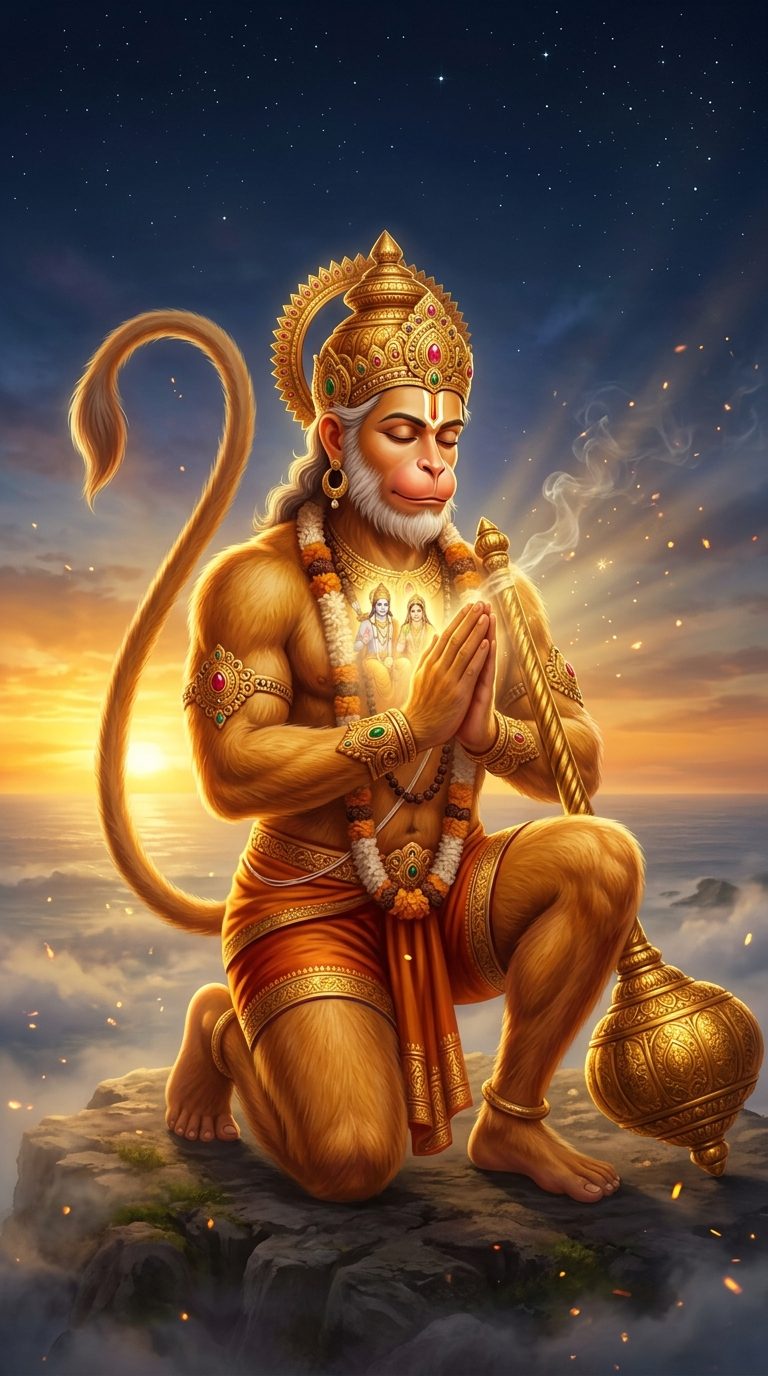
Lord Hanuman standing tall on a cliff with twelve glowing scenes from his life floating around him like a halo
HanumanStotram

Hanuman Dvadasha Nama Stotram

Lyrics · Meaning · Audio

Twelve names of Hanuman in a few short lines — each one a chapter of his story — which tradition says remove all fear when recited at bedtime, on waking and before a journey.

Traditional hymn (Ananda Ramayana tradition)

Listen

Hanuman Dvadasha Nama Stotram

Son of Kali · Power of Hanuman

0:007:12
Deity
Hanuman
Type
Stotram
Verses
2
Language
Sanskrit

Hanuman Dvadasha Nama Stotram Lyrics with Meaning

Each line shows an easy way to say it, with its English meaning. Turn on the Sanskrit, the exact pronunciation or the word-by-word meaning whenever you want to go deeper.

The Twelve Names

हनुमानञ्जनासूनुर्वायुपुत्रो महाबलः ।

Hanuman Anjanasunur Vayuputro Mahabalah

hanumānañjanāsūnurvāyuputro mahābalaḥ

Hanuman, son of Anjana, son of the Wind, the mighty one,

    रामेष्टः फाल्गुनसखः पिङ्गाक्षोऽमितविक्रमः ॥

    Rameshtah Phalgunasakhah Pingaksho Amitavikramah

    rāmeṣṭaḥ phālgunasakhaḥ piṅgākṣo'mitavikramaḥ

    dear to Rama, friend of Arjuna, tawny-eyed, of boundless valour,

      उदधिक्रमणश्चैव सीताशोकविनाशनः ।

      Udadhikramanashchaiva Sita Shoka Vinashanah

      udadhikramaṇaścaiva sītāśokavināśanaḥ

      the one who leapt the ocean, the destroyer of Sita’s grief,

        लक्ष्मणप्राणदाता च दशग्रीवस्य दर्पहा ॥

        Lakshmana Prana Data Cha Dashagrivasya Darpaha

        lakṣmaṇaprāṇadātā ca daśagrīvasya darpahā

        the giver of Lakshmana’s life, and the humbler of ten-headed Ravana’s pride.

          The Promise

          एवं द्वादश नामानि कपीन्द्रस्य महात्मनः ।

          Evam Dvadasha Namani Kapindrasya Mahatmanah

          evaṃ dvādaśa nāmāni kapīndrasya mahātmanaḥ

          These are the twelve names of the great-souled lord of the vanaras;

            स्वापकाले प्रबोधे च यात्राकाले च यः पठेत् ॥

            Svapakale Prabodhe Cha Yatrakale Cha Yah Pathet

            svāpakāle prabodhe ca yātrākāle ca yaḥ paṭhet

            whoever recites them at bedtime, on waking and when setting out on a journey —

              तस्य सर्वभयं नास्ति रणे च विजयी भवेत् ।

              Tasya Sarva Bhayam Nasti Rane Cha Vijayi Bhavet

              tasya sarvabhayaṃ nāsti raṇe ca vijayī bhavet

              for them there is no fear of any kind, and they are victorious in battle;

                राजद्वारे गह्वरे च भयं नास्ति कदाचन ॥

                Rajadvare Gahvare Cha Bhayam Nasti Kadachana

                rājadvāre gahvare ca bhayaṃ nāsti kadācana

                at the king’s door or in a dark cave, they never know fear.

                  About Hanuman Dvadasha Nama Stotram

                  This little hymn gives twelve names of Hanuman. Each is a miniature story: Añjanāsūnu, son of Anjana; Vāyuputra, son of the Wind; Rāmeṣṭa, dear to Rama; Phalgunasakha, friend of Arjuna; Udadhikramaṇa, the one who leapt the ocean; Sītāśokavināśana, who ended Sita’s grief; Lakṣmaṇaprāṇadātā, who gave Lakshmana back his life; and Daśagrīvadarpahā, who humbled ten-headed Ravana.

                  The closing lines give clear instructions: recite the twelve names when going to sleep, on waking and before a journey, and you will have no fear, win in conflict, and be safe at the king’s court and in dark places.

                  Because it is so short, it is a favourite for children and for anyone beginning a Hanuman practice.

                  The Stories Inside the Hymn

                  Friend of Arjuna

                  Phalgunasakha — “friend of Arjuna” — links Hanuman to the Mahabharata. Before the great war, Hanuman promised to sit on the flag of Arjuna’s chariot, which is why it was called Kapidhvaja, “the monkey banner.”

                  Throughout the battle, with Krishna as charioteer and Hanuman on the flag, Arjuna’s chariot could not be destroyed.

                  How to Chant Hanuman Dvadasha Nama Stotram

                  When to chant

                  • ✦At bedtime and on waking, as the hymn instructs
                  • ✦Before a journey
                  • ✦Tuesdays and Saturdays
                  • ✦When afraid, especially of the dark

                  How many times

                  Once each time; children often learn it as a bedtime prayer.

                  1. 1

                    Sit or lie quietly and close your eyes.

                  2. 2

                    Chant the twelve names slowly, picturing the story behind each one.

                  3. 3

                    Chant the closing lines as a prayer for protection.

                  4. 4

                    Rest in the feeling of being safe.

                  Pronunciation Guide

                  The sounds that trip people up most in this hymn, and how to say them.

                  añjanāsūnuḥ

                  un-ja-naa-soo-nuh — “son of Anjana.”

                  phalgunasakhaḥ

                  phul-gu-na-sa-khah — “friend of Arjuna.”

                  daśagrīva

                  da-sha-gree-va — “ten-necked” (Ravana).

                  Power of Hanuman by Son of Kali

                  The music

                  Power of Hanuman

                  by Son of Kali

                  More for Hanuman

                  Frequently Asked Questions

                  What are the 12 names of Hanuman?

                  Hanuman, Anjanasunu, Vayuputra, Mahabala, Rameshta, Phalgunasakha, Pingaksha, Amitavikrama, Udadhikramana, Sitashokavinashana, Lakshmanapranadata and Dashagrivadarpaha.

                  When should I chant the 12 names of Hanuman?

                  The hymn says: at bedtime, on waking and before travelling.

                  What are the benefits?

                  The hymn promises freedom from fear, victory in conflict, and safety at court and in dangerous places.

                  Text: Traditional public-domain Sanskrit hymn. Easy reading, transliteration and English translation written for the Jaguar Medicine Tribe Mantra Library.

                  Music: Recordings by Son of Kali, produced with AI-assisted vocals and instrumentation.

                  Note: Benefits described here are traditional beliefs, shared for understanding — not medical or guaranteed outcomes.