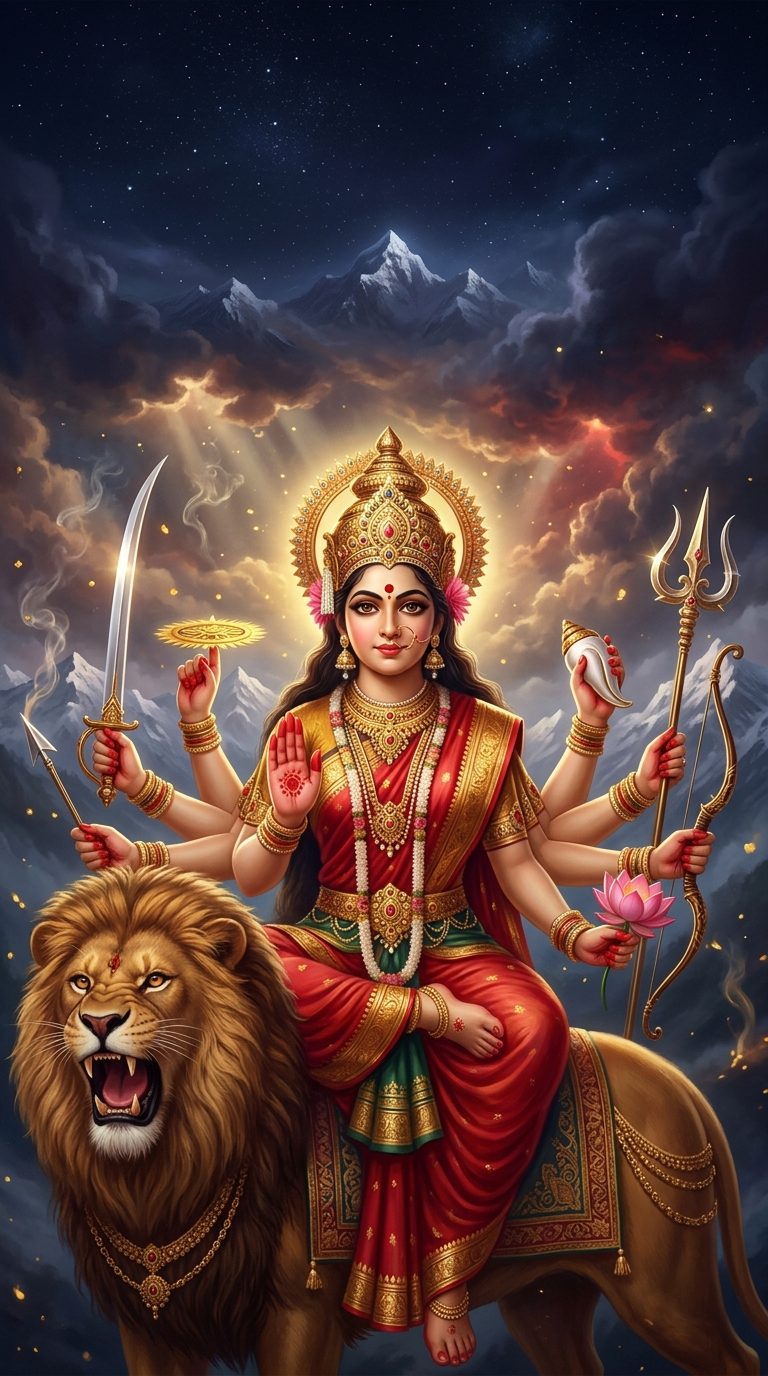
Goddess Durga riding her lion with eight arms holding weapons, devotees lighting forty lamps in a spiral before her
DurgaChalisa

Durga Chalisa

Lyrics · Meaning · Audio

Forty verses praising Durga as the light behind all three worlds — her forms as Annapurna, Lakshmi, Saraswati and the ten Mahavidyas, her victories over the demons, and her grace to all who call on her.

Traditional chalisa, signed by Devidas in the last verse

Listen

Durga Chalisa

Son of Kali · Sacred Navaratri Chants

0:006:25
Deity
Durga
Type
Chalisa
Verses
11
Language
Awadhi

Durga Chalisa Lyrics with Meaning

Each line shows an easy way to say it, with its English meaning. Turn on the Sanskrit, the exact pronunciation or the word-by-word meaning whenever you want to go deeper.

Verses 1–4

नमो नमो दुर्गे सुख करनी । नमो नमो अम्बे दुःख हरनी ॥ १ ॥

Namo Namo Durge Sukh Karni, Namo Namo Ambe Dukh Harni

namo namo durge sukha karanī namo namo ambe duḥkha haranī

Salutations, O Durga, giver of happiness; salutations, O Mother, remover of sorrow.

    निरंकार है ज्योति तुम्हारी । तिहूँ लोक फैली उजियारी ॥ २ ॥

    Nirankar Hai Jyoti Tumhari, Tihun Lok Phaili Ujiyari

    niraṃkāra hai jyoti tumhārī tihū̃ loka phailī ujiyārī

    Your light is formless, and its brightness fills the three worlds.

      शशि ललाट मुख महाविशाला । नेत्र लाल भृकुटि विकराला ॥ ३ ॥

      Shashi Lalaat Mukh Mahavishala, Netra Laal Bhrikuti Vikrala

      śaśi lalāṭa mukha mahāviśālā netra lāla bhṛkuṭi vikarālā

      The moon is on your brow, your face is vast; your eyes are red and your brows fierce.

        रूप मातु को अधिक सुहावे । दरश करत जन अति सुख पावे ॥ ४ ॥

        Roop Matu Ko Adhik Suhave, Darash Karat Jan Ati Sukh Pave

        rūpa mātu ko adhika suhāve daraśa karata jana ati sukha pāve

        The Mother’s form is so beautiful that those who see it feel great joy.

          Verses 5–8

          तुम संसार शक्ति लय कीना । पालन हेतु अन्न धन दीना ॥ ५ ॥

          Tum Sansar Shakti Lay Kina, Palan Hetu Ann Dhan Dina

          tuma saṃsāra śakti laya kīnā pālana hetu anna dhana dīnā

          You gave the world its power, and to sustain it you gave food and wealth.

            अन्नपूर्णा हुई जग पाला । तुम ही आदि सुन्दरी बाला ॥ ६ ॥

            Annapurna Hui Jag Pala, Tum Hi Adi Sundari Bala

            annapūrṇā huī jaga pālā tuma hī ādi sundarī bālā

            As Annapurna you nourish the world; you are the first, the beautiful maiden.

              प्रलयकाल सब नाशन हारी । तुम गौरी शिवशंकर प्यारी ॥ ७ ॥

              Pralaykal Sab Nashan Hari, Tum Gauri Shivshankar Pyari

              pralayakāla saba nāśana hārī tuma gaurī śivaśaṃkara pyārī

              At the time of dissolution you destroy all; you are Gauri, beloved of Shiva.

                शिव योगी तुम्हरे गुण गावें । ब्रह्मा विष्णु तुम्हें नित ध्यावें ॥ ८ ॥

                Shiv Yogi Tumhare Gun Gaven, Brahma Vishnu Tumhen Nit Dhyaven

                śiva yogī tumhare guṇa gāveṃ brahmā viṣṇu tumheṃ nita dhyāveṃ

                Shiva and the yogis sing your virtues; Brahma and Vishnu meditate on you always.

                  Verses 9–12

                  रूप सरस्वती को तुम धारा । दे सुबुद्धि ऋषि मुनिन उबारा ॥ ९ ॥

                  Roop Saraswati Ko Tum Dhara, De Subuddhi Rishi Munin Ubara

                  rūpa sarasvatī ko tuma dhārā de subuddhi ṛṣi munina ubārā

                  Taking the form of Saraswati, you gave good understanding and uplifted the sages.

                    धरयो रूप नरसिंह को अम्बा । परगट भई फाड़कर खम्बा ॥ १० ॥

                    Dharyo Roop Narsimha Ko Amba, Pragat Bhai Phadkar Khamba

                    dharayo rūpa narasiṃha ko ambā paragaṭa bhaī phāṛakara khambā

                    O Mother, you took the form of Narasimha and burst out from the pillar,

                      रक्षा करि प्रह्लाद बचायो । हिरण्याक्ष को स्वर्ग पठायो ॥ ११ ॥

                      Raksha Kari Prahlad Bachayo, Hiranyaksh Ko Swarg Pathayo

                      rakṣā kari prahlāda bacāyo hiraṇyākṣa ko svarga paṭhāyo

                      protecting and saving Prahlada, and sending the demon king to heaven.

                        लक्ष्मी रूप धरो जग माहीं । श्री नारायण अंग समाहीं ॥ १२ ॥

                        Lakshmi Roop Dharo Jag Mahin, Shri Narayan Ang Samahin

                        lakṣmī rūpa dharo jaga māhīṃ śrī nārāyaṇa aṃga samāhīṃ

                        In the world you took the form of Lakshmi, resting at Lord Narayana’s side.

                          Verses 13–16

                          क्षीरसिन्धु में करत विलासा । दयासिन्धु दीजै मन आसा ॥ १३ ॥

                          Kshirsindhu Mein Karat Vilasa, Dayasindhu Dijai Man Aasa

                          kṣīrasindhu meṃ karata vilāsā dayāsindhu dījai mana āsā

                          You play in the ocean of milk; O ocean of mercy, fulfil the hopes of my heart.

                            हिंगलाज में तुम्हीं भवानी । महिमा अमित न जात बखानी ॥ १४ ॥

                            Hinglaj Mein Tumhin Bhavani, Mahima Amit Na Jaat Bakhani

                            hiṃgalāja meṃ tumhīṃ bhavānī mahimā amita na jāta bakhānī

                            You are Bhavani at Hinglaj; your boundless glory cannot be described.

                              मातंगी अरु धूमावति माता । भुवनेश्वरी बगला सुख दाता ॥ १५ ॥

                              Matangi Aru Dhumavati Mata, Bhuvaneshwari Bagala Sukh Data

                              mātaṃgī aru dhūmāvati mātā bhuvaneśvarī bagalā sukha dātā

                              You are Mother Matangi and Dhumavati, Bhuvaneshvari and Bagala, givers of happiness;

                                श्री भैरव तारा जग तारिणी । छिन्न भाल भव दुःख निवारिणी ॥ १६ ॥

                                Shri Bhairav Tara Jag Tarini, Chhinna Bhaal Bhav Dukh Nivarini

                                śrī bhairava tārā jaga tāriṇī chinna bhāla bhava duḥkha nivāriṇī

                                Bhairavi and Tara who carry the world across, and Chhinnamasta who ends worldly sorrow.

                                  Verses 17–20

                                  केहरि वाहन सोह भवानी । लांगुर वीर चलत अगवानी ॥ १७ ॥

                                  Kehari Vahan Soh Bhavani, Langur Veer Chalat Agvani

                                  kehari vāhana soha bhavānī lāṃgura vīra calata agavānī

                                  Bhavani shines upon her lion, the heroic Langura (Hanuman) leading the way.

                                    कर में खप्पर खड्ग विराजै । जाको देख काल डर भाजै ॥ १८ ॥

                                    Kar Mein Khappar Khadag Virajai, Jako Dekh Kaal Dar Bhajai

                                    kara meṃ khappara khaḍga virājai jāko dekha kāla ḍara bhājai

                                    In your hands shine the skull-bowl and sword; seeing them, even Death flees in fear.

                                      सोहै अस्त्र और त्रिशूला । जाते उठत शत्रु हिय शूला ॥ १९ ॥

                                      Sohai Astra Aur Trishula, Jaate Uthat Shatru Hiya Shula

                                      sohai astra aura triśūlā jāte uṭhata śatru hiya śūlā

                                      Weapons and the trident adorn you, piercing the hearts of enemies with fear.

                                        नगरकोट में तुम्हीं विराजत । तिहुँलोक में डंका बाजत ॥ २० ॥

                                        Nagarkot Mein Tumhin Virajat, Tihun Lok Mein Danka Baajat

                                        nagarakoṭa meṃ tumhīṃ virājata tihũloka meṃ ḍaṃkā bājata

                                        You reside at Nagarkot, and your drum resounds through the three worlds.

                                          Verses 21–24

                                          शुम्भ निशुम्भ दानव तुम मारे । रक्तबीज शंखन संहारे ॥ २१ ॥

                                          Shumbh Nishumbh Danav Tum Maare, Raktabeej Shankhan Sanhare

                                          śumbha niśumbha dānava tuma māre raktabīja śaṃkhana saṃhāre

                                          You killed the demons Shumbha and Nishumbha, and destroyed countless Raktabijas.

                                            महिषासुर नृप अति अभिमानी । जेहि अघ भार मही अकुलानी ॥ २२ ॥

                                            Mahishasur Nrip Ati Abhimani, Jehi Agh Bhaar Mahi Akulani

                                            mahiṣāsura nṛpa ati abhimānī jehi agha bhāra mahī akulānī

                                            Mahishasura, the arrogant demon king, under whose weight of sin the earth groaned —

                                              रूप कराल कालिका धारा । सेन सहित तुम तिहि संहारा ॥ २३ ॥

                                              Roop Karal Kalika Dhara, Sen Sahit Tum Tihi Sanhara

                                              rūpa karāla kālikā dhārā sena sahita tuma tihi saṃhārā

                                              taking the terrible form of Kali, you destroyed him along with his army.

                                                परी गाढ़ सन्तन पर जब जब । भई सहाय मातु तुम तब तब ॥ २४ ॥

                                                Pari Gaadh Santan Par Jab Jab, Bhai Sahay Matu Tum Tab Tab

                                                parī gāṛha santana para jaba jaba bhaī sahāya mātu tuma taba taba

                                                Whenever hardship fell upon the good, O Mother, you came to their aid.

                                                  Verses 25–28

                                                  अमरपुरी अरु बासव लोका । तब महिमा सब रहें अशोका ॥ २५ ॥

                                                  Amarpuri Aru Basav Loka, Tab Mahima Sab Rahen Ashoka

                                                  amarapurī aru bāsava lokā taba mahimā saba raheṃ aśokā

                                                  By your glory, the city of the gods and Indra’s realm remain free of sorrow.

                                                    ज्वाला में है ज्योति तुम्हारी । तुम्हें सदा पूजें नरनारी ॥ २६ ॥

                                                    Jwala Mein Hai Jyoti Tumhari, Tumhen Sada Pujen Nar Nari

                                                    jvālā meṃ hai jyoti tumhārī tumheṃ sadā pūjeṃ naranārī

                                                    Your light burns at Jwala, where men and women always worship you.

                                                      प्रेम भक्ति से जो यश गावें । दुःख दारिद्र निकट नहिं आवें ॥ २७ ॥

                                                      Prem Bhakti Se Jo Yash Gaven, Dukh Daridra Nikat Nahin Aaven

                                                      prema bhakti se jo yaśa gāveṃ duḥkha dāridra nikaṭa nahiṃ āveṃ

                                                      Those who sing your glory with love and devotion are never touched by sorrow or poverty.

                                                        ध्यावे तुम्हें जो नर मन लाई । जन्म-मरण ताकौ छुटि जाई ॥ २८ ॥

                                                        Dhyave Tumhen Jo Nar Man Lai, Janam Maran Takau Chhuti Jai

                                                        dhyāve tumheṃ jo nara mana lāī janma-maraṇa tākau chuṭi jāī

                                                        Whoever meditates on you with a focused mind is freed from birth and death.

                                                          Verses 29–32

                                                          जोगी सुर मुनि कहत पुकारी । योग न हो बिन शक्ति तुम्हारी ॥ २९ ॥

                                                          Jogi Sur Muni Kahat Pukari, Yog Na Ho Bin Shakti Tumhari

                                                          jogī sura muni kahata pukārī yoga na ho bina śakti tumhārī

                                                          Yogis, gods and sages proclaim aloud: without your power, there is no yoga.

                                                            शंकर आचारज तप कीनो । काम अरु क्रोध जीति सब लीनो ॥ ३० ॥

                                                            Shankar Acharaj Tap Kino, Kaam Aru Krodh Jeeti Sab Lino

                                                            śaṃkara ācāraja tapa kīno kāma aru krodha jīti saba līno

                                                            Shankaracharya performed austerities and conquered desire and anger,

                                                              निशिदिन ध्यान धरो शंकर को । काहु काल नहिं सुमिरो तुमको ॥ ३१ ॥

                                                              Nishidin Dhyan Dharo Shankar Ko, Kahu Kaal Nahin Sumiro Tumko

                                                              niśidina dhyāna dharo śaṃkara ko kāhu kāla nahiṃ sumiro tumako

                                                              meditating day and night on Shiva, but never once remembering you.

                                                                शक्ति रूप का मरम न पायो । शक्ति गई तब मन पछितायो ॥ ३२ ॥

                                                                Shakti Roop Ka Maram Na Payo, Shakti Gayi Tab Man Pachhitayo

                                                                śakti rūpa kā marama na pāyo śakti gaī taba mana pachitāyo

                                                                He did not grasp the secret of Shakti; when his power left him, he repented.

                                                                  Verses 33–36

                                                                  शरणागत हुई कीर्ति बखानी । जय जय जय जगदम्ब भवानी ॥ ३३ ॥

                                                                  Sharanagat Hui Kirti Bakhani, Jai Jai Jai Jagadamb Bhavani

                                                                  śaraṇāgata huī kīrti bakhānī jaya jaya jaya jagadamba bhavānī

                                                                  Taking refuge, he sang your glory: “Victory, victory, victory to Bhavani, Mother of the world!”

                                                                    भई प्रसन्न आदि जगदम्बा । दई शक्ति नहिं कीन विलम्बा ॥ ३४ ॥

                                                                    Bhai Prasanna Aadi Jagadamba, Dai Shakti Nahin Kin Vilamba

                                                                    bhaī prasanna ādi jagadambā daī śakti nahiṃ kīna vilambā

                                                                    The primordial Mother was pleased and returned his power without delay.

                                                                      मोको मातु कष्ट अति घेरो । तुम बिन कौन हरै दुःख मेरो ॥ ३५ ॥

                                                                      Moko Matu Kasht Ati Ghero, Tum Bin Kaun Harai Dukh Mero

                                                                      moko mātu kaṣṭa ati ghero tuma bina kauna harai duḥkha mero

                                                                      O Mother, great troubles surround me — who but you can take my sorrow away?

                                                                        आशा तृष्णा निपट सतावें । रिपु मूरख मोहि अति डरपावें ॥ ३६ ॥

                                                                        Aasha Trishna Nipat Sataven, Ripu Murakh Mohi Ati Darpaven

                                                                        āśā tṛṣṇā nipaṭa satāveṃ ripu mūrakha mohi ati ḍarapāveṃ

                                                                        Hope and craving torment me endlessly, and foolish enemies frighten me.

                                                                          Verses 37–40

                                                                          शत्रु नाश कीजै महारानी । सुमिरौं इकचित तुम्हें भवानी ॥ ३७ ॥

                                                                          Shatru Naash Kijai Maharani, Sumiraun Ikchit Tumhen Bhavani

                                                                          śatru nāśa kījai mahārānī sumirauṃ ikacita tumheṃ bhavānī

                                                                          Destroy my enemies, O great Queen; I remember you single-mindedly, O Bhavani.

                                                                            करो कृपा हे मातु दयाला । ऋद्धि-सिद्धि दै करहु निहाला ॥ ३८ ॥

                                                                            Karo Kripa He Matu Dayala, Riddhi Siddhi Dai Karahu Nihala

                                                                            karo kṛpā he mātu dayālā ṛddhi-siddhi dai karahu nihālā

                                                                            Have mercy, O compassionate Mother; bless me with prosperity and success.

                                                                              जब लगि जिऊँ दया फल पाऊँ । तुम्हरो यश मैं सदा सुनाऊँ ॥ ३९ ॥

                                                                              Jab Lagi Jiun Daya Phal Paun, Tumharo Yash Main Sada Sunaun

                                                                              jaba lagi jiū̃ dayā phala pāū̃ tumharo yaśa maiṃ sadā sunāū̃

                                                                              As long as I live, may I receive your kindness, and always tell of your glory.

                                                                                दुर्गा चालीसा जो कोई गावै । सब सुख भोग परमपद पावै ॥ ४० ॥

                                                                                Durga Chalisa Jo Koi Gavai, Sab Sukh Bhog Parampad Pavai

                                                                                durgā cālīsā jo koī gāvai saba sukha bhoga paramapada pāvai

                                                                                Whoever sings the Durga Chalisa enjoys every happiness and reaches the highest state.

                                                                                  Closing

                                                                                  देवीदास शरण निज जानी । करहु कृपा जगदम्ब भवानी ॥

                                                                                  Devidas Sharan Nij Jani, Karahu Kripa Jagadamb Bhavani

                                                                                  devīdāsa śaraṇa nija jānī karahu kṛpā jagadamba bhavānī

                                                                                  Knowing Devidas to be in your refuge, have mercy on him, O Bhavani, Mother of the world.

                                                                                    About Durga Chalisa

                                                                                    A chalisa is a hymn of forty verses (chālīs means forty), usually in Awadhi or old Hindi. The Durga Chalisa is recited by millions of households, especially during Navaratri, on Fridays and on Ashtami.

                                                                                    It opens by saluting Durga as the giver of happiness and remover of sorrow, then walks through her many forms: the formless light, Annapurna who feeds the world, Lakshmi beside Vishnu, Saraswati who gives wisdom, Narasimha who saved Prahlada, and the Mahavidyas — Matangi, Dhumavati, Bhuvaneshvari, Bagalamukhi, Bhairavi, Tara and Chhinnamasta.

                                                                                    It then recounts her battles, tells how even Shankaracharya realised that nothing is possible without Shakti, and ends with a personal plea for help and protection. The last verse names the poet Devidas. Words vary a little between printed versions; this page gives a common one.

                                                                                    The Stories Inside the Hymn

                                                                                    Shankara and the power of Shakti

                                                                                    Verses 30 to 34 tell a striking story: the great teacher Shankaracharya meditated only on Shiva and never on the Goddess. When his power suddenly left him, he understood that Shakti — the Goddess — is the energy behind everything, even meditation.

                                                                                    He praised her, and she returned his strength without delay. The chalisa uses the story to make one point: “Without your power, there is no yoga.”

                                                                                    How to Chant Durga Chalisa

                                                                                    When to chant

                                                                                    • ✦Every day of Navaratri
                                                                                    • ✦Fridays and Tuesdays
                                                                                    • ✦Durga Ashtami
                                                                                    • ✦In times of trouble

                                                                                    How many times

                                                                                    Once a day; some devotees recite it 7, 11 or 40 times as a vow.

                                                                                    1. 1

                                                                                      Light a lamp and incense before an image of Durga, and offer a red flower.

                                                                                    2. 2

                                                                                      Recite the forty verses slowly, with the recording if you are learning.

                                                                                    3. 3

                                                                                      Picture each form of the Goddess as the verses describe her.

                                                                                    4. 4

                                                                                      Finish with the Jai Ambe Gauri aarti if you like.

                                                                                    Pronunciation Guide

                                                                                    The sounds that trip people up most in this hymn, and how to say them.

                                                                                    durge

                                                                                    dur-gay.

                                                                                    nirākāra

                                                                                    ni-raa-kaa-ra — “formless.”

                                                                                    jagadamba

                                                                                    ja-gad-um-ba — “Mother of the world.”

                                                                                    Sacred Navaratri Chants – Navadurga Mantras – Devi Stotras by Son of Kali

                                                                                    The music

                                                                                    Sacred Navaratri Chants – Navadurga Mantras – Devi Stotras

                                                                                    by Son of Kali

                                                                                    More for Durga

                                                                                    Frequently Asked Questions

                                                                                    Who wrote the Durga Chalisa?

                                                                                    The final verse names Devidas as the poet; little else is known about him.

                                                                                    What are the benefits of reciting the Durga Chalisa?

                                                                                    The chalisa itself says that those who sing it with love are untouched by sorrow and poverty, and are freed from the cycle of birth and death. Devotees recite it for protection, courage and the Mother’s grace.

                                                                                    When should I recite the Durga Chalisa?

                                                                                    Daily, or on Fridays, Tuesdays and during Navaratri. Morning or evening both work.

                                                                                    Why do different books have slightly different words?

                                                                                    The chalisa was passed down orally and printed by many publishers, so small variations are normal. The meaning is the same.

                                                                                    Text: Traditional public-domain Awadhi hymn. Easy reading, transliteration and English translation written for the Jaguar Medicine Tribe Mantra Library.

                                                                                    Music: Recordings by Son of Kali, produced with AI-assisted vocals and instrumentation.

                                                                                    Note: Benefits described here are traditional beliefs, shared for understanding — not medical or guaranteed outcomes.