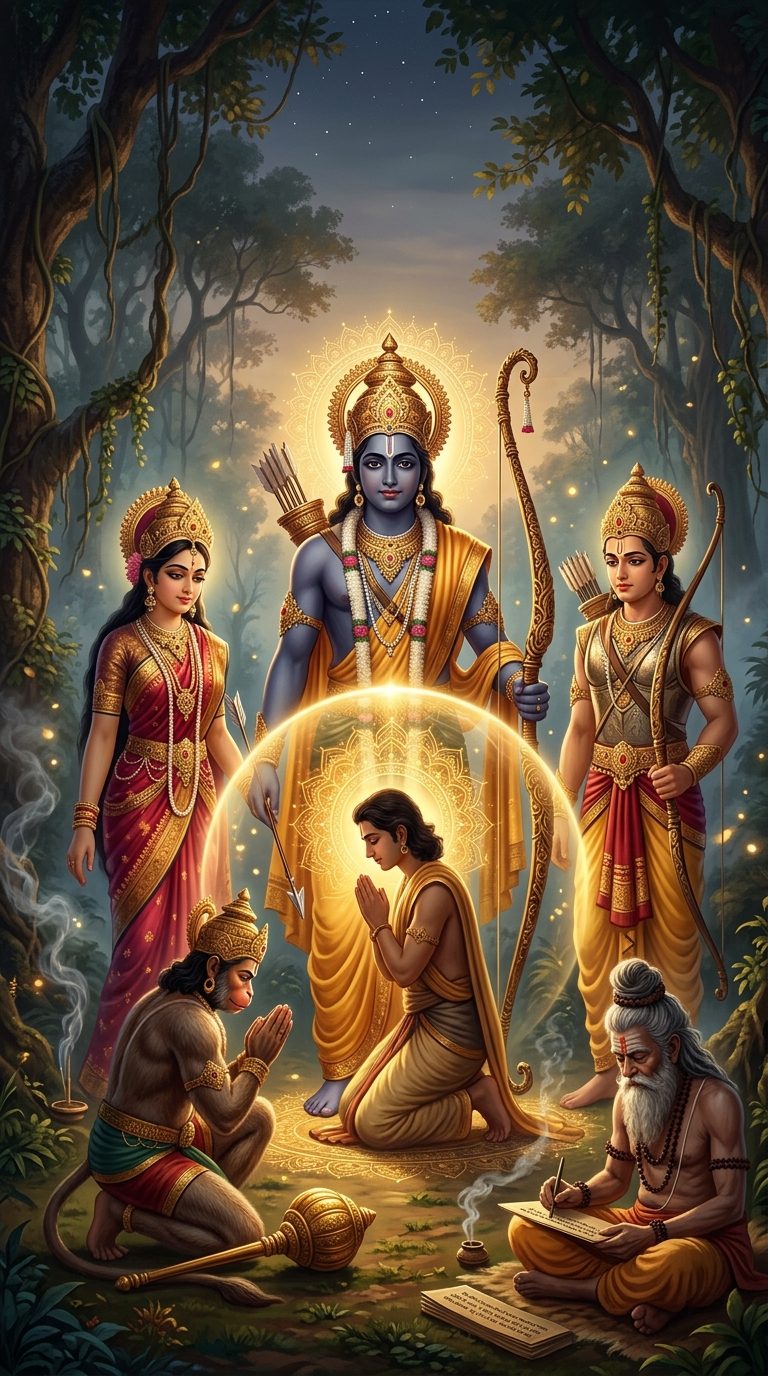
Rama with his bow standing as a protector, a golden shield of light around a kneeling devotee, with Sita, Lakshmana and Hanuman beside him
RamaKavacham

Shri Rama Raksha Stotram

Lyrics · Meaning · Audio

The great protective hymn of Rama — a “shield of the name” that asks Rama, in his many forms, to guard every part of the body and every step of life, ending in some of the most loving verses ever written to him.

Composed by the sage Budha Kaushika

Listen

Shri Rama Raksha Stotram

Son of Kali · Power of Ram

0:005:45
Deity
Rama
Type
Kavacham
Verses
39
Language
Sanskrit

Shri Rama Raksha Stotram Lyrics with Meaning

Each line shows an easy way to say it, with its English meaning. Turn on the Sanskrit, the exact pronunciation or the word-by-word meaning whenever you want to go deeper.

Meditation (Dhyanam)

ध्यायेदाजानुबाहुं धृतशरधनुषं बद्धपद्मासनस्थं

Dhyayed Ajanu Bahum Dhrita Shara Dhanusham Baddha Padmasanastham

dhyāyedājānubāhuṃ dhṛtaśaradhanuṣaṃ baddhapadmāsanasthaṃ

Meditate on Rama, his arms reaching to his knees, holding bow and arrows, seated in the lotus posture,

    पीतं वासो वसानं नवकमलदलस्पर्धिनेत्रं प्रसन्नम् ।

    Pitam Vaso Vasanam Nava Kamala Dala Spardhi Netram Prasannam

    pītaṃ vāso vasānaṃ navakamaladalaspardhinetraṃ prasannam

    wearing yellow silk, his eyes rivalling fresh lotus petals, serene,

      वामाङ्कारूढसीतामुखकमलमिलल्लोचनं नीरदाभं

      Vamankarudha Sita Mukha Kamala Milal Lochanam Niradabham

      vāmāṅkārūḍhasītāmukhakamalamilallocanaṃ nīradābhaṃ

      his eyes meeting the lotus face of Sita seated at his left, his skin the colour of a rain cloud,

        नानालङ्कारदीप्तं दधतमुरुजटामण्डनं रामचन्द्रम् ॥

        Nanalankara Diptam Dadhatam Uru Jata Mandanam Ramachandram

        nānālaṅkāradīptaṃ dadhatamurujaṭāmaṇḍanaṃ rāmacandram

        shining with many ornaments, his long matted hair his crown — Ramachandra.

          Verse 1

          चरितं रघुनाथस्य शतकोटिप्रविस्तरम् ।

          Charitam Raghunathasya Shatakoti Pravistaram

          caritaṃ raghunāthasya śatakoṭipravistaram

          The story of Rama, lord of the Raghus, spreads across a billion verses;

            एकैकमक्षरं पुंसां महापातकनाशनम् ॥ १ ॥

            Ekaikam Aksharam Pumsam Mahapataka Nashanam

            ekaikamakṣaraṃ puṃsāṃ mahāpātakanāśanam

            every single syllable of it destroys even the gravest sins.

              Verse 2

              ध्यात्वा नीलोत्पलश्यामं रामं राजीवलोचनम् ।

              Dhyatva Nilotpala Shyamam Ramam Rajiva Lochanam

              dhyātvā nīlotpalaśyāmaṃ rāmaṃ rājīvalocanam

              Meditating on Rama, dark as a blue lotus, with lotus eyes,

                जानकीलक्ष्मणोपेतं जटामुकुटमण्डितम् ॥ २ ॥

                Janaki Lakshmanopetam Jata Mukuta Manditam

                jānakīlakṣmaṇopetaṃ jaṭāmukuṭamaṇḍitam

                with Sita and Lakshmana beside him, his matted hair his crown —

                  Verse 3

                  सासितूणधनुर्बाणपाणिं नक्तञ्चरान्तकम् ।

                  Sasi Tuna Dhanur Bana Panim Naktancharantakam

                  sāsitūṇadhanurbāṇapāṇiṃ naktañcarāntakam

                  holding sword, quiver, bow and arrows, destroyer of the demons of the night,

                    स्वलीलया जगत्त्रातुमाविर्भूतमजं विभुम् ॥ ३ ॥

                    Svalilaya Jagat Tratum Avirbhutam Ajam Vibhum

                    svalīlayā jagattrātumāvirbhūtamajaṃ vibhum

                    the unborn, all-pervading one who appeared by his own play to save the world —

                      Verse 4

                      रामरक्षां पठेत्प्राज्ञः पापघ्नीं सर्वकामदाम् ।

                      Rama Raksham Pathet Pragyah Papaghnim Sarva Kamadam

                      rāmarakṣāṃ paṭhetprājñaḥ pāpaghnīṃ sarvakāmadām

                      the wise should recite this Rama Raksha, which destroys sin and fulfils every wish:

                        शिरो मे राघवः पातु भालं दशरथात्मजः ॥ ४ ॥

                        Shiro Me Raghavah Patu Bhalam Dasharathatmajah

                        śiro me rāghavaḥ pātu bhālaṃ daśarathātmajaḥ

                        May Raghava protect my head, and the son of Dasharatha my forehead.

                          Verse 5

                          कौसल्येयो दृशौ पातु विश्वामित्रप्रियः श्रुती ।

                          Kausalyeyo Drishau Patu Vishvamitra Priyah Shruti

                          kausalyeyo dṛśau pātu viśvāmitrapriyaḥ śrutī

                          May Kausalya’s son protect my eyes, and Vishvamitra’s beloved my ears;

                            घ्राणं पातु मखत्राता मुखं सौमित्रिवत्सलः ॥ ५ ॥

                            Ghranam Patu Makha Trata Mukham Saumitri Vatsalah

                            ghrāṇaṃ pātu makhatrātā mukhaṃ saumitrivatsalaḥ

                            may the protector of the sacrifice guard my nose, and the one who loves Lakshmana my mouth.

                              Verse 6

                              जिह्वां विद्यानिधिः पातु कण्ठं भरतवन्दितः ।

                              Jihvam Vidyanidhih Patu Kantham Bharata Vanditah

                              jihvāṃ vidyānidhiḥ pātu kaṇṭhaṃ bharatavanditaḥ

                              May the treasury of knowledge protect my tongue, and the one honoured by Bharata my throat;

                                स्कन्धौ दिव्यायुधः पातु भुजौ भग्नेशकार्मुकः ॥ ६ ॥

                                Skandhau Divyayudhah Patu Bhujau Bhagnesha Karmukah

                                skandhau divyāyudhaḥ pātu bhujau bhagneśakārmukaḥ

                                may the bearer of divine weapons guard my shoulders, and the breaker of Shiva’s bow my arms.

                                  Verse 7

                                  करौ सीतापतिः पातु हृदयं जामदग्न्यजित् ।

                                  Karau Sitapatih Patu Hridayam Jamadagnyajit

                                  karau sītāpatiḥ pātu hṛdayaṃ jāmadagnyajit

                                  May Sita’s husband protect my hands, and the conqueror of Parashurama my heart;

                                    मध्यं पातु खरध्वंसी नाभिं जाम्बवदाश्रयः ॥ ७ ॥

                                    Madhyam Patu Khara Dhvamsi Nabhim Jambavad Ashrayah

                                    madhyaṃ pātu kharadhvaṃsī nābhiṃ jāmbavadāśrayaḥ

                                    may the slayer of the demon Khara guard my middle, and Jambavan’s refuge my navel.

                                      Verse 8

                                      सुग्रीवेशः कटी पातु सक्थिनी हनुमत्प्रभुः ।

                                      Sugrivesha Kati Patu Sakthini Hanumat Prabhuh

                                      sugrīveśaḥ kaṭī pātu sakthinī hanumatprabhuḥ

                                      May Sugriva’s lord protect my waist, and Hanuman’s master my hips;

                                        ऊरू रघूत्तमः पातु रक्षःकुलविनाशकृत् ॥ ८ ॥

                                        Uru Raghuttamah Patu Rakshah Kula Vinashakrit

                                        ūrū raghūttamaḥ pātu rakṣaḥkulavināśakṛt

                                        may the best of the Raghus, destroyer of the demon race, guard my thighs.

                                          Verse 9

                                          जानुनी सेतुकृत्पातु जङ्घे दशमुखान्तकः ।

                                          Januni Setukrit Patu Janghe Dashamukhantakah

                                          jānunī setukṛtpātu jaṅghe daśamukhāntakaḥ

                                          May the builder of the bridge protect my knees, and the slayer of ten-headed Ravana my shins;

                                            पादौ बिभीषणश्रीदः पातु रामोऽखिलं वपुः ॥ ९ ॥

                                            Padau Bibhishana Shridah Patu Ramo Khilam Vapuh

                                            pādau bibhīṣaṇaśrīdaḥ pātu rāmo'khilaṃ vapuḥ

                                            may the giver of Vibhishana’s kingdom guard my feet — and may Rama protect my whole body.

                                              Verse 10

                                              एतां रामबलोपेतां रक्षां यः सुकृती पठेत् ।

                                              Etam Rama Balopetam Raksham Yah Sukriti Pathet

                                              etāṃ rāmabalopetāṃ rakṣāṃ yaḥ sukṛtī paṭhet

                                              The fortunate one who recites this protection, full of Rama’s strength,

                                                स चिरायुः सुखी पुत्री विजयी विनयी भवेत् ॥ १० ॥

                                                Sa Chirayuh Sukhi Putri Vijayi Vinayi Bhavet

                                                sa cirāyuḥ sukhī putrī vijayī vinayī bhavet

                                                will live long and be happy, blessed with children, victorious and humble.

                                                  Verse 11

                                                  पातालभूतलव्योमचारिणश्छद्मचारिणः ।

                                                  Patala Bhutala Vyoma Charinash Chhadma Charinah

                                                  pātālabhūtalavyomacāriṇaśchadmacāriṇaḥ

                                                  Beings that roam beneath the earth, on the earth or in the sky, or that move in disguise,

                                                    न द्रष्टुमपि शक्तास्ते रक्षितं रामनामभिः ॥ ११ ॥

                                                    Na Drashtum Api Shaktas Te Rakshitam Rama Namabhih

                                                    na draṣṭumapi śaktāste rakṣitaṃ rāmanāmabhiḥ

                                                    cannot even look at one who is protected by the names of Rama.

                                                      Verse 12

                                                      रामेति रामभद्रेति रामचन्द्रेति वा स्मरन् ।

                                                      Rameti Ramabhadreti Ramachandreti Va Smaran

                                                      rāmeti rāmabhadreti rāmacandreti vā smaran

                                                      Remembering him as Rama, Ramabhadra or Ramachandra,

                                                        नरो न लिप्यते पापैर्भुक्तिं मुक्तिं च विन्दति ॥ १२ ॥

                                                        Naro Na Lipyate Papair Bhuktim Muktim Cha Vindati

                                                        naro na lipyate pāpairbhuktiṃ muktiṃ ca vindati

                                                        a person is untouched by sin and finds both worldly joy and liberation.

                                                          Verse 13

                                                          जगज्जैत्रैकमन्त्रेण रामनाम्नाभिरक्षितम् ।

                                                          Jagaj Jaitraika Mantrena Rama Namnabhirakshitam

                                                          jagajjaitraikamantreṇa rāmanāmnābhirakṣitam

                                                          Whoever wears this, protected by Rama’s name — the one mantra that conquers the world —

                                                            यः कण्ठे धारयेत्तस्य करस्थाः सर्वसिद्धयः ॥ १३ ॥

                                                            Yah Kanthe Dharayet Tasya Karasthah Sarva Siddhayah

                                                            yaḥ kaṇṭhe dhārayettasya karasthāḥ sarvasiddhayaḥ

                                                            close to the heart like a necklace, holds every success in the palm of the hand.

                                                              Verse 14

                                                              वज्रपञ्जरनामेदं यो रामकवचं स्मरेत् ।

                                                              Vajra Panjara Namedam Yo Rama Kavacham Smaret

                                                              vajrapañjaranāmedaṃ yo rāmakavacaṃ smaret

                                                              Whoever remembers this armour of Rama, called the “diamond cage,”

                                                                अव्याहताज्ञः सर्वत्र लभते जयमङ्गलम् ॥ १४ ॥

                                                                Avyahatagyah Sarvatra Labhate Jaya Mangalam

                                                                avyāhatājñaḥ sarvatra labhate jayamaṅgalam

                                                                is obeyed everywhere and gains victory and blessings.

                                                                  Verse 15

                                                                  आदिष्टवान्यथा स्वप्ने रामरक्षामिमां हरः ।

                                                                  Adishtavan Yatha Svapne Rama Rakshamimam Harah

                                                                  ādiṣṭavānyathā svapne rāmarakṣāmimāṃ haraḥ

                                                                  Just as Shiva taught this Rama Raksha in a dream,

                                                                    तथा लिखितवान्प्रातः प्रबुद्धो बुधकौशिकः ॥ १५ ॥

                                                                    Tatha Likhitavan Pratah Prabuddho Budhakaushikah

                                                                    tathā likhitavānprātaḥ prabuddho budhakauśikaḥ

                                                                    so Budha Kaushika, waking at dawn, wrote it down.

                                                                      Verse 16

                                                                      आरामः कल्पवृक्षाणां विरामः सकलापदाम् ।

                                                                      Aramah Kalpa Vrikshanam Viramah Sakalapadam

                                                                      ārāmaḥ kalpavṛkṣāṇāṃ virāmaḥ sakalāpadām

                                                                      He is a garden of wish-fulfilling trees, the end of every misfortune,

                                                                        अभिरामस्त्रिलोकानां रामः श्रीमान्स नः प्रभुः ॥ १६ ॥

                                                                        Abhiramas Trilokanam Ramah Shriman Sa Nah Prabhuh

                                                                        abhirāmastrilokānāṃ rāmaḥ śrīmānsa naḥ prabhuḥ

                                                                        the delight of the three worlds — glorious Rama is our Lord.

                                                                          Verse 17

                                                                          तरुणौ रूपसम्पन्नौ सुकुमारौ महाबलौ ।

                                                                          Tarunau Rupa Sampannau Sukumarau Mahabalau

                                                                          taruṇau rūpasampannau sukumārau mahābalau

                                                                          Young, beautiful, gentle and mighty,

                                                                            पुण्डरीकविशालाक्षौ चीरकृष्णाजिनाम्बरौ ॥ १७ ॥

                                                                            Pundarika Vishalakshau Chira Krishnajinambarau

                                                                            puṇḍarīkaviśālākṣau cīrakṛṣṇājināmbarau

                                                                            with wide lotus eyes, dressed in bark cloth and black deerskin,

                                                                              Verse 18

                                                                              फलमूलाशिनौ दान्तौ तापसौ ब्रह्मचारिणौ ।

                                                                              Phala Mulashinau Dantau Tapasau Brahmacharinau

                                                                              phalamūlāśinau dāntau tāpasau brahmacāriṇau

                                                                              living on fruits and roots, self-controlled ascetics living in purity —

                                                                                पुत्रौ दशरथस्यैतौ भ्रातरौ रामलक्ष्मणौ ॥ १८ ॥

                                                                                Putrau Dasharathasyaitau Bhratarau Rama Lakshmanau

                                                                                putrau daśarathasyaitau bhrātarau rāmalakṣmaṇau

                                                                                these are the sons of Dasharatha, the brothers Rama and Lakshmana.

                                                                                  Verse 19

                                                                                  शरण्यौ सर्वसत्त्वानां श्रेष्ठौ सर्वधनुष्मताम् ।

                                                                                  Sharanyau Sarva Sattvanam Shreshthau Sarva Dhanushmatam

                                                                                  śaraṇyau sarvasattvānāṃ śreṣṭhau sarvadhanuṣmatām

                                                                                  The refuge of all beings, the best of all archers,

                                                                                    रक्षःकुलनिहन्तारौ त्रायेतां नो रघूत्तमौ ॥ १९ ॥

                                                                                    Rakshah Kula Nihantarau Trayetam No Raghuttamau

                                                                                    rakṣaḥkulanihantārau trāyetāṃ no raghūttamau

                                                                                    destroyers of the demon race — may these two best of the Raghus protect us.

                                                                                      Verse 20

                                                                                      आत्तसज्यधनुषाविषुस्पृशावक्षयाशुगनिषङ्गसङ्गिनौ ।

                                                                                      Atta Sajya Dhanushav Ishusprishav Akshayashuga Nishanga Sanginau

                                                                                      āttasajyadhanuṣāviṣuspṛśāvakṣayāśuganiṣaṅgasaṅginau

                                                                                      With strung bows in hand, fingers on their arrows, carrying quivers that never empty,

                                                                                        रक्षणाय मम रामलक्ष्मणावग्रतः पथि सदैव गच्छताम् ॥ २० ॥

                                                                                        Rakshanaya Mama Rama Lakshmanav Agratah Pathi Sadaiva Gachchhatam

                                                                                        rakṣaṇāya mama rāmalakṣmaṇāvagrataḥ pathi sadaiva gacchatām

                                                                                        may Rama and Lakshmana always walk ahead of me on my path, to protect me.

                                                                                          Verse 21

                                                                                          सन्नद्धः कवची खड्गी चापबाणधरो युवा ।

                                                                                          Sannaddhah Kavachi Khadgi Chapa Bana Dharo Yuva

                                                                                          sannaddhaḥ kavacī khaḍgī cāpabāṇadharo yuvā

                                                                                          Ready, armoured, sword in hand, carrying bow and arrows, young,

                                                                                            गच्छन्मनोरथोऽस्माकं रामः पातु सलक्ष्मणः ॥ २१ ॥

                                                                                            Gachchhan Manoratho Smakam Ramah Patu Salakshmanah

                                                                                            gacchanmanoratho'smākaṃ rāmaḥ pātu salakṣmaṇaḥ

                                                                                            moving ahead as our heart’s wish — may Rama protect us, together with Lakshmana.

                                                                                              Verse 22

                                                                                              रामो दाशरथिः शूरो लक्ष्मणानुचरो बली ।

                                                                                              Ramo Dasharathih Shuro Lakshmananucharo Bali

                                                                                              rāmo dāśarathiḥ śūro lakṣmaṇānucaro balī

                                                                                              Rama, son of Dasharatha, the brave, the strong, followed by Lakshmana,

                                                                                                काकुत्स्थः पुरुषः पूर्णः कौसल्येयो रघूत्तमः ॥ २२ ॥

                                                                                                Kakutsthah Purushah Purnah Kausalyeyo Raghuttamah

                                                                                                kākutsthaḥ puruṣaḥ pūrṇaḥ kausalyeyo raghūttamaḥ

                                                                                                descendant of Kakutstha, the complete Person, son of Kausalya, best of the Raghus,

                                                                                                  Verse 23

                                                                                                  वेदान्तवेद्यो यज्ञेशः पुराणपुरुषोत्तमः ।

                                                                                                  Vedanta Vedyo Yagyeshah Purana Purushottamah

                                                                                                  vedāntavedyo yajñeśaḥ purāṇapuruṣottamaḥ

                                                                                                  known through the Upanishads, lord of sacrifice, the ancient supreme Person,

                                                                                                    जानकीवल्लभः श्रीमानप्रमेयपराक्रमः ॥ २३ ॥

                                                                                                    Janaki Vallabhah Shriman Aprameya Parakramah

                                                                                                    jānakīvallabhaḥ śrīmānaprameyaparākramaḥ

                                                                                                    beloved of Sita, glorious, of boundless valour.

                                                                                                      Verse 24

                                                                                                      इत्येतानि जपन्नित्यं मद्भक्तः श्रद्धयान्वितः ।

                                                                                                      Ityetani Japan Nityam Madbhaktah Shraddhayanvitah

                                                                                                      ityetāni japannityaṃ madbhaktaḥ śraddhayānvitaḥ

                                                                                                      My devotee who chants these names daily, full of faith,

                                                                                                        अश्वमेधाधिकं पुण्यं सम्प्राप्नोति न संशयः ॥ २४ ॥

                                                                                                        Ashvamedhadhikam Punyam Samprapnoti Na Samshayah

                                                                                                        aśvamedhādhikaṃ puṇyaṃ samprāpnoti na saṃśayaḥ

                                                                                                        gains merit greater than the great horse sacrifice — there is no doubt.

                                                                                                          Verse 25

                                                                                                          रामं दूर्वादलश्यामं पद्माक्षं पीतवाससम् ।

                                                                                                          Ramam Durvadala Shyamam Padmaksham Pita Vasasam

                                                                                                          rāmaṃ dūrvādalaśyāmaṃ padmākṣaṃ pītavāsasam

                                                                                                          Those who praise Rama — dark as durva grass, lotus-eyed, dressed in yellow —

                                                                                                            स्तुवन्ति नामभिर्दिव्यैर्न ते संसारिणो नराः ॥ २५ ॥

                                                                                                            Stuvanti Namabhir Divyair Na Te Samsarino Narah

                                                                                                            stuvanti nāmabhirdivyairna te saṃsāriṇo narāḥ

                                                                                                            with his divine names are no longer bound to the cycle of rebirth.

                                                                                                              Verse 26

                                                                                                              रामं लक्ष्मणपूर्वजं रघुवरं सीतापतिं सुन्दरं

                                                                                                              Ramam Lakshmana Purvajam Raghuvaram Sitapatim Sundaram

                                                                                                              rāmaṃ lakṣmaṇapūrvajaṃ raghuvaraṃ sītāpatiṃ sundaraṃ

                                                                                                              Rama, Lakshmana’s elder brother, best of the Raghus, Sita’s beautiful husband,

                                                                                                                काकुत्स्थं करुणार्णवं गुणनिधिं विप्रप्रियं धार्मिकम् ।

                                                                                                                Kakutstham Karunarnavam Gunanidhim Vipra Priyam Dharmikam

                                                                                                                kākutsthaṃ karuṇārṇavaṃ guṇanidhiṃ viprapriyaṃ dhārmikam

                                                                                                                of Kakutstha’s line, an ocean of compassion, treasury of virtues, dear to the wise, righteous,

                                                                                                                  राजेन्द्रं सत्यसन्धं दशरथतनयं श्यामलं शान्तमूर्तिं

                                                                                                                  Rajendram Satya Sandham Dasharatha Tanayam Shyamalam Shanta Murtim

                                                                                                                  rājendraṃ satyasandhaṃ daśarathatanayaṃ śyāmalaṃ śāntamūrtiṃ

                                                                                                                  king of kings, true to his word, son of Dasharatha, dark-skinned, the very form of peace —

                                                                                                                    वन्दे लोकाभिरामं रघुकुलतिलकं राघवं रावणारिम् ॥ २६ ॥

                                                                                                                    Vande Lokabhiramam Raghukula Tilakam Raghavam Ravanarim

                                                                                                                    vande lokābhirāmaṃ raghukulatilakaṃ rāghavaṃ rāvaṇārim

                                                                                                                    I bow to the delight of the world, jewel of the Raghu clan, Raghava, enemy of Ravana.

                                                                                                                      Verse 27

                                                                                                                      रामाय रामभद्राय रामचन्द्राय वेधसे ।

                                                                                                                      Ramaya Ramabhadraya Ramachandraya Vedhase

                                                                                                                      rāmāya rāmabhadrāya rāmacandrāya vedhase

                                                                                                                      To Rama, to Ramabhadra, to Ramachandra, the creator,

                                                                                                                        रघुनाथाय नाथाय सीतायाः पतये नमः ॥ २७ ॥

                                                                                                                        Raghunathaya Nathaya Sitayah Pataye Namah

                                                                                                                        raghunāthāya nāthāya sītāyāḥ pataye namaḥ

                                                                                                                        to the lord of the Raghus, the Lord, the husband of Sita — I bow.

                                                                                                                          Verse 28

                                                                                                                          श्रीराम राम रघुनन्दन राम राम

                                                                                                                          Shri Rama Rama Raghunandana Rama Rama

                                                                                                                          śrīrāma rāma raghunandana rāma rāma

                                                                                                                          Shri Rama, Rama, joy of the Raghus, Rama, Rama;

                                                                                                                            श्रीराम राम भरताग्रज राम राम ।

                                                                                                                            Shri Rama Rama Bharatagraja Rama Rama

                                                                                                                            śrīrāma rāma bharatāgraja rāma rāma

                                                                                                                            Shri Rama, Rama, Bharata’s elder brother, Rama, Rama;

                                                                                                                              श्रीराम राम रणकर्कश राम राम

                                                                                                                              Shri Rama Rama Ranakarkasha Rama Rama

                                                                                                                              śrīrāma rāma raṇakarkaśa rāma rāma

                                                                                                                              Shri Rama, Rama, fierce in battle, Rama, Rama;

                                                                                                                                श्रीराम राम शरणं भव राम राम ॥ २८ ॥

                                                                                                                                Shri Rama Rama Sharanam Bhava Rama Rama

                                                                                                                                śrīrāma rāma śaraṇaṃ bhava rāma rāma

                                                                                                                                Shri Rama, Rama, be my refuge, Rama, Rama.

                                                                                                                                  Verse 29

                                                                                                                                  श्रीरामचन्द्रचरणौ मनसा स्मरामि

                                                                                                                                  Shri Ramachandra Charanau Manasa Smarami

                                                                                                                                  śrīrāmacandracaraṇau manasā smarāmi

                                                                                                                                  I remember the feet of Shri Ramachandra with my mind;

                                                                                                                                    श्रीरामचन्द्रचरणौ वचसा गृणामि ।

                                                                                                                                    Shri Ramachandra Charanau Vachasa Grinami

                                                                                                                                    śrīrāmacandracaraṇau vacasā gṛṇāmi

                                                                                                                                    I praise the feet of Shri Ramachandra with my words;

                                                                                                                                      श्रीरामचन्द्रचरणौ शिरसा नमामि

                                                                                                                                      Shri Ramachandra Charanau Shirasa Namami

                                                                                                                                      śrīrāmacandracaraṇau śirasā namāmi

                                                                                                                                      I bow my head to the feet of Shri Ramachandra;

                                                                                                                                        श्रीरामचन्द्रचरणौ शरणं प्रपद्ये ॥ २९ ॥

                                                                                                                                        Shri Ramachandra Charanau Sharanam Prapadye

                                                                                                                                        śrīrāmacandracaraṇau śaraṇaṃ prapadye

                                                                                                                                        I take refuge at the feet of Shri Ramachandra.

                                                                                                                                          Verse 30

                                                                                                                                          माता रामो मत्पिता रामचन्द्रः

                                                                                                                                          Mata Ramo Matpita Ramachandrah

                                                                                                                                          mātā rāmo matpitā rāmacandraḥ

                                                                                                                                          Rama is my mother, Ramachandra is my father;

                                                                                                                                            स्वामी रामो मत्सखा रामचन्द्रः ।

                                                                                                                                            Svami Ramo Matsakha Ramachandrah

                                                                                                                                            svāmī rāmo matsakhā rāmacandraḥ

                                                                                                                                            Rama is my master, Ramachandra is my friend;

                                                                                                                                              सर्वस्वं मे रामचन्द्रो दयालु-

                                                                                                                                              Sarvasvam Me Ramachandro Dayalur

                                                                                                                                              sarvasvaṃ me rāmacandro dayālu-

                                                                                                                                              kind Ramachandra is my everything —

                                                                                                                                                र्नान्यं जाने नैव जाने न जाने ॥ ३० ॥

                                                                                                                                                Nanyam Jane Naiva Jane Na Jane

                                                                                                                                                rnānyaṃ jāne naiva jāne na jāne

                                                                                                                                                I know no other, no other at all, none.

                                                                                                                                                  Verse 31

                                                                                                                                                  दक्षिणे लक्ष्मणो यस्य वामे तु जनकात्मजा ।

                                                                                                                                                  Dakshine Lakshmano Yasya Vame Tu Janakatmaja

                                                                                                                                                  dakṣiṇe lakṣmaṇo yasya vāme tu janakātmajā

                                                                                                                                                  With Lakshmana at his right and Sita, daughter of Janaka, at his left,

                                                                                                                                                    पुरतो मारुतिर्यस्य तं वन्दे रघुनन्दनम् ॥ ३१ ॥

                                                                                                                                                    Purato Marutir Yasya Tam Vande Raghunandanam

                                                                                                                                                    purato mārutiryasya taṃ vande raghunandanam

                                                                                                                                                    and Hanuman before him — to that joy of the Raghus I bow.

                                                                                                                                                      Verse 32

                                                                                                                                                      लोकाभिरामं रणरङ्गधीरं राजीवनेत्रं रघुवंशनाथम् ।

                                                                                                                                                      Lokabhiramam Ranaranga Dhiram Rajiva Netram Raghuvamsha Natham

                                                                                                                                                      lokābhirāmaṃ raṇaraṅgadhīraṃ rājīvanetraṃ raghuvaṃśanātham

                                                                                                                                                      The delight of the world, steady on the battlefield, lotus-eyed, lord of the Raghu dynasty,

                                                                                                                                                        कारुण्यरूपं करुणाकरं तं श्रीरामचन्द्रं शरणं प्रपद्ये ॥ ३२ ॥

                                                                                                                                                        Karunya Rupam Karunakaram Tam Shri Ramachandram Sharanam Prapadye

                                                                                                                                                        kāruṇyarūpaṃ karuṇākaraṃ taṃ śrīrāmacandraṃ śaraṇaṃ prapadye

                                                                                                                                                        compassion in form, the source of mercy — in Shri Ramachandra I take refuge.

                                                                                                                                                          Verse 33

                                                                                                                                                          मनोजवं मारुततुल्यवेगं जितेन्द्रियं बुद्धिमतां वरिष्ठम् ।

                                                                                                                                                          Manojavam Maruta Tulya Vegam Jitendriyam Buddhimatam Varishtham

                                                                                                                                                          manojavaṃ mārutatulyavegaṃ jitendriyaṃ buddhimatāṃ variṣṭham

                                                                                                                                                          Swift as the mind, fast as the wind, master of the senses, foremost of the wise,

                                                                                                                                                            वातात्मजं वानरयूथमुख्यं श्रीरामदूतं शरणं प्रपद्ये ॥ ३३ ॥

                                                                                                                                                            Vatatmajam Vanara Yutha Mukhyam Shri Rama Dutam Sharanam Prapadye

                                                                                                                                                            vātātmajaṃ vānarayūthamukhyaṃ śrīrāmadūtaṃ śaraṇaṃ prapadye

                                                                                                                                                            son of the Wind, chief of the monkey army, messenger of Shri Rama — in him I take refuge.

                                                                                                                                                              Verse 34

                                                                                                                                                              कूजन्तं रामरामेति मधुरं मधुराक्षरम् ।

                                                                                                                                                              Kujantam Rama Rameti Madhuram Madhuraksharam

                                                                                                                                                              kūjantaṃ rāmarāmeti madhuraṃ madhurākṣaram

                                                                                                                                                              Singing “Rama, Rama” in sweet, sweet syllables,

                                                                                                                                                                आरुह्य कविताशाखां वन्दे वाल्मीकिकोकिलम् ॥ ३४ ॥

                                                                                                                                                                Aruhya Kavita Shakham Vande Valmiki Kokilam

                                                                                                                                                                āruhya kavitāśākhāṃ vande vālmīkikokilam

                                                                                                                                                                perched on the branch of poetry — I bow to Valmiki, the cuckoo.

                                                                                                                                                                  Verse 35

                                                                                                                                                                  आपदामपहर्तारं दातारं सर्वसम्पदाम् ।

                                                                                                                                                                  Apadam Apahartaram Dataram Sarva Sampadam

                                                                                                                                                                  āpadāmapahartāraṃ dātāraṃ sarvasampadām

                                                                                                                                                                  Remover of misfortunes, giver of every blessing,

                                                                                                                                                                    लोकाभिरामं श्रीरामं भूयो भूयो नमाम्यहम् ॥ ३५ ॥

                                                                                                                                                                    Lokabhiramam Shri Ramam Bhuyo Bhuyo Namamyaham

                                                                                                                                                                    lokābhirāmaṃ śrīrāmaṃ bhūyo bhūyo namāmyaham

                                                                                                                                                                    delight of the world — to Shri Rama I bow again and again.

                                                                                                                                                                      Verse 36

                                                                                                                                                                      भर्जनं भवबीजानामर्जनं सुखसम्पदाम् ।

                                                                                                                                                                      Bharjanam Bhava Bijanam Arjanam Sukha Sampadam

                                                                                                                                                                      bharjanaṃ bhavabījānāmarjanaṃ sukhasampadām

                                                                                                                                                                      It roasts the seeds of rebirth, it earns happiness and wealth,

                                                                                                                                                                        तर्जनं यमदूतानां रामरामेति गर्जनम् ॥ ३६ ॥

                                                                                                                                                                        Tarjanam Yama Dutanam Rama Rameti Garjanam

                                                                                                                                                                        tarjanaṃ yamadūtānāṃ rāmarāmeti garjanam

                                                                                                                                                                        it frightens away the messengers of death — the roar of “Rama, Rama!”

                                                                                                                                                                          Verse 37

                                                                                                                                                                          रामो राजमणिः सदा विजयते रामं रमेशं भजे

                                                                                                                                                                          Ramo Rajamanih Sada Vijayate Ramam Ramesham Bhaje

                                                                                                                                                                          rāmo rājamaṇiḥ sadā vijayate rāmaṃ rameśaṃ bhaje

                                                                                                                                                                          Rama, jewel among kings, is always victorious; I worship Rama, lord of Lakshmi.

                                                                                                                                                                            रामेणाभिहता निशाचरचमू रामाय तस्मै नमः ।

                                                                                                                                                                            Ramenabhihata Nishachara Chamu Ramaya Tasmai Namah

                                                                                                                                                                            rāmeṇābhihatā niśācaracamū rāmāya tasmai namaḥ

                                                                                                                                                                            By Rama the demon army was destroyed — to that Rama I bow.

                                                                                                                                                                              रामान्नास्ति परायणं परतरं रामस्य दासोऽस्म्यहं

                                                                                                                                                                              Raman Nasti Parayanam Parataram Ramasya Daso Smyaham

                                                                                                                                                                              rāmānnāsti parāyaṇaṃ parataraṃ rāmasya dāso'smyahaṃ

                                                                                                                                                                              There is no refuge higher than Rama; I am Rama’s servant.

                                                                                                                                                                                रामे चित्तलयः सदा भवतु मे भो राम मामुद्धर ॥ ३७ ॥

                                                                                                                                                                                Rame Chitta Layah Sada Bhavatu Me Bho Rama Mam Uddhara

                                                                                                                                                                                rāme cittalayaḥ sadā bhavatu me bho rāma māmuddhara

                                                                                                                                                                                May my mind always be absorbed in Rama — O Rama, lift me up.

                                                                                                                                                                                  Verse 38

                                                                                                                                                                                  श्रीराम राम रामेति रमे रामे मनोरमे ।

                                                                                                                                                                                  Shri Rama Rama Rameti Rame Rame Manorame

                                                                                                                                                                                  śrīrāma rāma rāmeti rame rāme manorame

                                                                                                                                                                                  “Shri Rama, Rama, Rama” — I delight in Rama, O lovely one;

                                                                                                                                                                                    सहस्रनाम तत्तुल्यं रामनाम वरानने ॥ ३८ ॥

                                                                                                                                                                                    Sahasranama Tat Tulyam Rama Nama Varanane

                                                                                                                                                                                    sahasranāma tattulyaṃ rāmanāma varānane

                                                                                                                                                                                    the name of Rama equals the thousand names, O fair-faced one.

                                                                                                                                                                                      About Shri Rama Raksha Stotram

                                                                                                                                                                                      The Rama Raksha Stotram is a kavacha — a “spiritual armour” prayer. It is said to have been revealed in a dream by Shiva to the sage Budha Kaushika, who wrote it down the next morning. For centuries it has been recited every evening in many Indian homes, especially in Maharashtra, often by children taught it by their grandparents.

                                                                                                                                                                                      Its heart (verses 4–9) is a protection prayer for the whole body: “May Raghava protect my head, the son of Dasharatha my forehead, Kausalya’s son my eyes…” all the way down to the feet. Each part of the body is placed under the care of a different name of Rama, recalling a different story — the one who broke Shiva’s bow, the one who built the bridge to Lanka, the friend of Sugriva.

                                                                                                                                                                                      The second half turns to pure devotion: the famous lines “Shri Rama Rama Raghunandana Rama Rama,” “Rama is my mother, Rama is my father,” and the closing teaching that saying “Rama” three times equals reciting the thousand names of Vishnu.

                                                                                                                                                                                      The Stories Inside the Hymn

                                                                                                                                                                                      A hymn received in a dream

                                                                                                                                                                                      Verse 15 tells its own origin: Shiva (Hara) appeared to the sage Budha Kaushika in a dream and recited this Rama Raksha. When the sage awoke at dawn, he wrote it down exactly as he had heard it.

                                                                                                                                                                                      That is why the stotram is treated not simply as a poem but as a revealed protection — Shiva himself praising the name of Rama.

                                                                                                                                                                                      Rama’s name as a shield

                                                                                                                                                                                      Verses 11–14 promise that beings who wander under the earth, on the earth or in the sky, even those who move in disguise, cannot so much as look at someone protected by Rama’s names. The hymn calls itself the vajra-pañjara — the “diamond cage.”

                                                                                                                                                                                      The real armour, it suggests, is remembrance: keeping Rama’s name in the mind turns fear into steadiness.

                                                                                                                                                                                      Rama equals a thousand names

                                                                                                                                                                                      In the final verse Shiva tells Parvati that chanting “Rama” is equal to reciting all thousand names of Vishnu. A popular explanation uses the old Sanskrit number-code: the syllables of “Rāma” each stand for numbers that multiply to a thousand when said three times.

                                                                                                                                                                                      Whatever the arithmetic, the message is simple: one name, said with love, is enough.

                                                                                                                                                                                      How to Chant Shri Rama Raksha Stotram

                                                                                                                                                                                      When to chant

                                                                                                                                                                                      • ✦Every evening at dusk — the traditional time
                                                                                                                                                                                      • ✦Rama Navami and Tuesdays
                                                                                                                                                                                      • ✦Before travel or at night if afraid
                                                                                                                                                                                      • ✦During illness or difficult periods, as a prayer for protection

                                                                                                                                                                                      How many times

                                                                                                                                                                                      Once daily. During Rama Navami or a vow, 11 times a day is common.

                                                                                                                                                                                      1. 1

                                                                                                                                                                                        Sit facing an image of Rama, Sita and Lakshmana, or a lit lamp.

                                                                                                                                                                                      2. 2

                                                                                                                                                                                        Begin with the meditation verse, picturing Rama seated with Sita.

                                                                                                                                                                                      3. 3

                                                                                                                                                                                        For verses 4–9, touch or focus on each part of the body as it is named.

                                                                                                                                                                                      4. 4

                                                                                                                                                                                        Let the devotional verses 26–38 be sung slowly and with feeling.

                                                                                                                                                                                      5. 5

                                                                                                                                                                                        End by chanting “Rama” three times.

                                                                                                                                                                                      Pronunciation Guide

                                                                                                                                                                                      The sounds that trip people up most in this hymn, and how to say them.

                                                                                                                                                                                      rāghavaḥ

                                                                                                                                                                                      raa-gha-vah — “descendant of Raghu.”

                                                                                                                                                                                      pātu

                                                                                                                                                                                      paa-tu — “may he protect,” the key word of verses 4–9.

                                                                                                                                                                                      kausalyeyo

                                                                                                                                                                                      kow-sal-yay-yoh — “son of Kausalya.”

                                                                                                                                                                                      raghunandana

                                                                                                                                                                                      ra-ghu-nun-da-na.

                                                                                                                                                                                      rāmeti

                                                                                                                                                                                      raa-may-ti — “saying ‘Rama’.”

                                                                                                                                                                                      Power of Ram by Son of Kali

                                                                                                                                                                                      The music

                                                                                                                                                                                      Power of Ram

                                                                                                                                                                                      by Son of Kali

                                                                                                                                                                                      More for Rama

                                                                                                                                                                                      Frequently Asked Questions

                                                                                                                                                                                      Who wrote the Rama Raksha Stotram?

                                                                                                                                                                                      It is credited to the sage Budha Kaushika. The hymn itself says Shiva recited it to him in a dream and he wrote it down in the morning.

                                                                                                                                                                                      What does Rama Raksha mean?

                                                                                                                                                                                      “Raksha” means protection. It is a prayer of protection, asking Rama to guard the body, mind and life of the one who recites it.

                                                                                                                                                                                      When should the Rama Raksha Stotram be recited?

                                                                                                                                                                                      Traditionally every evening at dusk, and especially on Rama Navami. Many people also recite it before travel or at night.

                                                                                                                                                                                      What are the benefits of reciting it?

                                                                                                                                                                                      Verse 10 says the one who recites it becomes long-lived, happy, blessed with children, victorious and humble. It is traditionally recited for protection and courage.

                                                                                                                                                                                      How many verses are in the Rama Raksha Stotram?

                                                                                                                                                                                      The common text has a meditation verse followed by 38 verses.

                                                                                                                                                                                      Text: Shri Rama Raksha Stotram by Budha Kaushika — public domain (Sanskrit Wikisource), with typographical errors corrected to the standard text. Easy reading, transliteration and English translation written for the Jaguar Medicine Tribe Mantra Library.

                                                                                                                                                                                      Music: Recordings by Son of Kali, produced with AI-assisted vocals and instrumentation.

                                                                                                                                                                                      Note: Benefits described here are traditional beliefs, shared for understanding — not medical or guaranteed outcomes.