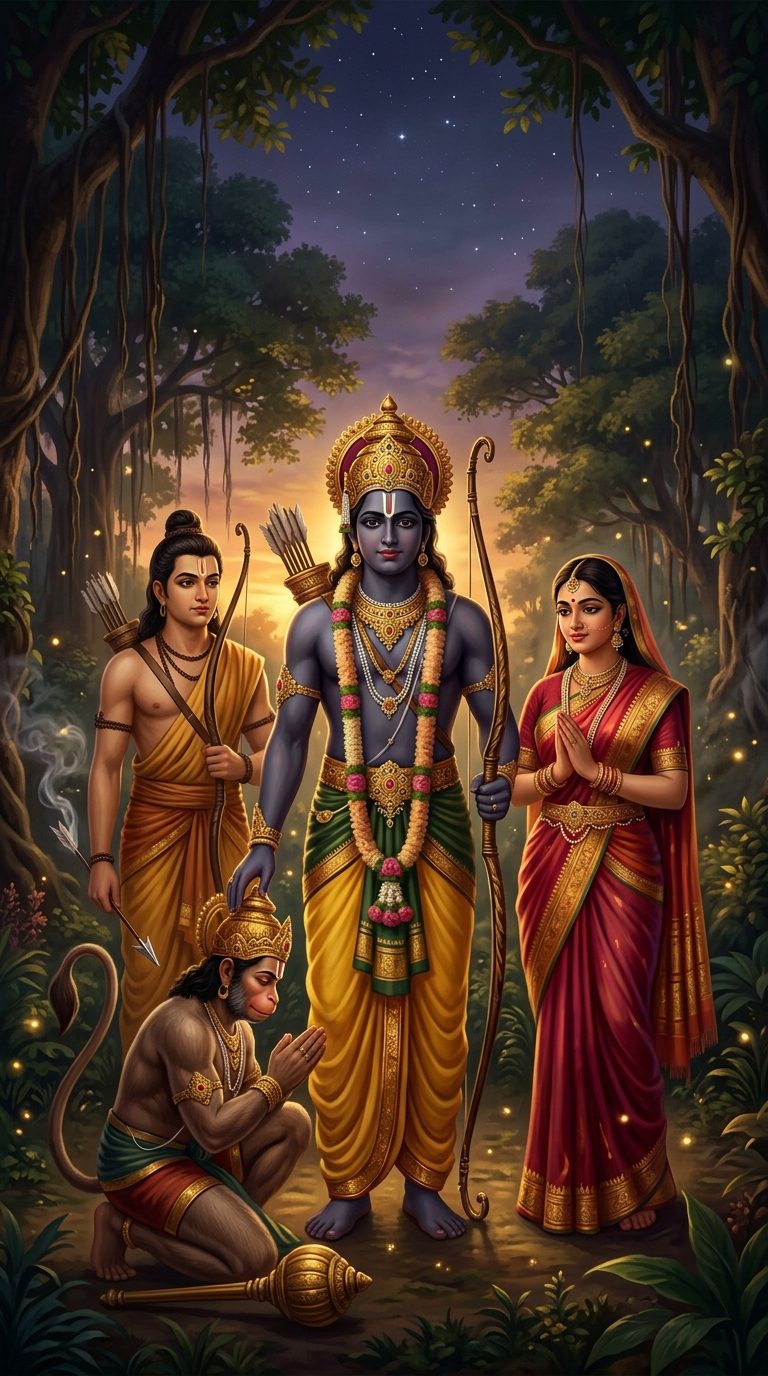
Five luminous lotus jewels encircling Lord Rama seated beneath a golden canopy, Hanuman at his feet
RamaStotram

Rama Pancharatnam

Lyrics · Meaning · Audio

Five “jewel” verses to Rama, each ending “namo’stu rāmāya salakṣmaṇāya” — “salutations to Rama, together with Lakshmana” — promising the highest goal to those who chant them at dawn, noon and dusk.

Attributed to Adi Shankaracharya

Listen

Rama Pancharatnam

Son of Kali · Power of Ram

0:005:26
Deity
Rama
Type
Stotram
Verses
6
Language
Sanskrit

Rama Pancharatnam Lyrics with Meaning

Each line shows an easy way to say it, with its English meaning. Turn on the Sanskrit, the exact pronunciation or the word-by-word meaning whenever you want to go deeper.

Jewel 1

कञ्जातपत्रायतलोचनाय कर्णावतंसोज्ज्वलकुण्डलाय ।

Kanjata Patrayata Lochanaya Karnavatamsojjvala Kundalaya

kañjātapatrāyatalocanāya karṇāvataṃsojjvalakuṇḍalāya

To him whose eyes are long like lotus petals, whose earrings shine brightly,

    कारुण्यपात्राय सुवंशजाय नमोऽस्तु रामाय सलक्ष्मणाय ॥ १ ॥

    Karunya Patraya Suvamshajaya Namostu Ramaya Salakshmanaya

    kāruṇyapātrāya suvaṃśajāya namo'stu rāmāya salakṣmaṇāya

    the vessel of compassion, born of a noble line — salutations to Rama, with Lakshmana.

      Jewel 2

      विद्युन्निभाम्भोदसुविग्रहाय विद्याधरैः संस्तुतसद्गुणाय ।

      Vidyunnibhambhoda Suvigrahaya Vidyadharaih Samstuta Sadgunaya

      vidyunnibhāmbhodasuvigrahāya vidyādharaiḥ saṃstutasadguṇāya

      To him whose form is like a rain cloud lit by lightning, whose virtues are praised by the celestial vidyadharas,

        वीरावताराय विरोधिहर्त्रे नमोऽस्तु रामाय सलक्ष्मणाय ॥ २ ॥

        Viravataraya Virodhihartre Namostu Ramaya Salakshmanaya

        vīrāvatārāya virodhihartre namo'stu rāmāya salakṣmaṇāya

        the hero incarnate, destroyer of enemies — salutations to Rama, with Lakshmana.

          Jewel 3

          संसक्तदिव्यायुधकार्मुकाय समुद्रगर्वापहरायुधाय ।

          Samsakta Divyayudha Karmukaya Samudra Garvapaharayudhaya

          saṃsaktadivyāyudhakārmukāya samudragarvāpaharāyudhāya

          To him who holds divine weapons and the bow, whose arrow humbled the pride of the ocean,

            सुग्रीवमित्राय सुरारिहन्त्रे नमोऽस्तु रामाय सलक्ष्मणाय ॥ ३ ॥

            Sugriva Mitraya Surarihantre Namostu Ramaya Salakshmanaya

            sugrīvamitrāya surārihantre namo'stu rāmāya salakṣmaṇāya

            friend of Sugriva, slayer of the gods’ enemies — salutations to Rama, with Lakshmana.

              Jewel 4

              पीताम्बरालङ्कृतमध्यकाय पितामहेन्द्रामरवन्दिताय ।

              Pitambaralankrita Madhyakaya Pitamahendramara Vanditaya

              pītāmbarālaṅkṛtamadhyakāya pitāmahendrāmaravanditāya

              To him whose waist is adorned with yellow silk, worshipped by Brahma, Indra and the gods,

                पित्रे स्वभक्तस्य जनस्य मात्रे नमोऽस्तु रामाय सलक्ष्मणाय ॥ ४ ॥

                Pitre Svabhaktasya Janasya Matre Namostu Ramaya Salakshmanaya

                pitre svabhaktasya janasya mātre namo'stu rāmāya salakṣmaṇāya

                who is father and mother to his devotees — salutations to Rama, with Lakshmana.

                  Jewel 5

                  नमो नमस्तेऽखिलपूजिताय नमो नमस्तेन्दुनिभाननाय ।

                  Namo Namaste Akhila Pujitaya Namo Namastendu Nibhananaya

                  namo namaste'khilapūjitāya namo namastendunibhānanāya

                  Salutations, salutations to you, worshipped by all; salutations, salutations to you with a moon-like face;

                    नमो नमस्ते रघुवंशजाय नमोऽस्तु रामाय सलक्ष्मणाय ॥ ५ ॥

                    Namo Namaste Raghuvamshajaya Namostu Ramaya Salakshmanaya

                    namo namaste raghuvaṃśajāya namo'stu rāmāya salakṣmaṇāya

                    salutations, salutations to you, born of the Raghu line — salutations to Rama, with Lakshmana.

                      Closing verse

                      इमानि पञ्चरत्नानि त्रिसन्ध्यं यः पठेन्नरः ।

                      Imani Pancharatnani Trisandhyam Yah Pathen Narah

                      imāni pañcaratnāni trisandhyaṃ yaḥ paṭhennaraḥ

                      Whoever recites these five jewels at dawn, noon and dusk

                        सर्वपापविनिर्मुक्तः स याति परमां गतिम् ॥ ६ ॥

                        Sarva Papa Vinirmuktah Sa Yati Paramam Gatim

                        sarvapāpavinirmuktaḥ sa yāti paramāṃ gatim

                        is freed from every sin and reaches the highest goal.

                          About Rama Pancharatnam

                          Pañcaratna means “five jewels.” Adi Shankaracharya wrote several such five-verse hymns, short enough to memorise and bright as gems.

                          This one praises Rama’s lotus-like eyes, his dazzling earrings and cloud-dark form, his weapons and his friendship with Sugriva, his yellow silk and his love for his devotees — he is called both father and mother to them. Every verse ends by saluting Rama together with his brother Lakshmana, who never left his side.

                          A sixth verse says that whoever chants these five jewels at the three junctions of the day is freed from every sin and reaches the highest goal.

                          The Stories Inside the Hymn

                          Why Lakshmana too

                          Lakshmana followed Rama into fourteen years of exile without being asked, guarding him and Sita day and night. Tradition says he did not sleep once in all those years.

                          By saluting Rama “with Lakshmana,” the hymn honours the devotion of the perfect brother alongside the Lord himself.

                          How to Chant Rama Pancharatnam

                          When to chant

                          • ✦Dawn, noon and dusk, as the closing verse suggests
                          • ✦Rama Navami
                          • ✦Thursdays

                          How many times

                          Once at each sandhya, or once daily.

                          1. 1

                            Sit before an image of Rama and Lakshmana.

                          2. 2

                            Chant the five verses, joining the refrain each time.

                          3. 3

                            Close with the sixth verse and a bow.

                          Pronunciation Guide

                          The sounds that trip people up most in this hymn, and how to say them.

                          kañjāta

                          kun-jaa-ta — “lotus.”

                          salakṣmaṇāya

                          sa-luk-shma-naa-ya — “with Lakshmana.”

                          kārmuka

                          kaar-mu-ka — “bow.”

                          Power of Ram by Son of Kali

                          The music

                          Power of Ram

                          by Son of Kali

                          More for Rama

                          Frequently Asked Questions

                          Who wrote the Rama Pancharatnam?

                          It is attributed to Adi Shankaracharya.

                          What does Namostu Ramaya Salakshmanaya mean?

                          “Salutations to Rama, together with Lakshmana.”

                          When should it be chanted?

                          The closing verse recommends the three sandhyas — dawn, noon and dusk.

                          Text: Traditional public-domain Sanskrit hymn. Easy reading, transliteration and English translation written for the Jaguar Medicine Tribe Mantra Library.

                          Music: Recordings by Son of Kali, produced with AI-assisted vocals and instrumentation.

                          Note: Benefits described here are traditional beliefs, shared for understanding — not medical or guaranteed outcomes.