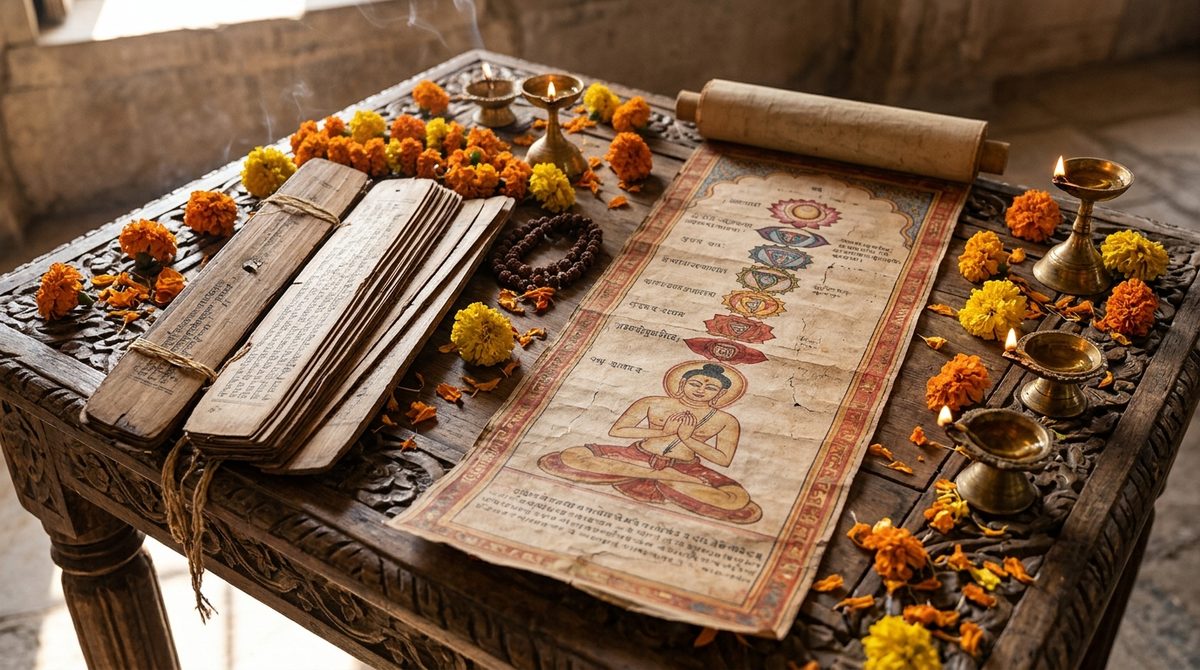
Chakra means 'wheel' in Sanskrit. In tantric yoga, the chakras are centres along the central channel of the subtle body, from the base of the spine to the crown of the head. Before you work with them, it helps to know what the tradition actually says — and what got added along the way.
Where The System Comes From
Chakras appear in Indian tantric texts from roughly the 8th century onwards, and early sources don't agree on how many there are — five, six, seven, or more. The seven-centre system that's now standard was set out in detail in the Ṣaṭ-cakra-nirūpaṇa, written by Pūrṇānanda in 1577. Each chakra was described with a number of lotus petals, an element, a seed syllable (bija), a presiding deity, and its place in the body.
The West met this system mainly through Sir John Woodroffe (writing as Arthur Avalon), whose book The Serpent Power translated that text in 1919. Over the 20th century, Western writers added new layers: the rainbow colour scheme (red at the root to violet at the crown), links to glands and psychology, and the idea of 'blocked' chakras. Some of that is useful; it's just good to know it's recent.
A Map, Not Anatomy
Chakras aren't physical organs you could find in a scan. Think of them as a map for paying attention. Each centre gathers a cluster of body sensations, emotions and behaviours — the root around safety and the legs and feet, the throat around speaking and listening, and so on. Moving your attention region by region is a structured way of noticing what's going on in you.
That's how this course uses them. 'Blocked' means a quality is hard to reach (under-active). 'Overactive' means a quality has gone too far and is running the show — the solar plexus drive tipping into control, the heart's care tipping into self-erasure. Balance is the middle.
The Seven At A Glance
Each has its traditional Sanskrit name, element and seed syllable.
- ✦Root · Mūlādhāra · earth · LAM — safety, body, belonging
- ✦Sacral · Svādhiṣṭhāna · water · VAM — feeling, pleasure, creativity
- ✦Solar plexus · Maṇipūra · fire · RAM — will, confidence, action
- ✦Heart · Anāhata · air · YAM — love, compassion, connection
- ✦Throat · Viśuddha · space · HAM — truth, voice, expression
- ✦Third eye · Ājñā · mind · OM — insight, intuition, clarity
- ✦Crown · Sahasrāra · beyond the elements · silence — meaning, spirit, wholeness
The practice · 10 minutes
The Seven-Point Body Scan
- 1Take the Chakra Check-In on the course page first so you have a baseline.
- 2Sit upright. Breathe slowly through the nose for a minute.
- 3Bring your attention to the base of your spine and pelvic floor. Spend three breaths there. Notice: heavy, light, tense, numb, warm?
- 4Move up in turn: lower belly, upper belly below the ribs, centre of the chest, throat, between the eyebrows, top of the head. Three breaths each.
- 5Don't try to fix anything. Just notice and name one word for each place.
- 6Write your seven words down. Compare them with your Check-In scores.
Coming back to it: Repeat the scan at the end of the seven-day cycle. Which words changed? That's the first evidence of the work landing.
Journal prompts
- “Which part of the chakra history surprised me?”
- “Which region of my body was hardest to feel in the scan?”
- “What do I hope chakra work will help me notice?”
Saved privately on this device. Come back tomorrow and log it again.
Check Your Understanding
3 quick questions. Retake it any time.
1. Which text set out the seven-chakra system that's now standard?
2. The rainbow colour scheme for the chakras is…
3. How does this course use the word 'blocked'?
Go deeper on the site
Keep Practising With Our Free Apps
Everything here is free, with no signup.
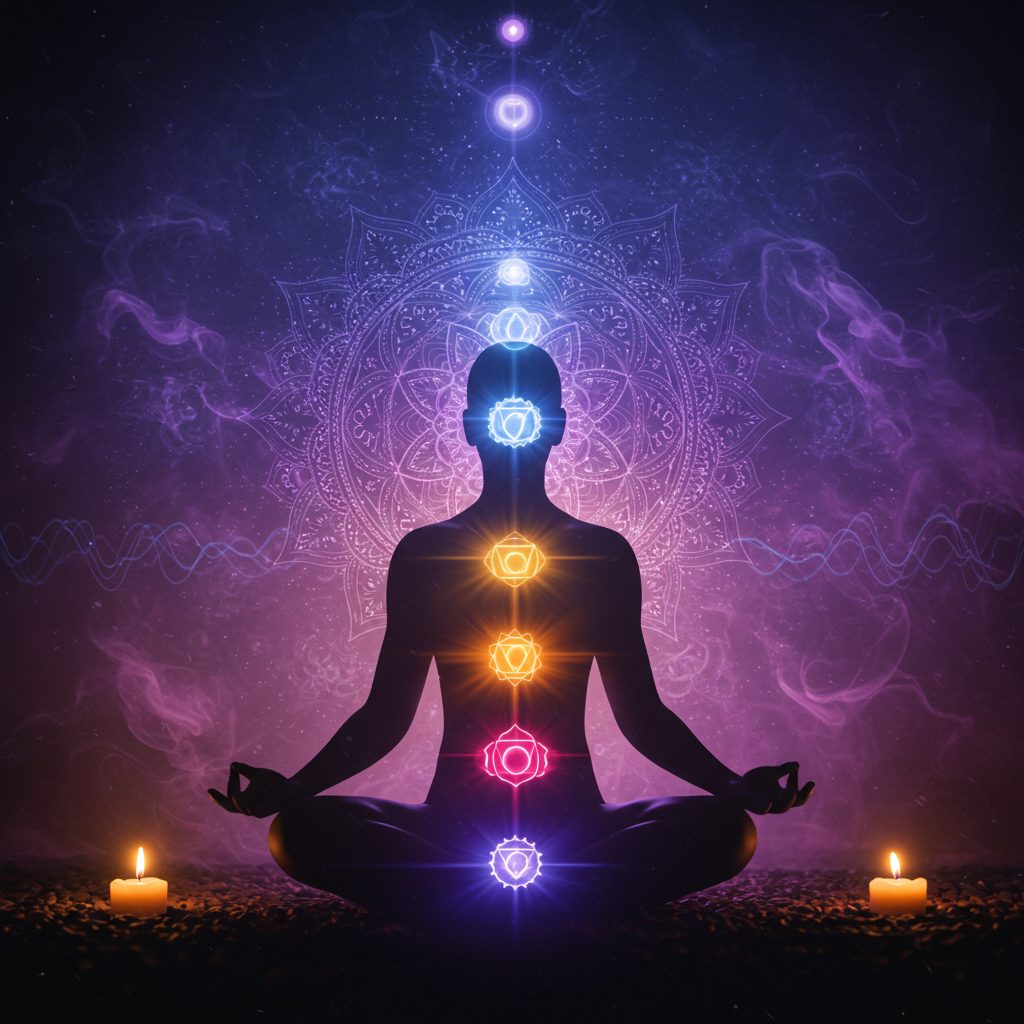
Chakra Alignment
A guided journey through all seven chakras with tones, colour and breath.
Align your chakras →
Mantra Library
Learn and chant sacred mantras, with meanings, pronunciation and recordings.
Explore mantras →
Breathwork Timer
Guided breathing patterns to pair with each chakra practice.
Open the timer →Safety: Chakra work is a reflective and contemplative practice, not a medical or psychological treatment. If you are dealing with physical symptoms, depression, trauma or anxiety, please work with a qualified professional alongside any practice here.