Chakra Journey
Move from root to crown with a tuned frequency and seed sound for each energy centre. Tap any chakra to hear it alone.
Press the centre button for the full root-to-crown sequence, or tap a single chakra to focus there.
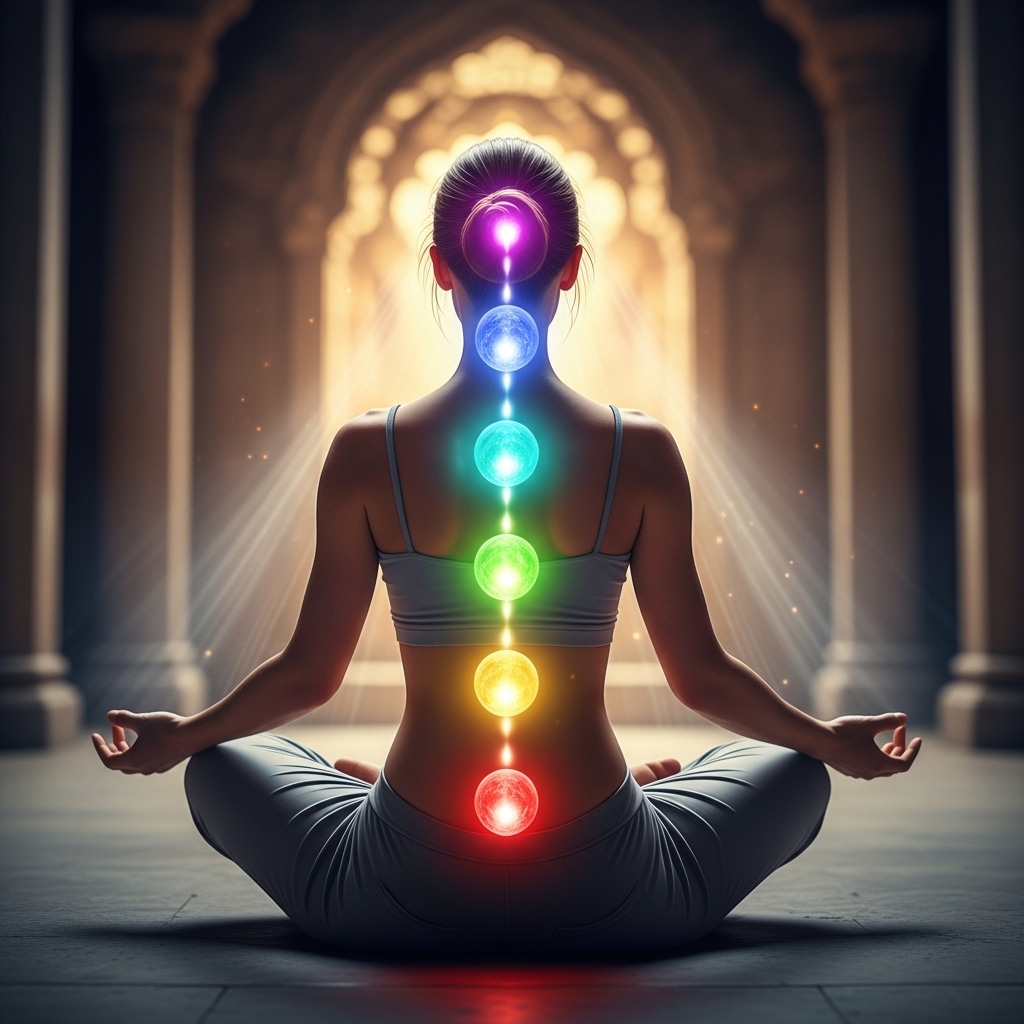
What Is Chakra Alignment?
The seven energy centres of the body
The chakra system is a map of the human energy body drawn from ancient Indian tantric and yogic texts, most fully described in texts like the Sat-Cakra-Nirupana written in the sixteenth century. The word chakra means wheel or disc in Sanskrit — each centre is understood as a spinning vortex of energy located along the central channel of the body, the sushumna nadi, through which prana (life force) moves.
Each chakra corresponds to a particular region of the physical body, a domain of psychological and emotional experience, and a quality of consciousness. When energy flows freely through all seven centres, there is a quality of integration — the body feels grounded, the emotions are responsive rather than reactive, creative expression flows naturally, the heart is open, communication is clear, intuition is trustworthy, and there is a felt sense of connection to something larger than the personal self.
The Seven Chakras
Muladhara — Root
Located at the base of the spine. Governs physical survival, safety, belonging, and the relationship with the body and the earth. When grounded here, there is a basic sense of okayness — the right to exist and belong. Imbalances show as chronic anxiety, financial instability, or a feeling of being untethered.
Svadhisthana — Sacral
Located below the navel. Governs pleasure, creativity, sensuality, emotional flow, and the capacity for intimacy. Healthy sacral energy moves fluidly between states without becoming stuck. Blockages here often appear as creative stagnation, emotional numbness, or an addictive relationship with pleasure.
Manipura — Solar Plexus
Located at the solar plexus. The seat of personal power, will, self-esteem and the capacity to act in the world. A healthy solar plexus gives the experience of being the author of one's own life. Imbalances show as either aggression and control-seeking (excess) or passivity, shame, and difficulty setting boundaries (deficiency).
Anahata — Heart
Located at the centre of the chest. The bridge between the lower three earthly chakras and the upper three spiritual chakras. Governs love, compassion, grief, and the capacity to both give and receive. The heart chakra is where individual will meets universal love. Wounds here — grief, heartbreak, betrayal — close this centre and affect every chakra above and below.
Vishuddha — Throat
Located at the throat. Governs self-expression, authentic communication, sound, and the capacity to speak one's truth. When this centre is open, words carry resonance — they land, they connect, they create. Blocked throat energy appears as difficulty speaking up, chronic sore throats, or alternatively, compulsive talking that substitutes for genuine expression.
Ajna — Third Eye
Located between and slightly above the eyebrows. The centre of intuition, inner vision, discernment and the witness consciousness — the part of awareness that observes experience without being consumed by it. A clear ajna perceives patterns, reads situations accurately, and trusts the inner knowing that arises before logic explains it.
Sahasrara — Crown
Located at the crown of the head. The gateway to transpersonal consciousness — the experience of interconnection with all life, pure awareness beyond personal identity. Working with this centre is less about opening it and more about clearing the path beneath it. When the lower six centres are reasonably balanced, the crown opens naturally.
Sound, Frequency and the Chakras
Each chakra has a seed syllable (bija mantra) — a primal sound vibration that resonates with its particular frequency: LAM (root), VAM (sacral), RAM (solar plexus), YAM (heart), HAM (throat), OM (third eye), silence or AH (crown). Chanting these sounds while bringing awareness to the corresponding centre is one of the oldest methods of chakra work in the tantric tradition.
The solfeggio frequencies associated with each chakra in contemporary practice — 396Hz, 417Hz, 528Hz and so on — are a more recent development, but the underlying principle is identical: specific vibrational patterns interact with specific aspects of the energy body. The music of Jaguar Medicine Tribe and Son of Kali, built from rhythmic entrainment and mantra, naturally functions as sonic chakra work even when that is not its explicit intention.
How to Use This Tool
Select the duration you want to spend at each chakra, or leave all at the default setting. Sit comfortably, close the eyes, and bring gentle attention to the region of the body indicated as each chakra becomes active. You do not need to visualise intensely — a soft, open awareness directed toward the area is enough. The tone will guide transitions.
Many practitioners combine this with the breathwork timer — two or three minutes of coherent breathing before the chakra sequence prepares the energy body to receive the work more deeply. After the session, sitting in silence for a few minutes before returning to activity allows the effects to settle.
Frequently Asked Questions
How does the Chakra Alignment tool work?
Press the centre button and it moves through all seven chakras in order, root to crown, playing each one's tuned frequency for a set number of minutes while a glowing orb marks its place on the spine. You can also tap any single chakra in the list to play just that frequency on its own, and adjust each chakra's duration from 1 to 9 minutes before you begin.
What are the frequencies used, and are they scientifically proven?
Each chakra plays a tone near its associated solfeggio frequency (396Hz for the root through 963Hz for the crown) paired with its traditional Sanskrit bija (seed) mantra — LAM, VAM, RAM, YAM, HAM, SHAM and OM. The bija mantras come from centuries-old tantric tradition; the specific solfeggio-Hz pairings are a more recent development in sound healing practice, not a peer-reviewed medical claim. Treat this as a contemplative and relaxation practice rather than a clinical treatment.
Can I focus on just one chakra instead of doing the full sequence?
Yes — tap any chakra directly in the list to play just that frequency and bija sound by itself, without moving through the rest. This is useful when you already know which centre needs attention, for example the throat before public speaking or the heart after a difficult conversation.
How long should a session be and how often should I practice?
The default is 3 minutes per chakra (about 21 minutes for the full root-to-crown journey), adjustable up to 9 minutes each. There's no fixed schedule — some practitioners do a full sequence weekly and a single chakra as needed; others pair a short session with the breathwork timer beforehand to settle the body first, then sit quietly for a few minutes afterward to let the effects integrate.