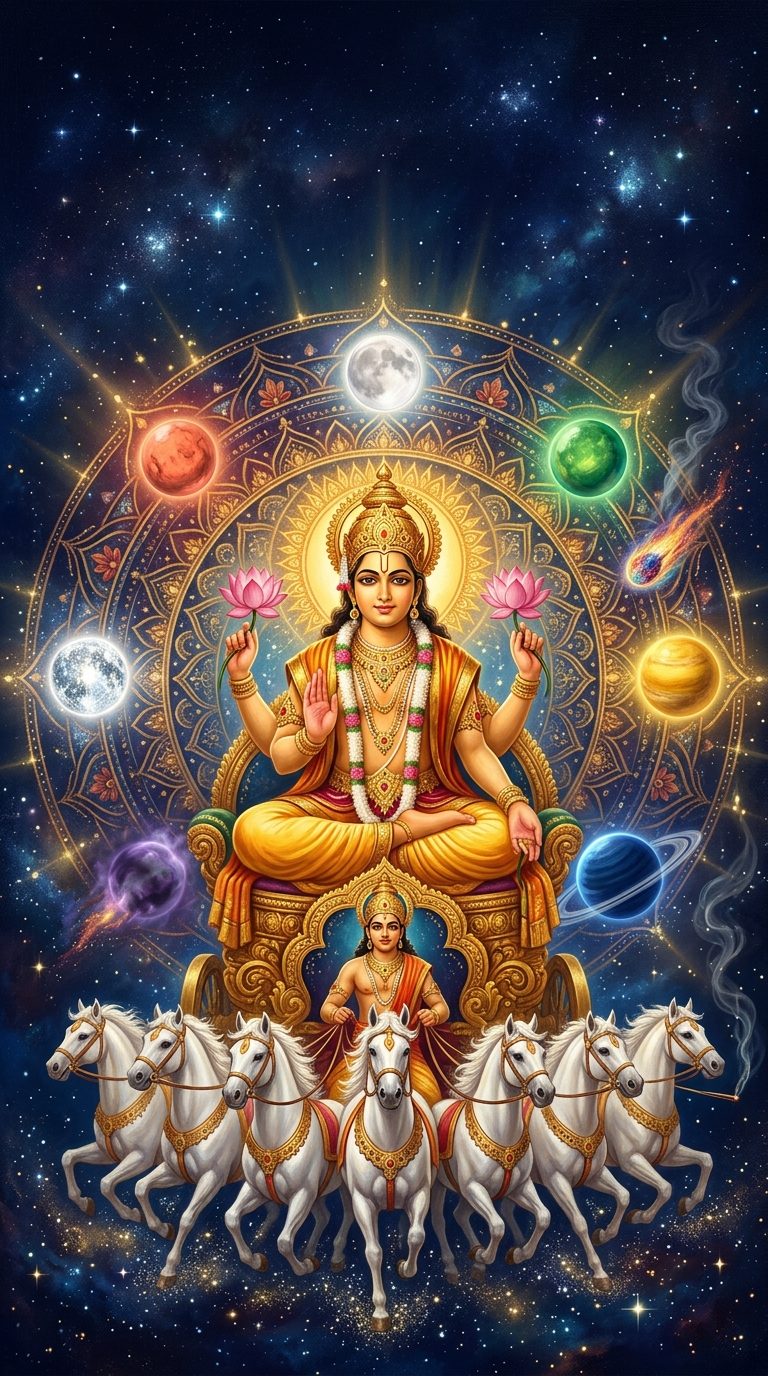
Surya the Sun God riding his golden chariot drawn by seven white horses across a dawn sky, a yogi performing the sun salutation below
NavagrahaMantra

Surya Namaskar Mantra

Lyrics · Meaning · Audio

The twelve names of the Sun chanted with the twelve movements of Surya Namaskar — “Om Mitraya Namah, Om Ravaye Namah…” — each one honouring a different gift of light.

Traditional mantras chanted with the twelve steps of Surya Namaskar

Listen

Surya Namaskar Mantra

Son of Kali · Navagraha Cosmic Chants

0:007:31
Deity
Navagraha
Type
Mantra
Verses
2
Language
Sanskrit

Surya Namaskar Mantra Lyrics with Meaning

Each line shows an easy way to say it, with its English meaning. Turn on the Sanskrit, the exact pronunciation or the word-by-word meaning whenever you want to go deeper.

Meditation verse (Dhyana)

ध्येयः सदा सवितृमण्डलमध्यवर्ती नारायणः सरसिजासनसन्निविष्टः ।

Dhyeyah Sada Savitri Mandala Madhyavarti Narayanah Sarasijasana Sannivishtah

dhyeyaḥ sadā savitṛmaṇḍalamadhyavartī nārāyaṇaḥ sarasijāsanasanniviṣṭaḥ

Meditate always on Narayana in the centre of the sun’s disc, seated on a lotus,

    केयूरवान् मकरकुण्डलवान् किरीटी हारी हिरण्मयवपुर्धृतशङ्खचक्रः ॥

    Keyuravan Makara Kundalavan Kiriti Hari Hiranmaya Vapur Dhrita Shankha Chakrah

    keyūravān makarakuṇḍalavān kirīṭī hārī hiraṇmayavapurdhṛtaśaṅkhacakraḥ

    wearing armlets, fish-shaped earrings, a crown and a necklace, his body golden, holding the conch and discus.

      The Twelve Names

      ॐ मित्राय नमः । ॐ रवये नमः । ॐ सूर्याय नमः ॥

      Om Mitraya Namah, Om Ravaye Namah, Om Suryaya Namah

      oṃ mitrāya namaḥ oṃ ravaye namaḥ oṃ sūryāya namaḥ

      Om — salutations to the friend of all; to the shining one; to the one who sets all in motion.

        ॐ भानवे नमः । ॐ खगाय नमः । ॐ पूष्णे नमः ॥

        Om Bhanave Namah, Om Khagaya Namah, Om Pushne Namah

        oṃ bhānave namaḥ oṃ khagāya namaḥ oṃ pūṣṇe namaḥ

        Om — salutations to the bright one; to the one who moves through the sky; to the nourisher.

          ॐ हिरण्यगर्भाय नमः । ॐ मरीचये नमः । ॐ आदित्याय नमः ॥

          Om Hiranyagarbhaya Namah, Om Marichaye Namah, Om Adityaya Namah

          oṃ hiraṇyagarbhāya namaḥ oṃ marīcaye namaḥ oṃ ādityāya namaḥ

          Om — salutations to the golden womb of creation; to the rays of dawn; to the son of Aditi.

            ॐ सवित्रे नमः । ॐ अर्काय नमः । ॐ भास्कराय नमः ॥

            Om Savitre Namah, Om Arkaya Namah, Om Bhaskaraya Namah

            oṃ savitre namaḥ oṃ arkāya namaḥ oṃ bhāskarāya namaḥ

            Om — salutations to the inspirer; to the radiant one; to the one who makes all things shine.

              About Surya Namaskar Mantra

              Surya Namaskar, the sun salutation, is a flowing sequence of twelve yoga postures traditionally done at sunrise facing east. In the traditional practice, each posture is accompanied by one name of Surya, the Sun God.

              The twelve names each describe a different side of the sun: Mitra the friend of all, Ravi the shining one, Surya who sets everything in motion, Bhanu the bright, Khaga who moves through the sky, Pushan the nourisher, Hiranyagarbha the golden womb of creation, Marichi the rays of dawn, Aditya son of Aditi, Savitri the inspirer, Arka the radiant, and Bhaskara who makes all things clear.

              Many practitioners begin with the dhyāna verse, “Dhyeyah Sada,” which pictures Narayana seated in the centre of the sun’s disc.

              The Stories Inside the Hymn

              The sun as the eye of the world

              In the Vedas the sun is the eye of the cosmos, seeing everything without judging. Sun worship is among the oldest practices in India, and the Gayatri Mantra itself is addressed to Savitri, the sun as divine light.

              Surya Namaskar turns that ancient prayer into movement: body, breath and mantra all greeting the light together.

              How to Chant Surya Namaskar Mantra

              When to chant

              • ✦At sunrise, facing east
              • ✦Sundays, the day of the Sun
              • ✦Ratha Saptami and Makar Sankranti
              • ✦As part of a daily yoga practice

              How many times

              One name per posture through the twelve steps; repeat the full round as many times as your practice allows.

              1. 1

                Stand facing the rising sun with palms joined and chant the dhyana verse.

              2. 2

                Begin the twelve postures, saying one name at the start of each.

              3. 3

                Breathe in and out with the movements, letting the mantra set the pace.

              4. 4

                After the last round, stand still and feel the warmth of the sun.

              Pronunciation Guide

              The sounds that trip people up most in this hymn, and how to say them.

              pūṣṇe

              poosh-nay.

              hiraṇyagarbhāya

              hi-run-ya-gar-bhaa-ya.

              savitre

              sa-vit-ray.

              Navagraha Cosmic Chants – Sacred Mantras of the Nine Planets by Son of Kali

              The music

              Navagraha Cosmic Chants – Sacred Mantras of the Nine Planets

              by Son of Kali

              More for Navagraha

              Frequently Asked Questions

              What are the 12 Surya Namaskar mantras?

              Om Mitraya, Ravaye, Suryaya, Bhanave, Khagaya, Pushne, Hiranyagarbhaya, Marichaye, Adityaya, Savitre, Arkaya and Bhaskaraya — each followed by Namah.

              Do I have to chant while doing Surya Namaskar?

              No, but the traditional practice links one name to each posture, which helps focus the mind and regulate the breath.

              When is the best time?

              At sunrise, facing east, on an empty stomach.

              Text: Traditional public-domain Sanskrit mantras. Easy reading, transliteration and English translation written for the Jaguar Medicine Tribe Mantra Library.

              Music: Recordings by Son of Kali, produced with AI-assisted vocals and instrumentation.

              Note: Benefits described here are traditional beliefs, shared for understanding — not medical or guaranteed outcomes.