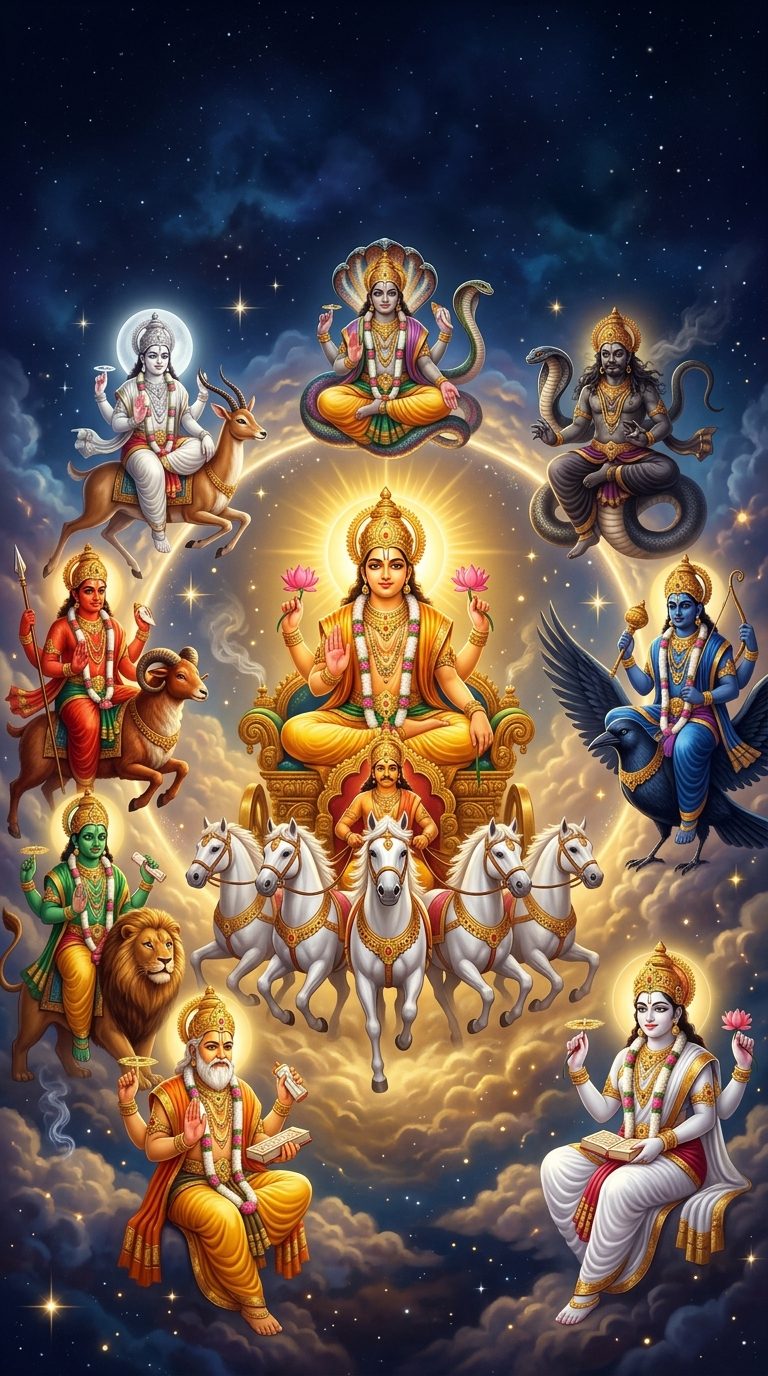
The nine planetary deities in a cosmic circle with Surya the Sun god at the centre on his seven-horse chariot
NavagrahaStotram

Navagraha Mantra & Stotram

Lyrics · Meaning · Audio

The prayer to all nine celestial powers of Vedic astrology — the short mantra naming every planet, followed by Vyasa’s classic stotram with one beautiful verse for each.

Navagraha Stotram attributed to the sage Vyasa

Listen

Navagraha Mantra & Stotram

All nine planets

0:007:52
Deity
Navagraha
Type
Stotram
Verses
11
Language
Sanskrit

Navagraha Mantra & Stotram Lyrics with Meaning

Each line shows an easy way to say it, with its English meaning. Turn on the Sanskrit, the exact pronunciation or the word-by-word meaning whenever you want to go deeper.

All nine planets

ॐ सूर्याय सोमाय मङ्गलाय बुधाय च ।

Om Suryaya Somaya Mangalaya Budhaya Cha

oṃ sūryāya somāya maṅgalāya budhāya ca

Om — salutations to the Sun, the Moon, Mars and Mercury,

    गुरुशुक्रशनिभ्यश्च राहवे केतवे नमः ॥

    Guru Shukra Shanibhyash Cha Rahave Ketave Namah

    guruśukraśanibhyaśca rāhave ketave namaḥ

    to Jupiter, Venus and Saturn, to Rahu and Ketu — I bow.

      Surya · Sun

      जपाकुसुमसङ्काशं काश्यपेयं महाद्युतिम् ।

      Japakusuma Sankasham Kashyapeyam Mahadyutim

      japākusumasaṅkāśaṃ kāśyapeyaṃ mahādyutim

      Red as the hibiscus flower, son of the sage Kashyapa, of great brilliance,

        तमोऽरिं सर्वपापघ्नं प्रणतोऽस्मि दिवाकरम् ॥ १ ॥

        Tamorim Sarva Papaghnam Pranatosmi Divakaram

        tamo'riṃ sarvapāpaghnaṃ praṇato'smi divākaram

        enemy of darkness, destroyer of all wrongs — to the maker of the day, I bow.

          Chandra · Moon

          दधिशङ्खतुषाराभं क्षीरोदार्णवसम्भवम् ।

          Dadhi Shankha Tusharabham Kshirodarnava Sambhavam

          dadhiśaṅkhatuṣārābhaṃ kṣīrodārṇavasambhavam

          White as curd, conch and snow, born from the Ocean of Milk,

            नमामि शशिनं सोमं शम्भोर्मुकुटभूषणम् ॥ २ ॥

            Namami Shashinam Somam Shambhor Mukuta Bhushanam

            namāmi śaśinaṃ somaṃ śambhormukuṭabhūṣaṇam

            I bow to the Moon, Soma, the ornament on Shiva’s crown.

              Mangala · Mars

              धरणीगर्भसम्भूतं विद्युत्कान्तिसमप्रभम् ।

              Dharani Garbha Sambhutam Vidyut Kanti Sama Prabham

              dharaṇīgarbhasambhūtaṃ vidyutkāntisamaprabham

              Born from the womb of the Earth, shining like lightning,

                कुमारं शक्तिहस्तं तं मङ्गलं प्रणमाम्यहम् ॥ ३ ॥

                Kumaram Shakti Hastam Tam Mangalam Pranamamyaham

                kumāraṃ śaktihastaṃ taṃ maṅgalaṃ praṇamāmyaham

                the youthful one holding a spear — to Mangala I bow.

                  Budha · Mercury

                  प्रियङ्गुकलिकाश्यामं रूपेणाप्रतिमं बुधम् ।

                  Priyangu Kalika Shyamam Rupenapratimam Budham

                  priyaṅgukalikāśyāmaṃ rūpeṇāpratimaṃ budham

                  Dark green like the priyangu bud, of matchless beauty,

                    सौम्यं सौम्यगुणोपेतं तं बुधं प्रणमाम्यहम् ॥ ४ ॥

                    Saumyam Saumya Gunopetam Tam Budham Pranamamyaham

                    saumyaṃ saumyaguṇopetaṃ taṃ budhaṃ praṇamāmyaham

                    gentle and full of gentle qualities — to Budha I bow.

                      Guru · Jupiter

                      देवानां च ऋषीणां च गुरुं काञ्चनसन्निभम् ।

                      Devanam Cha Rishinam Cha Gurum Kanchana Sannibham

                      devānāṃ ca ṛṣīṇāṃ ca guruṃ kāñcanasannibham

                      Teacher of the gods and of the sages, shining like gold,

                        बुद्धिभूतं त्रिलोकेशं तं नमामि बृहस्पतिम् ॥ ५ ॥

                        Buddhi Bhutam Trilokesham Tam Namami Brihaspatim

                        buddhibhūtaṃ trilokeśaṃ taṃ namāmi bṛhaspatim

                        wisdom itself, lord of the three worlds — to Brihaspati I bow.

                          Shukra · Venus

                          हिमकुन्दमृणालाभं दैत्यानां परमं गुरुम् ।

                          Hima Kunda Mrinalabham Daityanam Paramam Gurum

                          himakundamṛṇālābhaṃ daityānāṃ paramaṃ gurum

                          White as snow, jasmine and lotus stalk, the great teacher of the titans,

                            सर्वशास्त्रप्रवक्तारं भार्गवं प्रणमाम्यहम् ॥ ६ ॥

                            Sarva Shastra Pravaktaram Bhargavam Pranamamyaham

                            sarvaśāstrapravaktāraṃ bhārgavaṃ praṇamāmyaham

                            expounder of all sacred knowledge — to Bhargava (Shukra) I bow.

                              Shani · Saturn

                              नीलाञ्जनसमाभासं रविपुत्रं यमाग्रजम् ।

                              Nilanjana Samabhasam Ravi Putram Yamagrajam

                              nīlāñjanasamābhāsaṃ raviputraṃ yamāgrajam

                              Dark blue as kohl, son of the Sun, elder brother of Yama,

                                छायामार्तण्डसम्भूतं तं नमामि शनैश्चरम् ॥ ७ ॥

                                Chhaya Martanda Sambhutam Tam Namami Shanaishcharam

                                chāyāmārtaṇḍasambhūtaṃ taṃ namāmi śanaiścaram

                                born of Chhaya and the Sun — to slow-moving Shani I bow.

                                  Rahu · North Node

                                  अर्धकायं महावीर्यं चन्द्रादित्यविमर्दनम् ।

                                  Ardha Kayam Maha Viryam Chandraditya Vimardanam

                                  ardhakāyaṃ mahāvīryaṃ candrādityavimardanam

                                  Half-bodied, of great power, who swallows the Moon and Sun,

                                    सिंहिकागर्भसम्भूतं तं राहुं प्रणमाम्यहम् ॥ ८ ॥

                                    Simhika Garbha Sambhutam Tam Rahum Pranamamyaham

                                    siṃhikāgarbhasambhūtaṃ taṃ rāhuṃ praṇamāmyaham

                                    born of Simhika’s womb — to Rahu I bow.

                                      Ketu · South Node

                                      पलाशपुष्पसङ्काशं तारकाग्रहमस्तकम् ।

                                      Palasha Pushpa Sankasham Taraka Graha Mastakam

                                      palāśapuṣpasaṅkāśaṃ tārakāgrahamastakam

                                      Bright as the flame-of-the-forest flower, head of the stars and planets,

                                        रौद्रं रौद्रात्मकं घोरं तं केतुं प्रणमाम्यहम् ॥ ९ ॥

                                        Raudram Raudratmakam Ghoram Tam Ketum Pranamamyaham

                                        raudraṃ raudrātmakaṃ ghoraṃ taṃ ketuṃ praṇamāmyaham

                                        fierce, fierce by nature, awe-inspiring — to Ketu I bow.

                                          Closing verse (Phala Shruti)

                                          इति व्यासमुखोद्गीतं यः पठेत्सुसमाहितः ।

                                          Iti Vyasa Mukhodgitam Yah Pathet Susamahitah

                                          iti vyāsamukhodgītaṃ yaḥ paṭhetsusamāhitaḥ

                                          Whoever recites this hymn, sung from the lips of Vyasa, with a focused mind,

                                            दिवा वा यदि वा रात्रौ विघ्नशान्तिर्भविष्यति ॥

                                            Diva Va Yadi Va Ratrau Vighna Shantir Bhavishyati

                                            divā vā yadi vā rātrau vighnaśāntirbhaviṣyati

                                            by day or by night, will find peace from all obstacles.

                                              About Navagraha Mantra & Stotram

                                              The Navagraha (“nine grahas”) are the nine celestial powers of Vedic astrology: Surya (the Sun), Chandra (the Moon), Mangala (Mars), Budha (Mercury), Guru or Brihaspati (Jupiter), Shukra (Venus), Shani (Saturn), and the two shadow planets Rahu and Ketu, the points where the Moon’s path crosses the Sun’s. A graha is not just a planet but a “seizer” — an influence that takes hold of our lives.

                                              This page brings together two of the most chanted Navagraha prayers. The first is the short mantra that bows to all nine at once: Om sūryāya somāya maṅgalāya… The second is the Navagraha Stotram traditionally credited to the sage Vyasa, with one verse describing each planet — the Sun “red as the hibiscus flower,” the Moon “white as curd and conch,” Saturn “dark as kohl, son of the Sun and elder brother of Yama.”

                                              In Hindu practice the grahas are honoured, not feared. Navagraha shrines stand in most South Indian temples, and people chant these verses especially when astrologers say a planet is placing pressure on their life — or simply to bring harmony with the rhythms of the cosmos.
                                              The Stories Inside the Hymn

                                              How Rahu and Ketu were born

                                              When the gods and demons churned the cosmic ocean for the nectar of immortality, Vishnu, disguised as the enchantress Mohini, served the nectar only to the gods. One demon, Svarbhanu, slipped in among them in disguise and drank a drop.

                                              The Sun and Moon recognised him and raised the alarm. Vishnu’s discus cut off his head — but the nectar had already made him immortal. His head became Rahu and his body Ketu. Ever since, they chase the Sun and Moon across the sky, briefly swallowing them during eclipses.

                                              Shani, son of the Sun

                                              Shani (Saturn) is the son of Surya and Chhaya, the “shadow” wife of the Sun — which is why the stotram calls him born of Chhaya and Martanda. He moves slowly, and his gaze is said to test people with hardship.

                                              Yet Shani is also the great teacher of patience, discipline and justice. Devotees honour him on Saturdays, often lighting sesame-oil lamps, asking not to avoid his lessons but to learn them gracefully.

                                              How to Chant Navagraha Mantra & Stotram

                                              When to chant

                                              • ✦Daily at sunrise, facing the Sun
                                              • ✦On the weekday of a particular planet: Sunday (Sun), Monday (Moon), Tuesday (Mars), Wednesday (Mercury), Thursday (Jupiter), Friday (Venus), Saturday (Saturn)
                                              • ✦During eclipses (traditionally associated with Rahu and Ketu)
                                              • ✦When an astrological period (dasha) of a planet feels difficult

                                              How many times

                                              The all-planets mantra 9 or 108 times; the stotram once through. For a single planet, its verse can be chanted 108 times on its day.

                                              1. 1

                                                Sit facing east, ideally at sunrise.

                                              2. 2

                                                Begin with the short mantra bowing to all nine planets.

                                              3. 3

                                                Chant the nine verses of the stotram, picturing each graha as you go.

                                              4. 4

                                                Use the recording switcher to listen to the dedicated track for any single planet.

                                              5. 5

                                                End with the closing verses, asking for peace from all obstacles.

                                              Pronunciation Guide

                                              The sounds that trip people up most in this hymn, and how to say them.

                                              graha

                                              gra-ha — “that which seizes,” a planet.

                                              maṅgalāya

                                              mun-ga-laa-ya, with the “ng” of “sing”.

                                              śanaiścaram

                                              sha-naish-cha-rum — Saturn, “the slow-moving one.”

                                              bṛhaspatim

                                              bri-has-pa-tim — Jupiter, the teacher of the gods.

                                              praṇato’smi

                                              pra-na-toss-mi — “I bow.”

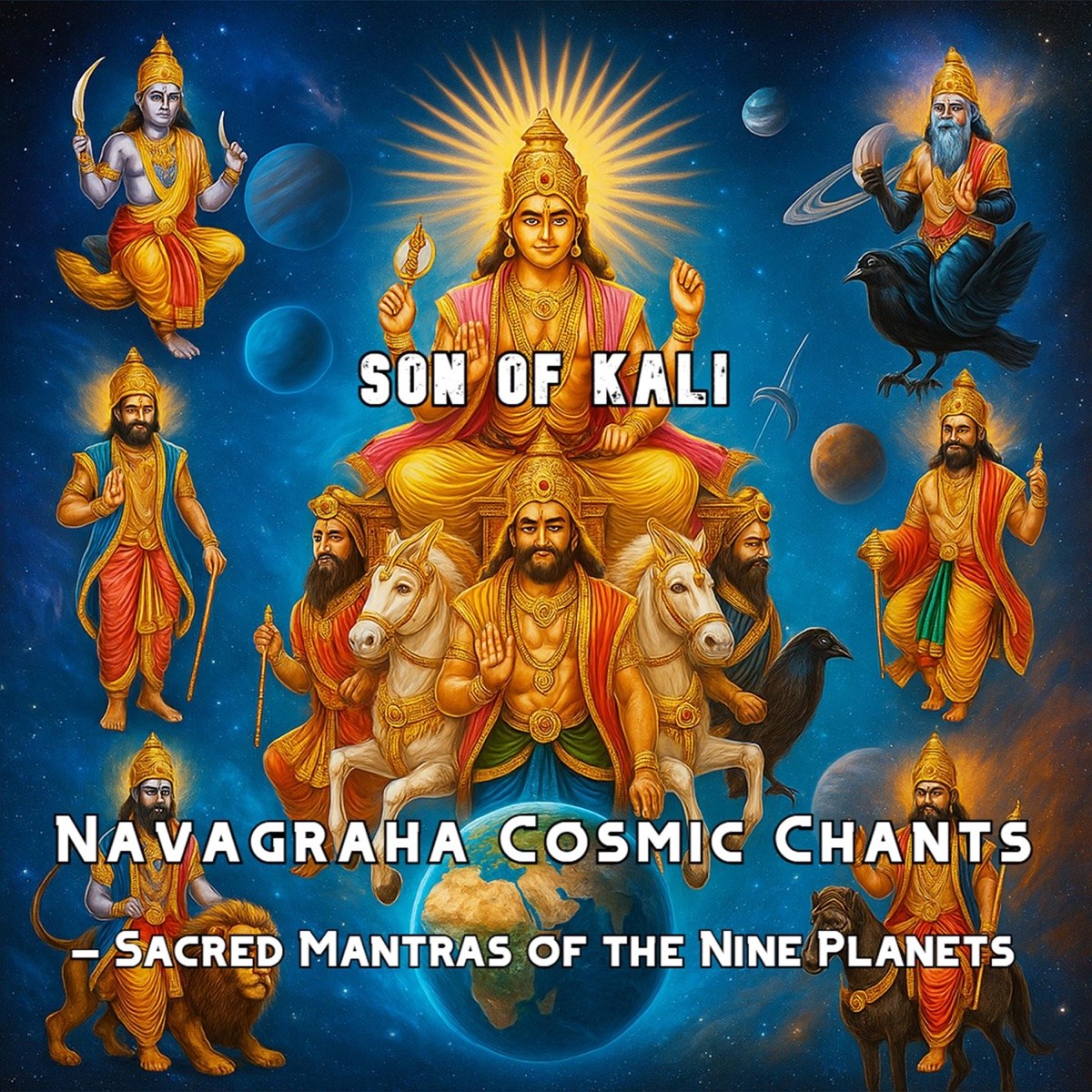
                                              Navagraha Cosmic Chants – Sacred Mantras of the Nine Planets by Son of Kali

                                              The music

                                              Navagraha Cosmic Chants – Sacred Mantras of the Nine Planets

                                              by Son of Kali

                                              More for Navagraha

                                              Frequently Asked Questions

                                              What are the Navagraha?

                                              The nine celestial influences of Vedic astrology: the Sun, Moon, Mars, Mercury, Jupiter, Venus, Saturn, and the lunar nodes Rahu and Ketu.

                                              What is the Navagraha mantra?

                                              The short Navagraha mantra bows to all nine at once: “Om, salutations to the Sun, the Moon, Mars and Mercury, to Jupiter, Venus and Saturn, to Rahu and Ketu.” The longer Navagraha Stotram gives one verse to each planet.

                                              Who wrote the Navagraha Stotram?

                                              It is traditionally attributed to the sage Vyasa, compiler of the Vedas and author of the Mahabharata.

                                              When should the Navagraha mantra be chanted?

                                              Daily at sunrise, or on the weekday of a particular planet, and especially when astrologers advise strengthening or pacifying a planet. It is a prayer for harmony, not a guaranteed remedy.

                                              Why are Rahu and Ketu counted as planets?

                                              They are the two points where the Moon’s orbit crosses the Sun’s apparent path, linked to eclipses. In mythology they are the head and body of the demon Svarbhanu.

                                              Text: Navagraha Stotram attributed to Vyasa — public domain (Sanskrit Wikisource); traditional Navagraha namaskara mantra. Easy reading, transliteration and English translation written for the Jaguar Medicine Tribe Mantra Library.

                                              Music: Recordings by Son of Kali, produced with AI-assisted vocals and instrumentation.

                                              Note: Benefits described here are traditional beliefs, shared for understanding — not medical or guaranteed outcomes.