The Mantra
ॐ तारे तुत्तारे तुरे स्वाहा
Om Tare Tuttare Ture Svaha
oṃ tāre tuttāre ture svāhā
Om — O Tara, swift liberator, quick one — free me from danger, from fear and from all suffering. So be it.
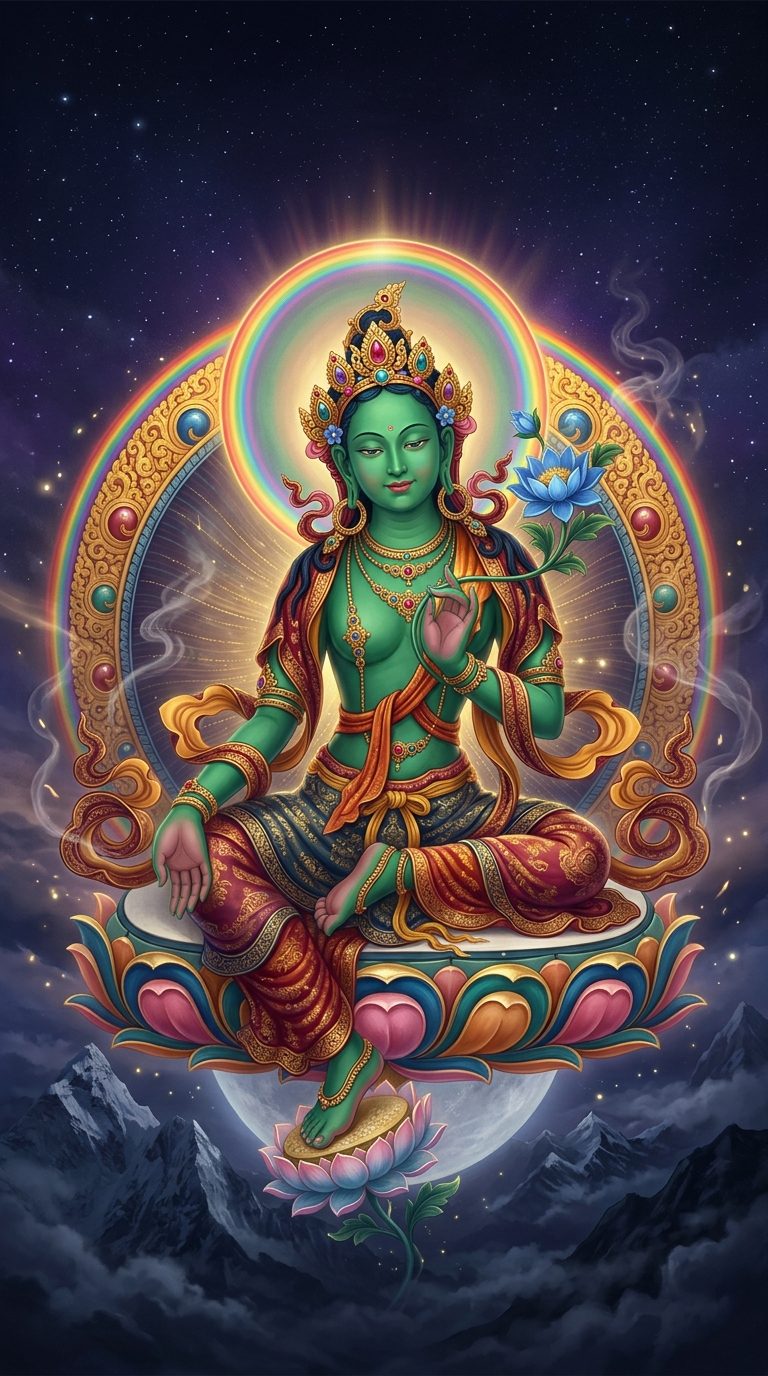
Buddhist · Mantra
Lyrics · Meaning · Audio
The mantra of Green Tara, the swift saviour of Buddhism — a play on her name meaning “She who carries across” — asking her to free us from danger, from inner afflictions and from suffering itself.
Mantra of Green Tara, from the Tara tantras of Mahayana and Vajrayana Buddhism
Listen
Om Tare Tuttare Ture Svaha
Son of Kali · Essence of Sacred Mantras

Each line shows an easy way to say it, with its English meaning. Turn on the Sanskrit, the exact pronunciation or the word-by-word meaning whenever you want to go deeper.
ॐ तारे तुत्तारे तुरे स्वाहा
Om Tare Tuttare Ture Svaha
oṃ tāre tuttāre ture svāhā
Om — O Tara, swift liberator, quick one — free me from danger, from fear and from all suffering. So be it.
Tara — “She who carries across”, or “star” — is one of the most loved figures in Buddhism, especially in Tibet. Green Tara is her swift, active form: she sits with her right leg stepping down from the lotus, ready to rise at once to help anyone who calls her.
Her mantra is a play on her own name. Tare, Tuttare and Ture are three forms of “Tara”, each traditionally given a meaning: Tare, the one who frees from worldly dangers; Tuttare, the one who frees from fear and inner afflictions; Ture, the one who frees from suffering itself and carries us to awakening. Svaha (often pronounced “soha” in Tibetan) seals the offering.
Green Tara is said to have been born from a tear of Avalokiteshvara, shed for the suffering of the world — so this mantra is often chanted alongside Om Mani Padme Hum.
A Tibetan story tells of a princess named Wisdom Moon who, after lifetimes of devotion, was told by monks to pray to be reborn as a man so she could reach enlightenment.
She answered that in truth there is neither male nor female, and vowed instead always to take a woman’s form until every being was free. She became Tara.
When to chant
How many times
21 or 108 times.
Picture Green Tara before you, emerald-green, smiling, one foot stepping forward to help.
Chant “Om Tare Tuttare Ture Svaha”, asking for her protection for yourself and others.
Imagine green light from her filling you and dissolving fear.
End by resting quietly, then dedicating the practice to all beings.
The sounds that trip people up most in this hymn, and how to say them.
tāre
taa-ray — her name, “O Tara.”
tuttāre
tut-taa-ray — double “t”.
svāhā
svaa-haa; in Tibetan often “so-ha”.
What does Om Tare Tuttare Ture Svaha mean?
It calls on Tara three ways — Tare, Tuttare, Ture — asking her to free us from danger, from fear and inner afflictions, and from suffering itself; svaha seals the prayer.
Who is Green Tara?
A female Buddha of compassion and swift action, especially loved in Tibet, shown stepping forward from her lotus ready to help.
Why “soha” instead of “svaha”?
Svaha is the Sanskrit; Tibetans usually pronounce it “soha”. Both are used.
How many times is it chanted?
Commonly 21 times (for Tara’s 21 forms) or 108 times on a mala.