The Mantra
ॐ मणि पद्मे हूँ
Om Mani Padme Hum
oṃ maṇi padme hūṃ
Om — the jewel in the lotus — Hum: may compassion and wisdom, joined as one, awaken in every being.
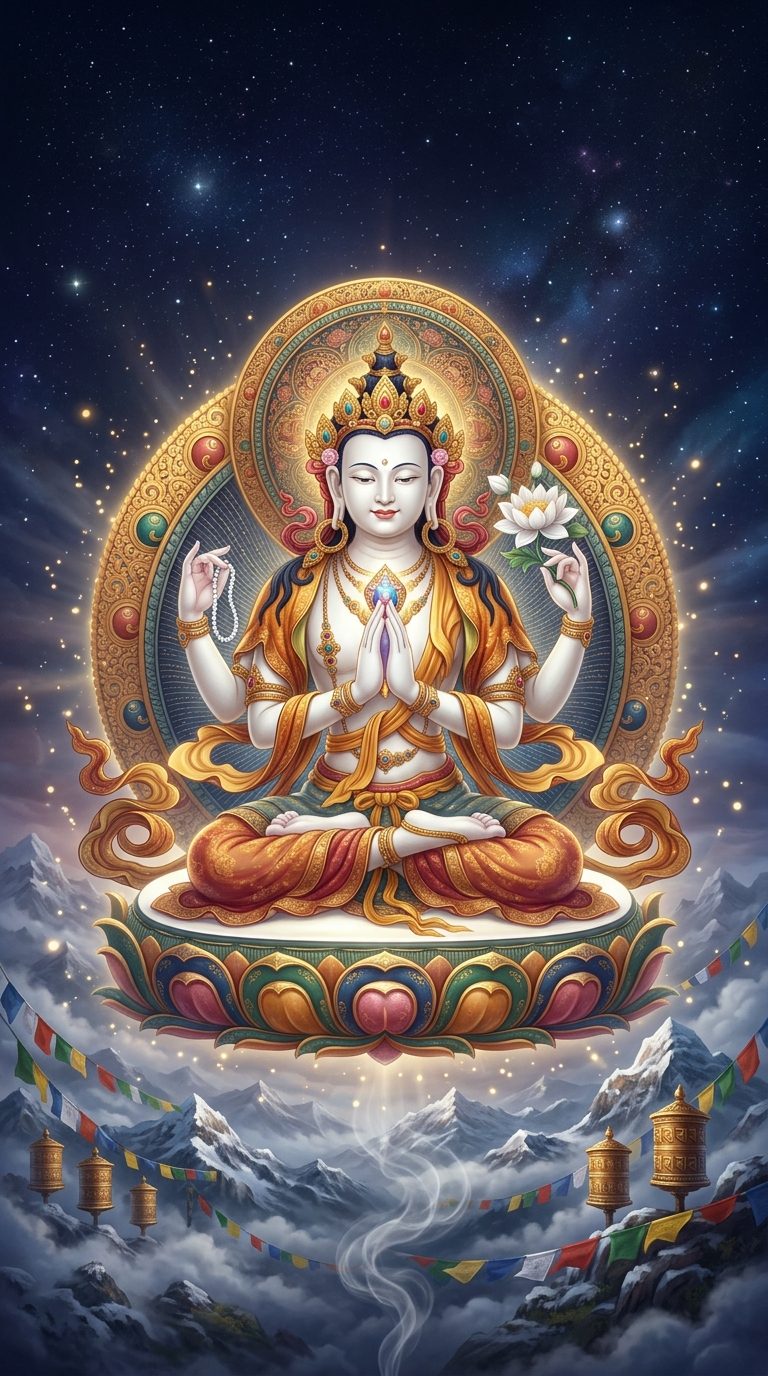
Buddhist · Mantra
Lyrics · Meaning · Audio
The six-syllable mantra of Avalokiteshvara, the bodhisattva of compassion — “Om, the jewel in the lotus, Hum” — the most widely chanted mantra in the Buddhist world, carved on stones and spun in prayer wheels across the Himalaya.
Mantra of Avalokiteshvara (Chenrezig), first recorded in the Karandavyuha Sutra
Listen
Om Mani Padme Hum
Son of Kali · Essence of Sacred Mantras

Each line shows an easy way to say it, with its English meaning. Turn on the Sanskrit, the exact pronunciation or the word-by-word meaning whenever you want to go deeper.
ॐ मणि पद्मे हूँ
Om Mani Padme Hum
oṃ maṇi padme hūṃ
Om — the jewel in the lotus — Hum: may compassion and wisdom, joined as one, awaken in every being.
Om Mani Padme Hum is the mantra of Avalokiteshvara — called Chenrezig in Tibet, Guanyin in China and Kannon in Japan — the bodhisattva who embodies the compassion of all the Buddhas. It first appears in the Karandavyuha Sutra, a Mahayana text of around the 4th–5th century, and became the heart-practice of Tibetan Buddhism.
Literally it means “Om, O jewel-lotus, Hum”, or as it is often explained, “the jewel in the lotus”. The jewel is the mind of compassion and the method of awakening; the lotus, growing pure out of mud, is wisdom. Joined together, they are enlightenment.
Tibetan teachers also link each of the six syllables to a perfection — generosity, ethics, patience, diligence, concentration and wisdom — and to the purification of one of the six realms of rebirth. It is chanted on 108-bead malas, written on prayer flags and spun inside prayer wheels, so that its blessing spreads in every direction.
A Tibetan story tells that Avalokiteshvara vowed to free every being from suffering. Looking out and seeing how many still suffered, his head split into pieces from grief.
Amitabha Buddha gave him eleven heads to see all beings and a thousand arms to help them, each palm with an eye of wisdom. Om Mani Padme Hum is said to call that endless compassion into the heart of the one who chants it.
When to chant
How many times
108 times on a mala, or as many times as you like.
Sit comfortably and bring to mind someone who is suffering.
Chant softly “Om Mani Padme Hum”, letting the words carry a wish for their happiness.
Gradually widen the wish to include all beings.
At the end, dedicate the merit of your practice to the welfare of all.
The sounds that trip people up most in this hymn, and how to say them.
maṇi
ma-ni — “jewel”; the “n” is retroflex.
padme
pud-may — “in the lotus”. Tibetans often say “pay-may”.
hūṃ
hoom — Tibetans often say “hung”.
What does Om Mani Padme Hum mean?
Literally “Om, jewel-lotus, Hum”, usually explained as “the jewel in the lotus”: compassion (the jewel) joined with wisdom (the lotus), which together are enlightenment.
Whose mantra is it?
It is the mantra of Avalokiteshvara (Chenrezig), the bodhisattva of compassion.
Is it Sanskrit or Tibetan?
The words are Sanskrit. In Tibet it is often pronounced “Om Mani Peme Hung”.
How many times should I chant it?
Traditionally 108 times on a mala, but any number chanted with a compassionate heart is meaningful.