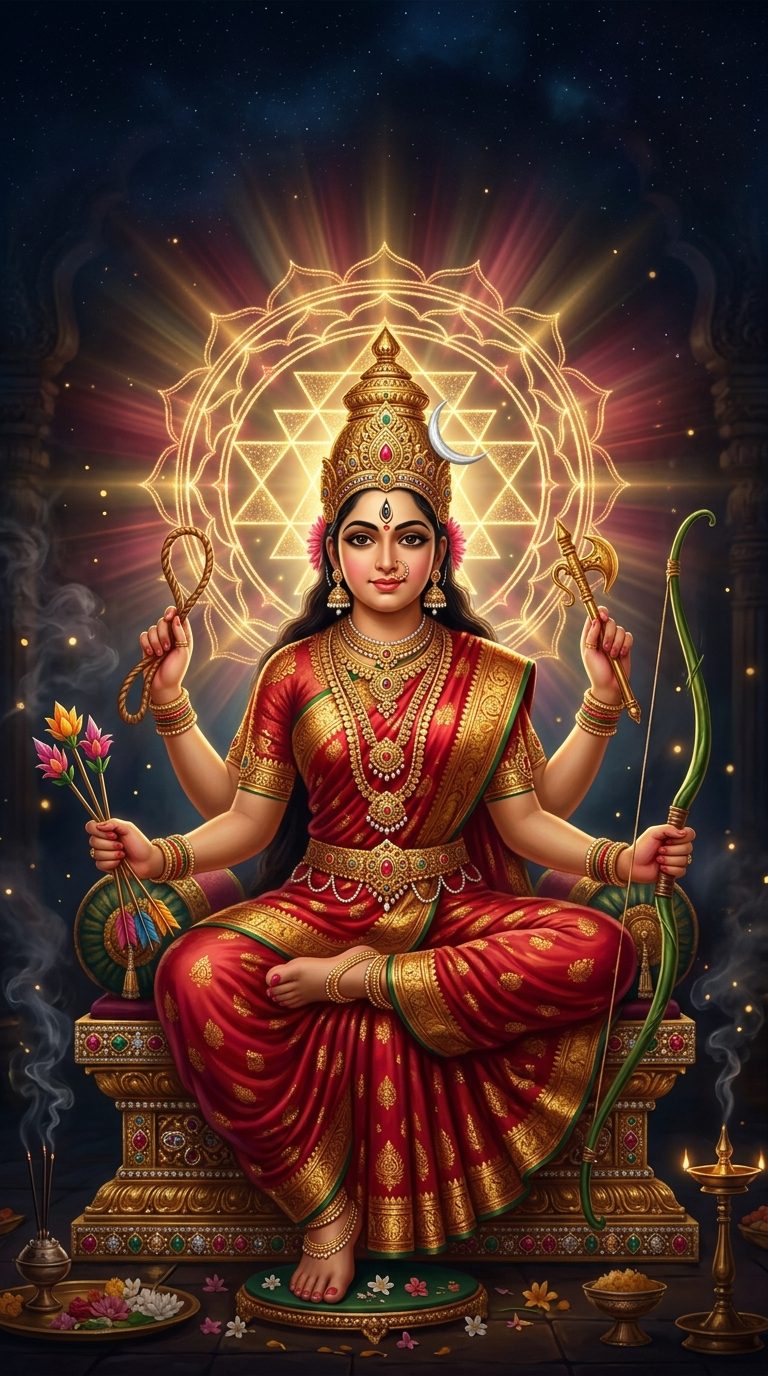
The most famous verse of praise to the Divine Mother — “O auspiciousness of all that is auspicious… O Narayani, salutations to you” — with the two verses that follow it in the Devi Mahatmya.
From the Devi Mahatmya (Durga Saptashati), chapter 11
Listen
Sarva Mangala Mangalye
Son of Kali · Navratri Nights
0:006:20
Deity
Devi
Type
Stuti
Verses
3
Language
Sanskrit
SarvaMangalaMangalyeLyricswithMeaning
Each line shows an easy way to say it, with its English meaning. Turn on the Sanskrit, the exact pronunciation or the word-by-word meaning whenever you want to go deeper.
Verse 1
सर्वमङ्गलमाङ्गल्ये शिवे सर्वार्थसाधिके ।
Sarva Mangala Mangalye Shive Sarvartha Sadhike
sarvamaṅgalamāṅgalye śive sarvārthasādhike
O auspiciousness of all that is auspicious, O gracious one who fulfils every good aim,
शरण्ये त्र्यम्बके गौरि नारायणि नमोऽस्तु ते ॥
Sharanye Tryambake Gauri Narayani Namostu Te
śaraṇye tryambake gauri nārāyaṇi namo'stu te
O refuge of all, three-eyed Gauri — O Narayani, salutations to you.
Verse 2
सृष्टिस्थितिविनाशानां शक्तिभूते सनातनि ।
Srishti Sthiti Vinashanam Shakti Bhute Sanatani
sṛṣṭisthitivināśānāṃ śaktibhūte sanātani
You who are the power of creation, preservation and dissolution, O eternal one,
गुणाश्रये गुणमये नारायणि नमोऽस्तु ते ॥
Gunashraye Gunamaye Narayani Namostu Te
guṇāśraye guṇamaye nārāyaṇi namo'stu te
support of all qualities, made of all qualities — O Narayani, salutations to you.
Verse 3
शरणागतदीनार्तपरित्राणपरायणे ।
Sharanagata Dinarta Paritrana Parayane
śaraṇāgatadīnārtaparitrāṇaparāyaṇe
You who are devoted to rescuing the helpless and suffering who come to you for refuge,
सर्वस्यार्तिहरे देवि नारायणि नमोऽस्तु ते ॥
Sarvasyartihare Devi Narayani Namostu Te
sarvasyārtihare devi nārāyaṇi namo'stu te
O Goddess who takes away everyone’s pain — O Narayani, salutations to you.
✦ ✦ ✦
AboutSarvaMangalaMangalye
Sarva Mangala Mangalye is one of the best-known verses in all of Hindu devotion. It comes from the Narayani Stuti in chapter 11 of the Devi Mahatmya, the hymn the gods sang after the Goddess defeated the demons Shumbha and Nishumbha. Each verse of that hymn ends nārāyaṇi namo’stu te — “O Narayani, salutations to you.”
The first verse calls her the auspiciousness within everything auspicious, the fulfiller of every good aim, the refuge, the three-eyed one, Gauri. The next verses praise her as the power of creation, preservation and dissolution, and as the one who rescues all who come to her in distress.
These lines are chanted at weddings, housewarmings, the start of journeys and every Navaratri, as a blessing for any new beginning.
✦ ✦ ✦
TheStoriesInsidetheHymn
Thegodsgivethanks
After a long war the Goddess destroyed the demon brothers Shumbha and Nishumbha, who had seized the three worlds. The relieved gods, led by Agni, gathered and poured out their gratitude in the Narayani Stuti.
Pleased, the Goddess promised that whenever evil rises again, she will return to protect the world — a promise renewed every Navaratri.
Why“Narayani”?
Narayani is the feminine form of Narayana, a name of Vishnu, meaning “the refuge of all beings.” Calling the Goddess Narayani honours her as the one in whom everything rests.
In the same breath she is called Gauri and Tryambaka (three-eyed), names of Parvati — showing that every form of the Goddess is one.
✦ ✦ ✦
HowtoChantSarvaMangalaMangalye
When to chant
✦Navaratri and Durga Puja
✦Weddings, housewarmings and new beginnings
✦Fridays and Tuesdays
✦Daily morning prayers
How many times
Three times, or 11 or 108 repetitions of the first verse as a meditation.
1
Light a lamp before an image of the Goddess.
2
Listen to the recording once with the meaning.
3
Chant the three verses slowly, bowing at each “namo’stu te.”
4
Offer a flower or simply your gratitude.
5
Ask her blessing for whatever you are beginning.
✦ ✦ ✦
PronunciationGuide
The sounds that trip people up most in this hymn, and how to say them.