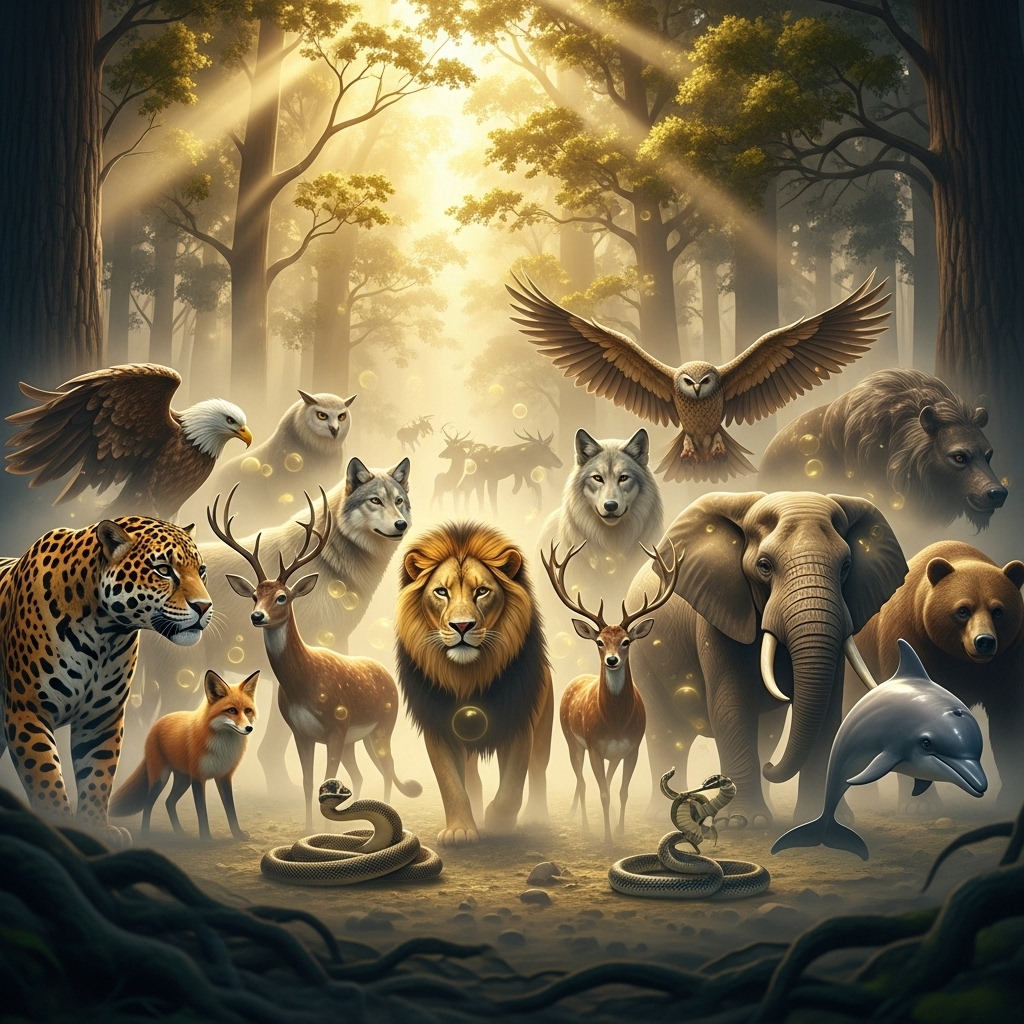
Find Your Power Animal
Three free ways in. Choose the one that fits how you want to arrive.

Answer Questions
A short guided journey through your instincts, symbols and inner landscape — the most direct first indication of your ally.
Begin the Journey→
Find by Birthday
Enter your birth date to instantly reveal three animal allies — your Western sign, your zodiac decan, and your Chinese zodiac year.
Find by Birthday→
Pull an Oracle Card
Draw a card from the Power Animal Oracle deck for an instant reading — no questions, just a direct pull.
Draw a Card→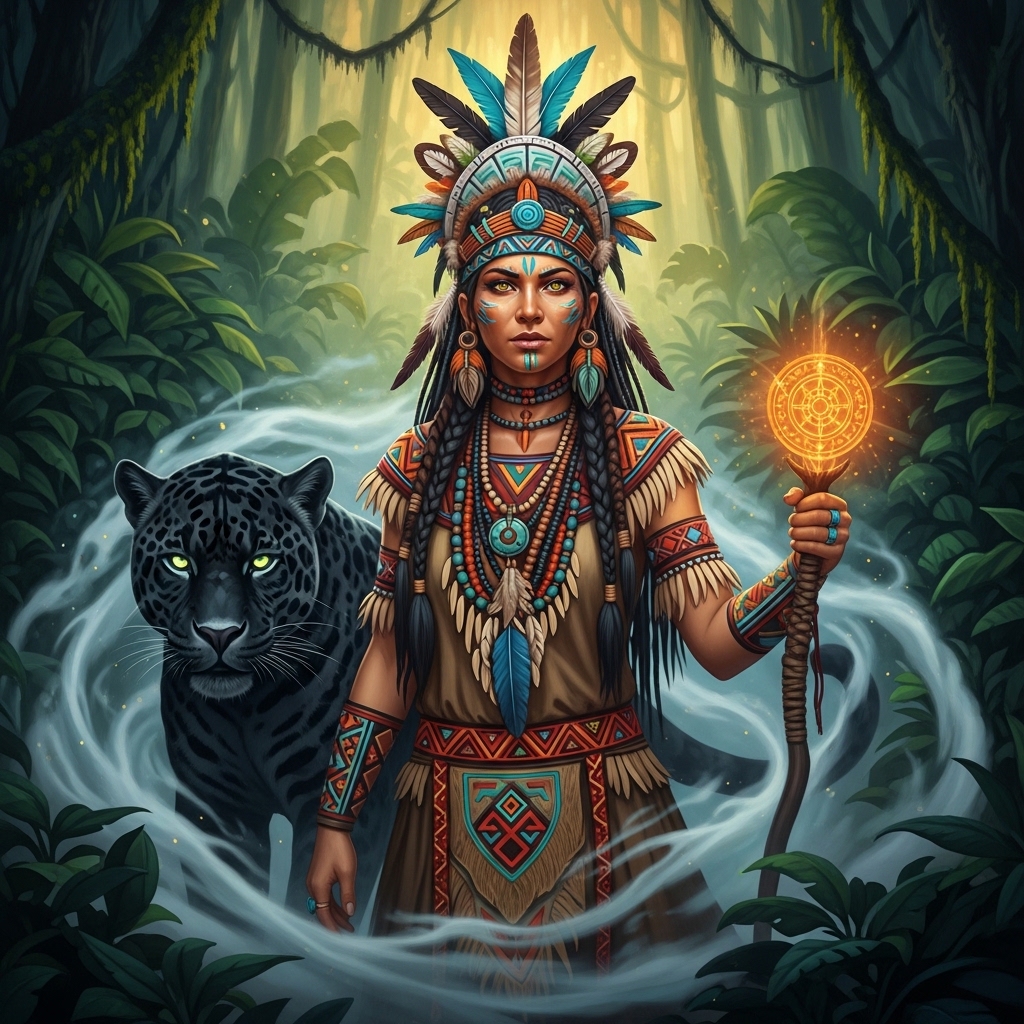
What Is a Power Animal?
Spirit guides in animal form
A power animal is an animal spirit or archetype that carries specific medicine — qualities, teachings, and strengths that are relevant to a person's life, protection, or current path. The concept is found in shamanic traditions across every inhabited continent: the Lakota and other Plains Nations, the Q'ero of Peru, the Sámi of Scandinavia, the Siberian shamans, the Celtic druids, the Aboriginal Australians. Despite emerging independently across cultures that had no contact with each other, the core understanding is strikingly consistent — that the animal world is not separate from the human world, and that particular animals serve as allies, teachers and protectors in the unseen dimensions.
A power animal is not the same as a totem. A totem belongs to a family lineage or clan and is inherited. A power animal is personal — it comes to an individual, may change across different life phases, and is understood to lend its particular strengths to the person it accompanies. The jaguar does not make every person a jaguar. It loans its qualities — seeing in the dark, moving between worlds, silent power — to the person who needs those qualities now.
The Shamanic Understanding of Animal Medicine
In the shamanic worldview, everything that exists in physical reality has a spirit or essence — an animating intelligence that precedes and survives the physical form. Animals are often seen as closer to this original intelligence than humans because they have not developed the layer of conceptual mind that creates the separation humans experience. A wolf does not think about being a wolf. It simply is wolf. This wholeness, this undivided way of being, is part of what the power animal carries as medicine.
The anthropologist and shamanic practitioner Michael Harner, who spent decades studying healing traditions across cultures, found the concept of spirit helpers and power animals to be one of the most universal elements of shamanic practice worldwide. In his foundational work on core shamanism, Harner documented that practitioners who maintained a relationship with their power animal reported greater resilience, clearer perception, and a felt sense of protection and support during difficult periods.
Working With Your Power Animal
The encounter with a power animal is not only an intellectual exercise — it is meant to be felt. When an animal appears repeatedly in dreams, in waking life at significant moments, or in inner journeys, that repetition is itself a message. The first step is simply to notice and acknowledge: this animal is showing up. What does it do in these appearances? How does it move? What is the quality of its presence — fierce, gentle, watchful, playful?
Studying the natural behaviour and characteristics of your power animal is part of the practice. What does a raven actually do? How does an eagle hunt? What is the social structure of wolves? The outer knowledge deepens the inner relationship. The animal's real qualities — not the romanticised version — carry the teaching.
You can call on your power animal directly — before a difficult conversation, before ceremony, before sleep. Simply holding its image in the mind and asking for its support is enough. This is not superstition. It is the activation of an inner resource that has been recognised across cultures for tens of thousands of years.
The Jaguar and This Work
The jaguar holds a particular place in Mesoamerican and Amazonian shamanic cosmology. Among the Q'ero of Peru, the jaguar — called otorongo — is one of the primary power animals of the shaman. It governs the ability to move between the worlds, to see in the dark, to navigate the unknown without fear. It represents transformation through confronting what is hidden, dying to old forms so new ones can emerge.
Jaguar Medicine Tribe takes its name and medicine from this archetype — the capacity to move with power and silence through the invisible dimensions, to bring back what is needed, and to hold the threshold between the everyday world and the sacred. Whoever arrives at this work is, in some sense, already in relationship with jaguar medicine, whether they know it yet or not.
Frequently Asked Questions
What are the three ways to find my power animal here?
Answer Questions takes you through a short guided quiz about your instincts and inner landscape, then matches you against all 125 animals in the library. Find by Birthday uses just your date of birth to reveal three animal allies at once — your Western zodiac sign, your zodiac decan, and your Chinese zodiac year. Pull an Oracle Card is the fastest option — an instant single-card draw from the Power Animal Oracle deck with no questions at all.
Is this free, and do I need to sign up?
Yes — all three paths are completely free with no account or sign-up required. Each one leads to a full teaching article about your matched animal at /teachings, so you get a real result to explore, not just a name.
Which method is most accurate?
They're different lenses rather than competing systems, so 'accuracy' isn't quite the right frame. The quiz reflects your current instincts and inner state and can change as you do. The birthday pairings are fixed, symbolic associations tied to the Western, decan and Chinese zodiac systems. The oracle pull is intentionally random — a prompt for what you need to hear right now, not a diagnosis. Many people find value in trying more than one and noticing where they agree.
Can I get a different result if I try again?
Yes for the quiz and the oracle draw — your instincts shift over time, and an oracle pull is meant to be revisited whenever you want fresh guidance. Your birthday pairings will always come back the same, since they're calculated directly from your date of birth rather than drawn or answered.