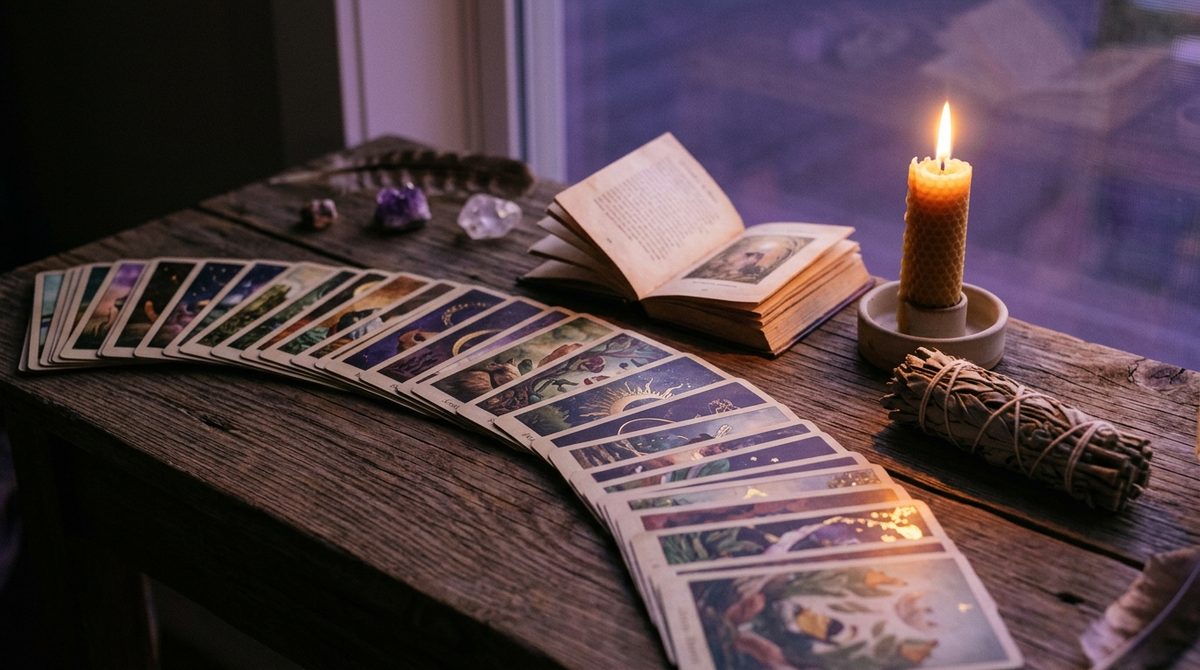
An oracle deck is a set of images and words designed to be drawn at random and read as a reflection of where you are. That's the whole idea. Everything else — rituals, spreads, symbolism — is there to help you look more honestly at what turns up.
Oracle Cards vs Tarot
Tarot is a closed system: 78 cards, 22 major arcana and four suits, with meanings that have been built up over centuries. Learning tarot means learning that system. Oracle decks are open. A creator might make 36 cards or 108, base them on animals, deities, plants or emotions, and write their own meanings. No two oracle decks work quite the same way.
That openness is why oracle cards are easier to begin with — and also why a guidebook alone won't make you a good reader. With no fixed system to lean on, the skill is in how you look: at the image, at the words, at your own reaction, and at your life. Those four layers are the method you will learn in Lesson 2, and they work with any deck you will ever pick up.
Choosing A Deck That Talks To You
The best first deck is the one whose art you want to look at for a long time. You'll be staring at these images every day, so pick by feel, not by reviews. A deck with clear, uncluttered images and a short keyword or phrase on each card is easiest to learn on. Very abstract decks are lovely but harder to read at the start.
Once you have a deck, spend one sitting just meeting it before you read with it. Go through every card face up. Sort them into three piles without thinking: cards you love, cards that leave you neutral, and cards you dislike or feel uneasy about. That third pile is valuable: those are the cards that will teach you most, because they show what you resist.
Cleansing, Shuffling And Care
Traditions differ on cleansing — smoke, moonlight, crystals, knocking on the deck — and none of it is required. What matters is a small, repeated action that tells your mind "now I'm reading". Many readers knock three times on the deck, take one breath, and shuffle. Use something simple you will actually do every time.
Shuffle in whatever way is comfortable: overhand, riffle, or spreading the cards face down on a table and swirling them. Stop when it feels done, or when a card jumps out. Jumpers — cards that fall out while you shuffle — are worth noting. Some readers always read them; others put them back. Decide your rule now and keep it, because consistency is what makes your results comparable over time.
The practice · 15 minutes, once per new deck
Meet Your Deck
- 1Sit somewhere quiet with your deck and a notebook (or your phone notes). Take three slow breaths.
- 2Turn the cards face up one by one. Spend about five seconds with each — just enough for a gut reaction.
- 3Sort them into three piles: love, neutral, uneasy. Don't read the guidebook yet.
- 4Count each pile and note the numbers. Write the names of the uneasy cards.
- 5Pick one uneasy card. Write two sentences: what you see in the picture, and what feeling it brings up.
- 6Shuffle the whole deck back together with your chosen opening ritual (for example: three knocks and a breath).
Coming back to it: Repeat the three-pile sort a month from now. Cards almost always move between piles, and the ones that move are a map of what has changed in you.
Journal prompts
- “Which card did I dislike most at first sight, and what does it remind me of?”
- “What do I hope oracle cards will help me with — honestly?”
- “What simple ritual will I do every time I start a reading?”
Saved privately on this device. Come back tomorrow and log it again.
Check Your Understanding
3 quick questions. Retake it any time.
1. What is the main structural difference between oracle cards and tarot?
2. Why does the lesson say the 'uneasy' pile is valuable?
3. What matters most about cleansing or opening a reading?
Go deeper on the site
Keep Practising With Our Free Apps
Everything here is free, with no signup.

Free Online Oracle Decks
A growing collection of illustrated oracle decks. Shuffle and draw a card on screen, with the full card meaning.
Draw a card →
Daily Oracle Card
One card a day, ready when you are. Perfect for the two-minute daily draw.
Get today's card →
Moon Phase Tracker
See where the moon is right now, so you can time your new and full moon spreads.
Check the moon →