Sacred Courses · Jaguar Medicine Tribe
Four Winds · Four Animals · One Sacred Map
A Peruvian shamanic journey through the sacred directions — from the serpent's shedding to the jaguar's shadow, the hummingbird's impossible migration to the condor's great vision.
Six chapters and one final trial. Choose where to begin.
N
S
W
E
This is not a course in the ordinary sense. Each chapter is a direction — a teaching, a practice, and a ceremony to carry into your days. Move through them in order, or return to whichever direction is calling.
Your Medicine Journal at each chapter saves privately on this device. The quiz tests your understanding before you move on. Chapter 7 is the Wheel Trial — twenty questions across all six chapters.
Or choose any chapter from the list above
Chapter 1 of 6
The Peruvian Medicine Wheel

The medicine wheel is one of the oldest and most widely distributed spiritual architectures in human history. It appears in the ceremonial traditions of the Lakota Sioux and the Andean Q'ero, in the Celtic cross and the Aboriginal Australian compass, in the alchemical schema of the four elements and the Jungian map of the four psychological functions. Every culture that has looked at the world carefully enough has arrived at some version of the same arrangement: a circle, four directions, and a sacred center. Something about reality organises itself this way.
The version of the wheel we work with in this course comes from the Q'ero people of the Peruvian high Andes — the last direct descendants of the Inka, who preserved their sacred teachings intact through five centuries of colonial pressure. This is not a New Age synthesis or an academic reconstruction. It is a living transmission, carried from elder to apprentice across generations, that the Q'ero themselves describe as medicine for the specific time we are living through now.
To walk this wheel is not to study a spiritual framework from the outside. It is to reorganise yourself — to place each direction's teaching in your body, in your decisions, in the way you meet what is difficult. The wheel is not a map you observe from a distance. It is a territory you enter and are changed by.

The Q'ero live above fourteen thousand feet in the Andean highlands of southern Peru, their communities for centuries largely unreachable by the forces that systematically dismantled indigenous spiritual traditions throughout the Americas. When the Spanish conquered the Inka empire in the sixteenth century, the Q'ero retreated higher into the mountains, carrying their ceremonies, their language, and their understanding of the cosmos with them. What survived is extraordinary precisely because of that withdrawal — a living cosmology, uncompromised.
In the late twentieth century, during what Q'ero elders recognised as a prophesied era of emergence, they began making their teachings available beyond their communities. Alberto Villoldo — a medical anthropologist who spent decades learning from Andean healers — became the primary bridge between Q'ero wisdom and Western audiences. Through the Four Winds Society and decades of writing and teaching, Villoldo translated these teachings without reducing them, making them accessible while preserving their essential integrity.
The Q'ero describe the current era as a Pachakuti — a great turning, a time when the world is reorganising itself. Their emergence from five centuries of isolation was not accidental. The teachings that helped them survive intact are, they say, exactly the teachings the world now needs: a living relationship with the sacred directions, the earth, and the intelligence that moves through all things.

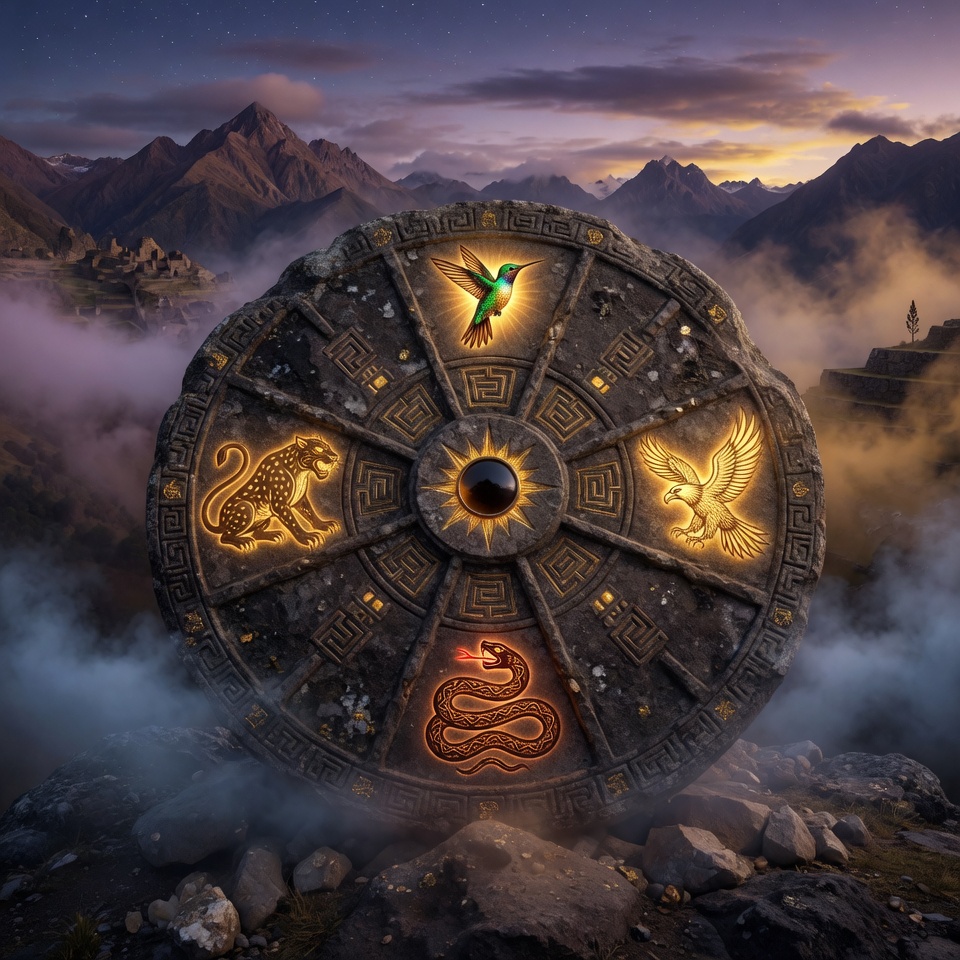
Each of the four cardinal directions is held by a sacred animal archetype — not merely a symbol, but a living quality of consciousness that the direction embodies and teaches. In the South sits Sachamama the Serpent, holding the medicine of healing, time, and shedding what no longer serves. In the West, Otorongo the Jaguar holds the medicine of transformation, shadow, and the willingness to face death without flinching. In the North, Siwar Q'enti the Hummingbird carries ancestral wisdom, the soul's direction, and the ability to find sweetness on even the most impossible journey. In the East, Apuchin the Condor soars between earth and sky, offering the medicine of vision, illumination, and the perspective that only great altitude makes possible.
These four archetypes are not external beings to be worshipped from a distance. They are qualities that live within you already — dimensions of your own consciousness that the wheel helps you cultivate, recognise, and embody. The serpent's capacity to shed an old identity cleanly. The jaguar's ability to walk without fear into the dark. The hummingbird's knowing that the soul's journey is worth taking no matter how long the road. The condor's ability to hold the long view when everything close feels overwhelming. You have all of this. The wheel shows you where you are strong and where the next work lives.
The fifth direction — the center — is held by Pachamama, the living Earth herself, the axis around which the wheel turns. She is not a destination you travel toward; she is the ground you stand on at every step. After walking all four directions, the center is where you return — not to rest from the journey, but to embody all four medicines simultaneously.
This course moves through the directions in the traditional Q'ero sequence: South first, then West, North, East, and finally the center. This sequence is not arbitrary. It follows the natural progression of shamanic healing — we begin by releasing what we carry from the past (South), move into the transformational work of the shadow (West), receive the guidance of ancestral wisdom and soul direction (North), open to the illuminating vision of the spirit (East), and arrive at the center as a being who holds all four medicines at once.
At each direction you will find a teaching, a practice, a ceremony prompt to carry with you, and a Medicine Journal for your reflections. The quiz at the end of each chapter tests your understanding before you continue. Move at your own pace — there is no correct speed for walking a medicine wheel. Some people sit with a single direction for a week. Some return to the same chapter many times before something fully lands. The wheel does not hurry.
The practices in this course draw from authentic Q'ero tradition but require no prior training or initiation. What they do require is sincerity — a genuine willingness to meet each direction honestly, without rushing past what is uncomfortable toward what feels good. The medicine is in the full encounter, not the comfortable parts alone.
Your Practice
Find a quiet space where you will not be interrupted. Stand — or sit facing each direction in turn. Begin facing South. Breathe slowly three times and then speak aloud, quietly but with your actual voice: 'Sachamama, great serpent of the South, I call you in.' Turn to face West: 'Otorongo, keeper of the West, I call you in.' Face North: 'Siwar Q'enti, hummingbird of the North, I call you in.' Face East: 'Apuchin, great condor of the East, I call you in.' Finally, touch the ground with both hands or simply lower your gaze downward: 'Pachamama, living Earth, I stand in your center.' Sit or stand in the space you have opened for two to three minutes, breathing slowly. Notice what you feel in each direction. This simple ceremony is the opening you will return to at the beginning of any practice session.
Hold this in ceremony
“Which direction draws you most strongly as you approach the wheel for the first time?”
In Q'ero tradition, the wheel is walked again at each turning of the year. The directions are most potent at their associated season: South at the summer solstice, West at the autumn equinox, North at the winter solstice, East at the spring equinox. Wherever you are in the year as you begin, one direction is always calling more loudly than the others.
Chapter 1 · Knowledge Test
Test your understanding before moving to the next chapter.
1. The Q'ero people are described as descendants of which ancient civilization?
2. What does 'Ayni' mean in Q'ero tradition?
3. Which figure is most associated with bringing Q'ero teachings to the Western world?
4. In the Peruvian medicine wheel, which four animals hold the cardinal directions?
5. What is a 'Pachakuti' in Andean tradition?
Chapter 1 · Medicine Journal
Private · Saved on this device only
Deepen your practice with the site's tools